



Charles de Gaulle
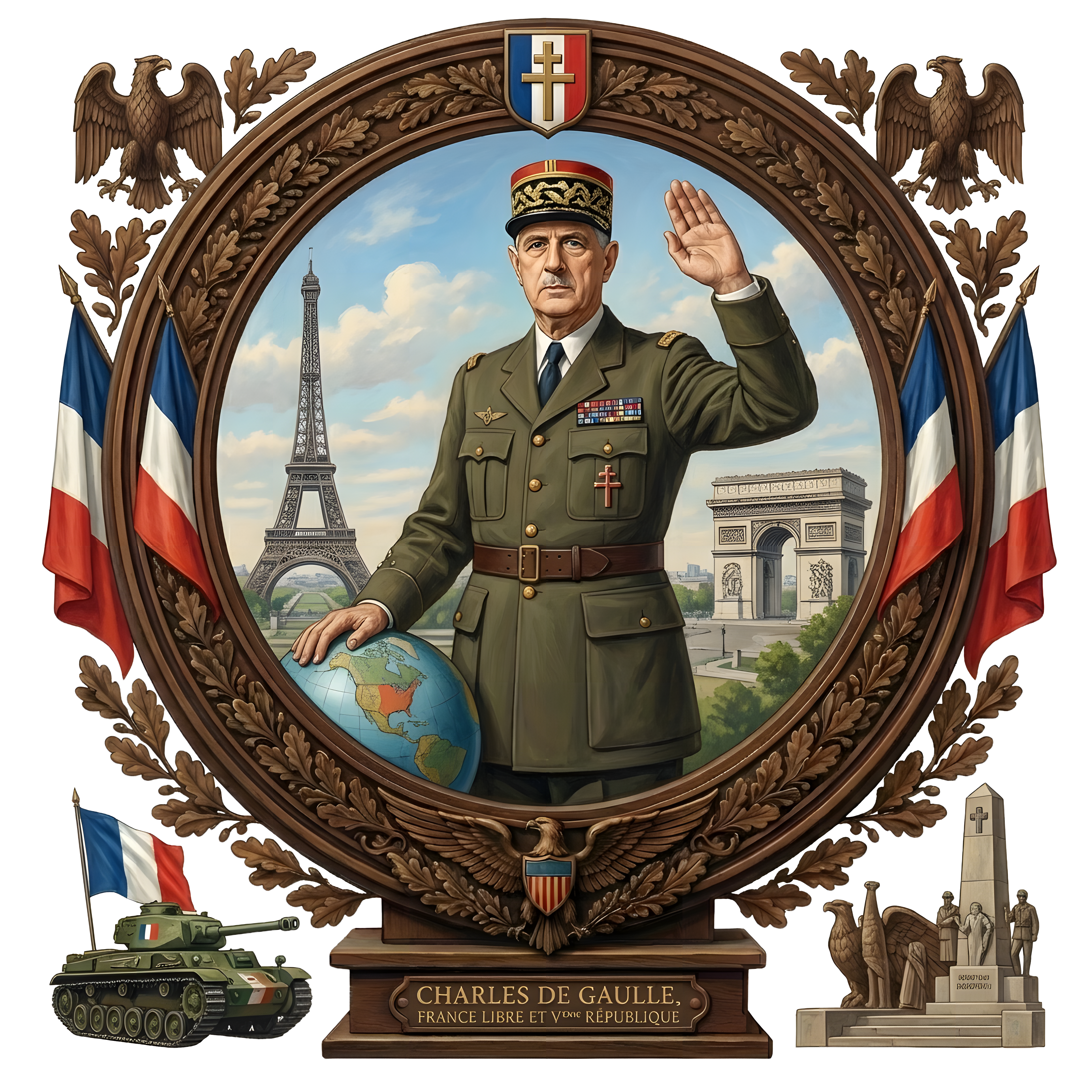
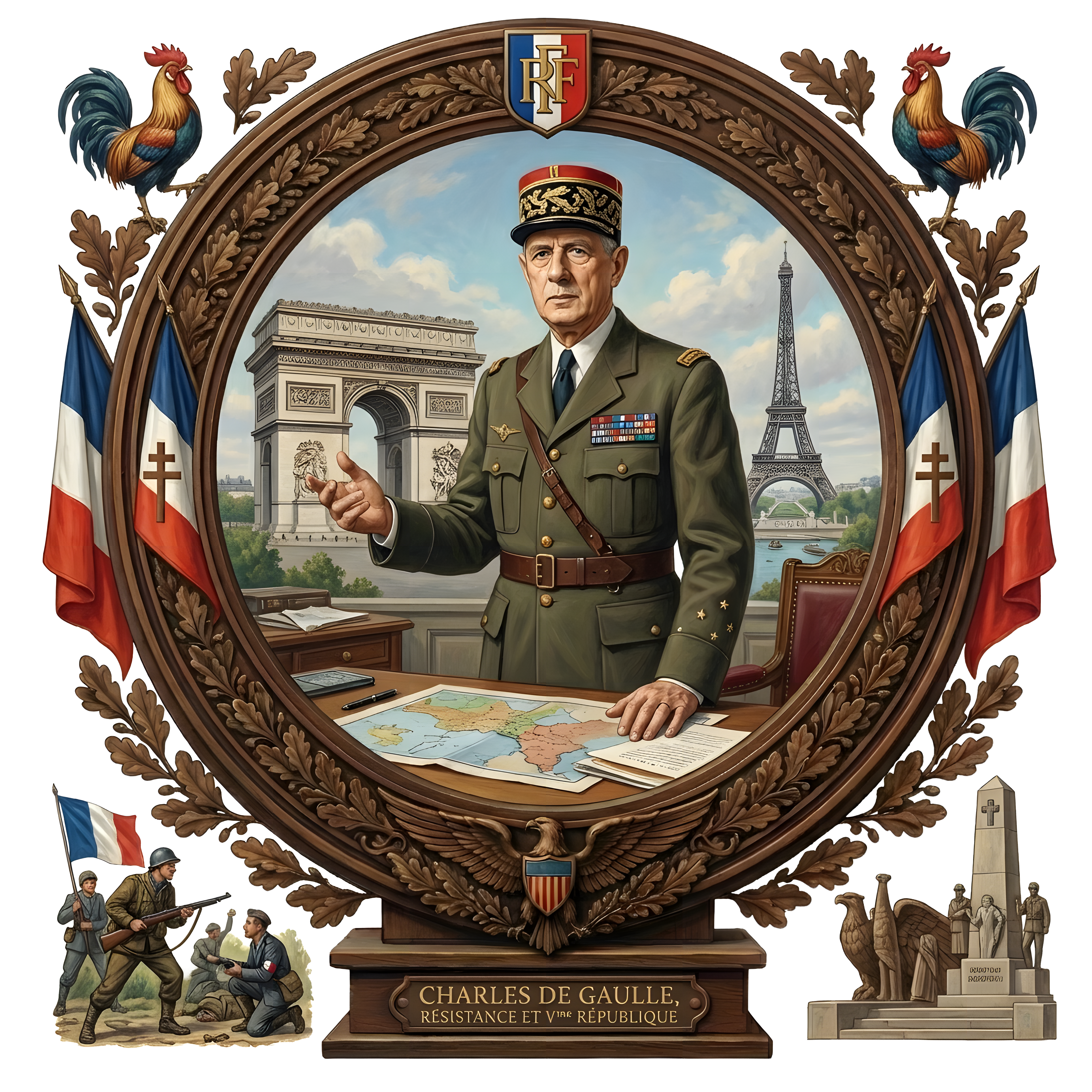
A French general and statesman who led Free France during WWII and founded the French Fifth Republic.
At a glance
- Born
- 1890 CE
- Died
- 1970 CE
- Era classification
- Modern
- Occupation
- Military General & Statesman
- Homeland
- France
- Period
- 20th Century
- Field
- Politics, Leadership & War
- Language
- French
- Religion
- Roman Catholicism
- Gender
- male
Biography
Charles de Gaulle was born in 1890 in Lille, France, into a family of traditionalist and patriotic values. He graduated from the Saint-Cyr military academy and served with distinction in World War I, where he was wounded and taken prisoner. During the interwar period, he became a vocal advocate for mechanized warfare and mobile tank divisions, though his innovative strategic theories were largely dismissed by the French military establishment in favor of static defense.
When Nazi Germany invaded France in 1940, de Gaulle refused to accept the French government's armistice. He fled to London and broadcast his historic 'Appeal of 18 June' via the BBC, urging the French people to resist the occupation. As the leader of the Free French Forces, he navigated complex diplomatic relationships with Churchill and Roosevelt, eventually returning to liberated Paris in 1944 as a national hero and head of the provisional government.
After resigning in 1946 due to political disagreements, he returned to power in 1958 amidst the crisis in Algeria. He oversaw the drafting of a new constitution that established the Fifth Republic, granting significant power to the presidency. His leadership during this period was marked by the difficult process of Algerian decolonization and the stabilization of the French economy through the introduction of the 'new franc.'
De Gaulle's foreign policy, often termed 'Gaullism,' sought to restore France's status as a global power independent of the Cold War superpowers. He developed France's independent nuclear deterrent, withdrew from NATO's integrated military command, and vetoed British entry into the European Economic Community. He resigned in 1969 following a failed referendum and died a year later, leaving a profound and lasting impact on French political identity.
Portrayal characteristics
Saved editorial descriptions used for the reconstruction; these are not authenticated statements by the depicted person.
- Authoritative
- Patriotic
- Resilient
- Strategic
- Independent-minded
- Charismatic
Images & artwork 4
Connections
Winston Churchill
WWII Allies & Complex Rivals
Churchill provided de Gaulle with asylum and a broadcasting platform in 1940, making the Free French movement possible. However, their relationship was famously tempestuous, marked by profound clashes of ego, national pride, and strategic vision.
After the fall of France in 1940, Churchill allowed de Gaulle to broadcast his famous 'Appeal of 18 June' from London, effectively launching the Free French resistance. Despite this foundational support, their relationship was incredibly fraught. De Gaulle, lacking formal power, used sheer intransigence to assert French sovereignty, often infuriating Churchill, who famously remarked that the heaviest cross he had to bear was the Cross of Lorraine (de Gaulle's symbol). They clashed over military strategy, the administration of liberated territories, and relations with Roosevelt, who actively disliked de Gaulle. Yet, beneath the bitter arguments lay a deep mutual respect; Churchill recognized de Gaulle's indomitable spirit as essential for France's resurrection, and de Gaulle acknowledged that without Churchill, France might have perished.
Napoleon Bonaparte
Historical Predecessor & Strategic Influence
As a military thinker and statesman, de Gaulle was profoundly influenced by Napoleon's legacy of centralized authority and French grandeur. While admiring Napoleon's genius, de Gaulle also viewed his ultimate defeat as a cautionary tale of hubris.
De Gaulle's entire political and military philosophy was steeped in French history, with Napoleon Bonaparte casting the longest shadow. In his interwar writings, particularly 'The Edge of the Sword', de Gaulle analyzed Napoleonic leadership, praising the Emperor's grasp of mobile warfare, decisive action, and the projection of national glory. When de Gaulle established the Fifth Republic in 1958, he created a powerful, quasi-monarchical presidency that many political scientists compared to Bonapartism—bypassing parliament to appeal directly to the people via plebiscites. However, de Gaulle was highly critical of Napoleon's lack of moderation, noting that his endless wars ultimately left France smaller and weaker. De Gaulle sought to emulate Napoleon's restoration of French pride and state capacity without repeating his catastrophic overreach.
Mohammad Reza Pahlavi
Diplomatic Allies & Fellow Nationalists
De Gaulle and the Shah of Iran shared a mutual admiration based on their respective desires to assert national independence from the Cold War superpowers. They engaged in significant diplomatic and cultural exchanges during the 1960s.
During the 1960s, Charles de Gaulle's foreign policy sought to establish France as an independent global power, a vision that resonated deeply with Mohammad Reza Pahlavi's ambitions for Iran. The Shah admired de Gaulle's strong leadership and his successful establishment of the Fifth Republic. In 1963, de Gaulle made a highly publicized state visit to Iran, where he praised the Shah's 'White Revolution' and Iran's ancient civilization. The two leaders found common ground in their skepticism of American and Soviet hegemony, seeking to diversify their geopolitical alliances. France became a key partner for Iran in technology, military procurement, and cultural exchange. Their relationship epitomized de Gaulle's strategy of building a 'third way' in global politics by forging strong bilateral ties with emerging regional powers.
Charlemagne
Historical Symbol of European Unity
De Gaulle frequently invoked the legacy of Charlemagne to conceptualize and promote Franco-German reconciliation as the engine of a unified, independent Europe.
In his post-WWII vision for Europe, Charles de Gaulle sought to end the centuries-old enmity between France and Germany. To provide a historical and cultural foundation for this new alliance, he frequently referenced Charlemagne, the 8th-century ruler who united much of Western Europe, encompassing both modern France and Germany. When de Gaulle and West German Chancellor Konrad Adenauer signed the Élysée Treaty in 1963, the symbolic resonance of the Carolingian Empire was palpable. Both leaders, devout Catholics with a deep sense of history, viewed their partnership as a restoration of the ancient unity of the Franks. De Gaulle used Charlemagne's legacy to advocate for a 'Europe of Nations' stretching 'from the Atlantic to the Urals,' independent of Anglo-American dominance, positioning the Franco-German core as the geopolitical successor to Charlemagne's empire.
Alexis de Tocqueville
Philosophical Counterpart
De Gaulle's constitutional architecture for the Fifth Republic was designed to cure the chronic political instability that Tocqueville had famously diagnosed in French democratic culture a century earlier.
Alexis de Tocqueville's profound analyses of French political sociology—particularly the tension between equality and liberty, and the French tendency toward administrative centralization coupled with revolutionary volatility—served as a backdrop to de Gaulle's statecraft. Tocqueville lamented the weakness of French civic institutions and the perpetual cycle of revolution and authoritarianism. A century later, de Gaulle faced the collapse of the Fourth Republic, which suffered from the exact parliamentary paralysis and factionalism Tocqueville had warned about. By founding the Fifth Republic, de Gaulle sought to synthesize the French desire for strong, centralized leadership with democratic legitimacy. While Tocqueville admired decentralized American democracy, de Gaulle concluded that France's unique historical temperament required a powerful executive to maintain national unity and prevent the systemic collapse that Tocqueville had so astutely chronicled.
Jean-Jacques Rousseau
Ideological Influence
De Gaulle's political methodology, particularly his use of national referendums to bypass parliament, was deeply rooted in Jean-Jacques Rousseau's concept of the 'general will.'
The political philosophy of Jean-Jacques Rousseau, particularly his articulation of the 'general will' in 'The Social Contract', profoundly influenced Charles de Gaulle's approach to governance. De Gaulle harbored a deep distrust of political parties, which he believed represented divisive, sectarian interests that fractured the nation. Instead, he sought a direct, unmediated relationship with the French people. This Rousseauian ideal was institutionalized in the Constitution of the Fifth Republic, which de Gaulle designed to elevate the President above partisan politics as the embodiment of the nation. De Gaulle's frequent use of referendums to legitimize his policies and constitutional changes was a direct application of Rousseau's belief that sovereignty resides in the people as a whole. When de Gaulle resigned in 1969 after losing a referendum, it was the ultimate expression of this philosophy: having lost the mandate of the general will, he believed he no longer had the right to rule.
Eleanor Roosevelt
Diplomatic Intermediary & Mutual Skeptics
Eleanor Roosevelt shared her husband Franklin D. Roosevelt's deep skepticism of de Gaulle's authoritarian tendencies, though she interacted with him during and after WWII in her capacity as a diplomat and human rights advocate.
The relationship between Charles de Gaulle and the Roosevelt administration was notoriously bitter. President Franklin D. Roosevelt viewed de Gaulle as an arrogant, dictatorial figure and repeatedly tried to sideline him in favor of other French leaders. Eleanor Roosevelt largely shared her husband's distrust, viewing de Gaulle's intense nationalism and rigid demeanor as antithetical to the cooperative, democratic internationalism she championed. During WWII, she observed the friction he caused among the Allies with concern. After the war, when Eleanor served at the United Nations and helped draft the Universal Declaration of Human Rights, she continued to navigate the complex legacy of Gaullist France. While de Gaulle prioritized French sovereignty and colonial retention (until the Algerian crisis forced his hand), Eleanor advocated for rapid decolonization and international human rights, placing their post-war worldviews in frequent ideological tension.
Karl Marx
Ideological Opponents
De Gaulle was a staunch conservative and nationalist whose political career was largely defined by his opposition to Marxist ideology and the French Communist Party, though he pragmatically engaged with Marxist states.
Charles de Gaulle's worldview was fundamentally opposed to the doctrines of Karl Marx. Where Marx emphasized class struggle and international proletarian solidarity, de Gaulle believed in the primacy of the nation-state, social cohesion, and French grandeur. Following World War II, the French Communist Party (PCF), heavily influenced by Marxist-Leninist ideology, emerged as one of the strongest political forces in France. De Gaulle viewed them as a direct threat to French sovereignty, famously referring to them as 'separatists' whose true loyalty lay with Moscow. During the May 1968 protests, which were driven by Marxist, Maoist, and anarchist student groups, de Gaulle faced the greatest domestic crisis of his presidency, ultimately rallying the conservative 'silent majority' to defeat the radical left. Despite his fierce anti-Marxism at home, de Gaulle's foreign policy was highly pragmatic; he recognized the Soviet Union and Communist China, believing that national interests always superseded Marxist ideology in geopolitics.
Yuri Gagarin
Cold War Diplomacy & Space Age Encounters
De Gaulle hosted Yuri Gagarin in Paris as part of his broader strategy to engage with the Soviet Union and assert French independence from the United States during the Cold War.
In the early 1960s, Charles de Gaulle sought to carve out an independent geopolitical role for France, famously distancing the country from American hegemony and NATO's integrated command. As part of this strategy, he pursued a policy of détente with the Soviet Union. When Yuri Gagarin, the first human in space, embarked on his global goodwill tour, de Gaulle welcomed him to Paris in 1961. De Gaulle, who was deeply invested in modernizing France's own scientific and aerospace capabilities, recognized the immense propaganda value of Gagarin's achievement. By warmly receiving the Soviet cosmonaut, de Gaulle signaled to Washington that France would chart its own course in the Cold War, using the triumphs of the Space Age as a backdrop for his vision of a multipolar world.
Pablo Picasso
Cultural Contemporaries & Political Opposites
De Gaulle and Picasso were the two most towering figures in post-war France, yet they represented entirely opposite ends of the political and cultural spectrum—de Gaulle as the conservative nationalist, Picasso as the radical communist.
In the decades following World War II, Charles de Gaulle and Pablo Picasso dominated the French national consciousness in politics and art, respectively. However, their worldviews were diametrically opposed. De Gaulle was a devout Catholic, a military man, and the embodiment of traditional French patriotism. Picasso, who lived in France for most of his life, was an avant-garde provocateur and a prominent member of the French Communist Party. While de Gaulle was working to rebuild the French state and suppress communist influence during the early Cold War, Picasso was drawing the 'Dove of Peace' for Soviet-backed peace congresses. Despite their profound ideological differences, both men were fiercely independent and anti-fascist. De Gaulle's government recognized Picasso's unparalleled cultural importance, and despite Picasso's communism, the Gaullist state eventually facilitated massive exhibitions of his work, acknowledging that Picasso's genius contributed to the global grandeur of France.
Vladimir Lenin
Military Opponents (Indirect)
Early in his military career, de Gaulle fought against Lenin's Bolshevik forces during the Polish-Soviet War, an experience that cemented his lifelong anti-communism.
In 1919, a young Captain Charles de Gaulle volunteered to serve in the French military mission to Poland. At the time, Vladimir Lenin's newly established Soviet state was attempting to export the Bolshevik revolution westward, leading to the Polish-Soviet War. De Gaulle served as an infantry instructor for the Polish army and saw direct combat against the Red Army near the Zbrucz River, earning Poland's highest military decoration, the Virtuti Militari. This direct confrontation with Lenin's forces profoundly shaped de Gaulle's worldview. It solidified his deep-seated anti-communism and his belief in the enduring power of nationalism over international class solidarity. While Lenin viewed the conflict as a stepping stone to global revolution, de Gaulle saw it as a defense of Western civilization and national sovereignty, themes that would dominate his leadership of France decades later.
Otto von Bismarck
Historical Antagonist
De Gaulle's worldview and military career were fundamentally shaped by the geopolitical order established by Bismarck, specifically the trauma of the Franco-Prussian War and the loss of Alsace-Lorraine.
Charles de Gaulle was born in 1890 in Lille, a region deeply scarred by the legacy of Otto von Bismarck. Bismarck's orchestration of the Franco-Prussian War (1870-1871) resulted in the humiliating defeat of France, the unification of the German Empire, and the annexation of Alsace-Lorraine. De Gaulle was raised in a fiercely patriotic family that mourned this loss; his father was a veteran of the 1870 war. The desire to avenge Bismarck's victory and restore French honor was the defining animus of de Gaulle's generation, leading directly to his service in World War I. Throughout his life, de Gaulle viewed Germany through the lens of Bismarck's legacy—recognizing its inherent power and the necessity of containing it. When de Gaulle later championed Franco-German reconciliation in the 1960s, it was a conscious effort to finally close the chapter of European history that Bismarck's blood-and-iron unification had opened.
Julius Caesar
Historical & Literary Influence
De Gaulle, a prolific writer and military theorist, frequently drew upon Julius Caesar's campaigns in Gaul to articulate his vision of French identity, military strategy, and leadership.
Charles de Gaulle possessed a profound sense of history, tracing the origins of the French nation back to antiquity. In his writings, particularly 'France and Her Army' (1938), de Gaulle extensively analyzed Julius Caesar's conquest of Gaul. He viewed Vercingetorix's resistance against Caesar as the first manifestation of French national patriotism. However, de Gaulle also deeply admired Caesar's military genius, his decisive leadership, and his ability to impose order and civilization. The term 'Gaullism' itself, while derived from his name, carries an undeniable phonetic and historical resonance with 'Gaul,' a connection de Gaulle subtly cultivated. Furthermore, de Gaulle's political style during the Fifth Republic—relying on personal charisma, direct appeals to the populace, and the concentration of executive power—led many political scientists to describe his governance as a modern form of 'Caesarism,' echoing the Roman dictator's transformation of the Republic.
George Washington
Parallel Historical Figures
De Gaulle was frequently compared to George Washington, as both were towering military leaders who led their nations through existential crises before establishing new constitutional republics.
The historical parallels between Charles de Gaulle and George Washington are frequently drawn by historians and political scientists. Both men emerged as indispensable military leaders during their nations' darkest hours—Washington during the American Revolution, and de Gaulle during the Nazi occupation of France. After achieving military victory, both men temporarily retired from public life, only to be called back to resolve severe political crises. Just as Washington presided over the creation of the US Constitution to replace the weak Articles of Confederation, de Gaulle orchestrated the drafting of the Constitution of the Fifth Republic to replace the dysfunctional Fourth Republic. Both leaders established powerful, independent executive branches and set the precedents for the modern presidencies of their respective nations. De Gaulle himself was highly conscious of this parallel, viewing Washington as the ultimate archetype of the soldier-statesman who embodies the nation.
Mahatma Gandhi
Parallel Figures in Decolonization
While Gandhi led the nonviolent dismantling of the British Empire, de Gaulle was forced to navigate the violent dismantling of the French Empire, representing contrasting approaches to 20th-century decolonization.
Mahatma Gandhi and Charles de Gaulle represent two monumental, yet fundamentally opposing, forces in the 20th-century process of decolonization. Gandhi's philosophy of Satyagraha successfully challenged British imperial rule, setting a moral and political precedent for anti-colonial movements worldwide. De Gaulle, conversely, initially sought to preserve the French Empire after WWII to maintain France's status as a global power. However, the relentless pressure of anti-colonial nationalism—inspired in part by the success of movements like Gandhi's—eventually forced de Gaulle's hand. When de Gaulle returned to power in 1958 amidst the brutal Algerian War, he realized that the era of traditional colonialism was over. In a pragmatic, albeit painful, pivot, de Gaulle orchestrated the independence of Algeria and sub-Saharan African colonies. While Gandhi was the architect of decolonization from below, de Gaulle became the reluctant but decisive facilitator of decolonization from above.
René Descartes
Philosophical Heritage
De Gaulle frequently invoked the rationalist philosophy of René Descartes to describe the ideal French intellectual temperament, contrasting it with the ideologies of other nations.
René Descartes, the father of modern Western philosophy, left an indelible mark on French cultural identity, one that Charles de Gaulle frequently weaponized in his rhetoric. De Gaulle often spoke of 'Cartesian logic' and 'Cartesian order' as the defining characteristics of the French mind—rational, structured, and clear. When navigating complex geopolitical crises, such as the Cold War or the Algerian conflict, de Gaulle would publicly appeal to the 'Cartesian' nature of the French people, urging them to see past emotional factionalism and recognize the cold, logical necessity of his policies. By aligning his own highly strategic, unsentimental statecraft with Descartes' legacy, de Gaulle sought to elevate his political decisions from mere pragmatism to the level of profound national philosophy.
Voltaire
Cultural Heritage & Ideological Contrast
While de Gaulle embodied the traditional, Catholic, and authoritative aspects of French history, he governed a nation deeply shaped by Voltaire's Enlightenment ideals of secularism and anti-authoritarianism.
The intellectual legacy of Voltaire, characterized by fierce secularism, skepticism of authority, and defense of civil liberties, formed the bedrock of the French republican tradition that de Gaulle had to navigate. De Gaulle himself was a product of the opposite French tradition: conservative, Catholic, and military. Throughout his presidency, particularly during the cultural upheavals of May 1968, de Gaulle clashed with the modern inheritors of Voltaire's rebellious spirit—students and intellectuals who rejected his paternalistic authority. Yet, de Gaulle possessed a profound respect for French literary genius. When his advisors suggested arresting the existentialist philosopher Jean-Paul Sartre (a modern-day Voltaire figure) for civil disobedience, de Gaulle famously refused, stating, 'One does not arrest Voltaire.' This demonstrated de Gaulle's understanding that France's greatness was built as much on its rebellious intellectuals as on its statesmen.
Known for
- Leading the Free French Forces
- Founding the French Fifth Republic
- The Appeal of 18 June
- Ending the Algerian War
- Establishing Gaullism
- Developing France's nuclear deterrent
Episodes featuring or mentioning this figure
No eligible published episode featuring this figure is currently in the library.