



René Descartes
French philosopher and mathematician known as the father of modern philosophy and analytical geometry.
At a glance
- Born
- 1596 CE
- Died
- 1650 CE
- Era classification
- 53
- Homeland
- France
- Period
- 1596–1650
- Field
- Philosophy & Ideology
- Language
- French
- Religion
- Catholic
- Gender
- male
Biography
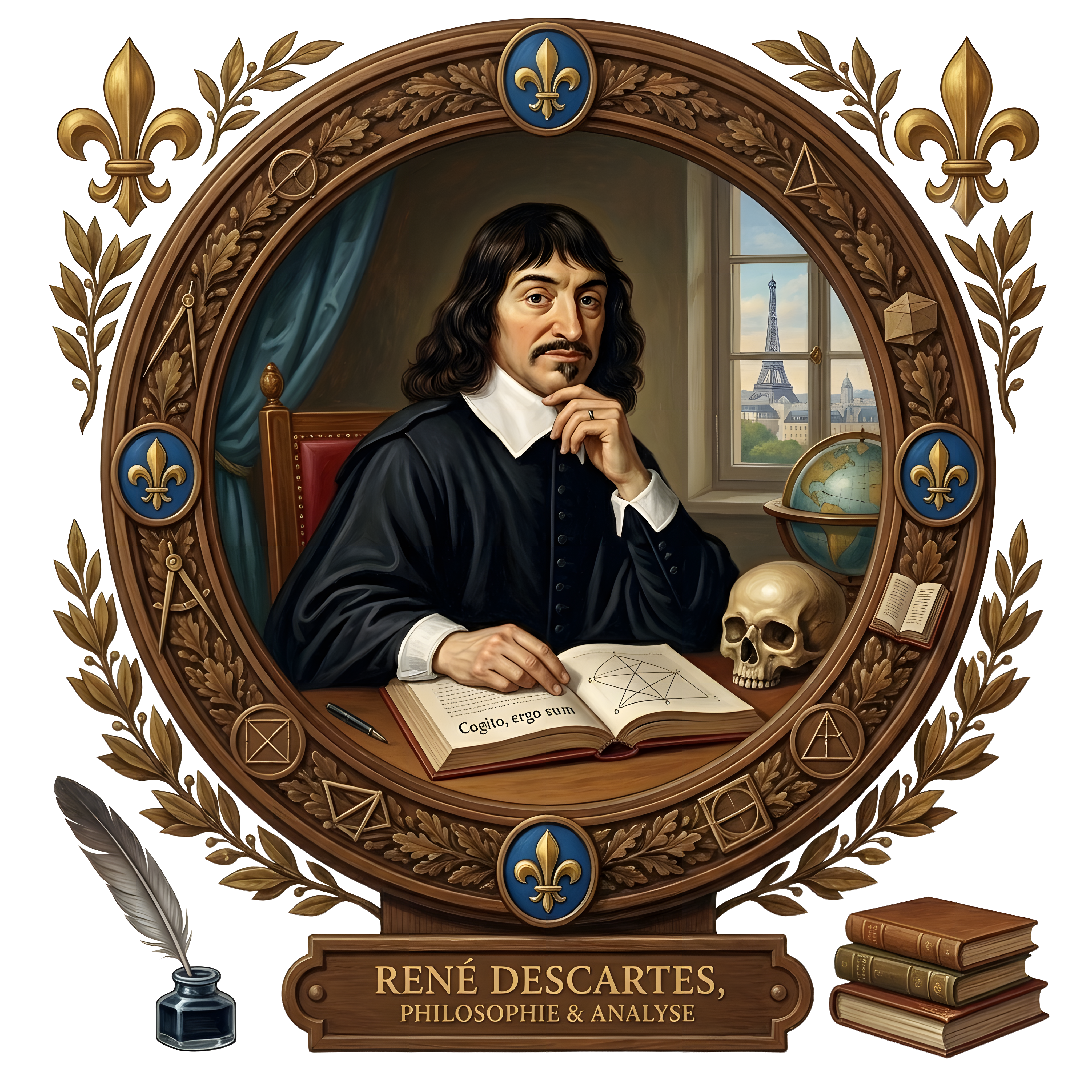
René Descartes was a French philosopher, mathematician, and scientist who is widely considered the father of modern Western philosophy. Born in 1596 in La Haye en Touraine, France, he received a comprehensive education at the Jesuit Collège Royal Henry-Le-Grand at La Flèche. There, he was steeped in the scholastic tradition, which he later sought to reform by applying the rigorous certainty of mathematics to philosophical inquiry. After obtaining a law degree from the University of Poitiers, Descartes spent several years traveling across Europe as a volunteer in various armies, seeking to learn from the 'book of the world.'
During his military travels in 1619, Descartes experienced a series of profound dreams that inspired him to dedicate his life to developing a unified science of nature based on mathematical principles. He eventually settled in the relatively tolerant Dutch Republic, where he spent over two decades producing his most influential works. It was here that he sought to strip away all preconceived notions and establish a foundation of absolute certainty, famously arriving at the indubitable truth: 'Cogito, ergo sum' (I think, therefore I am).
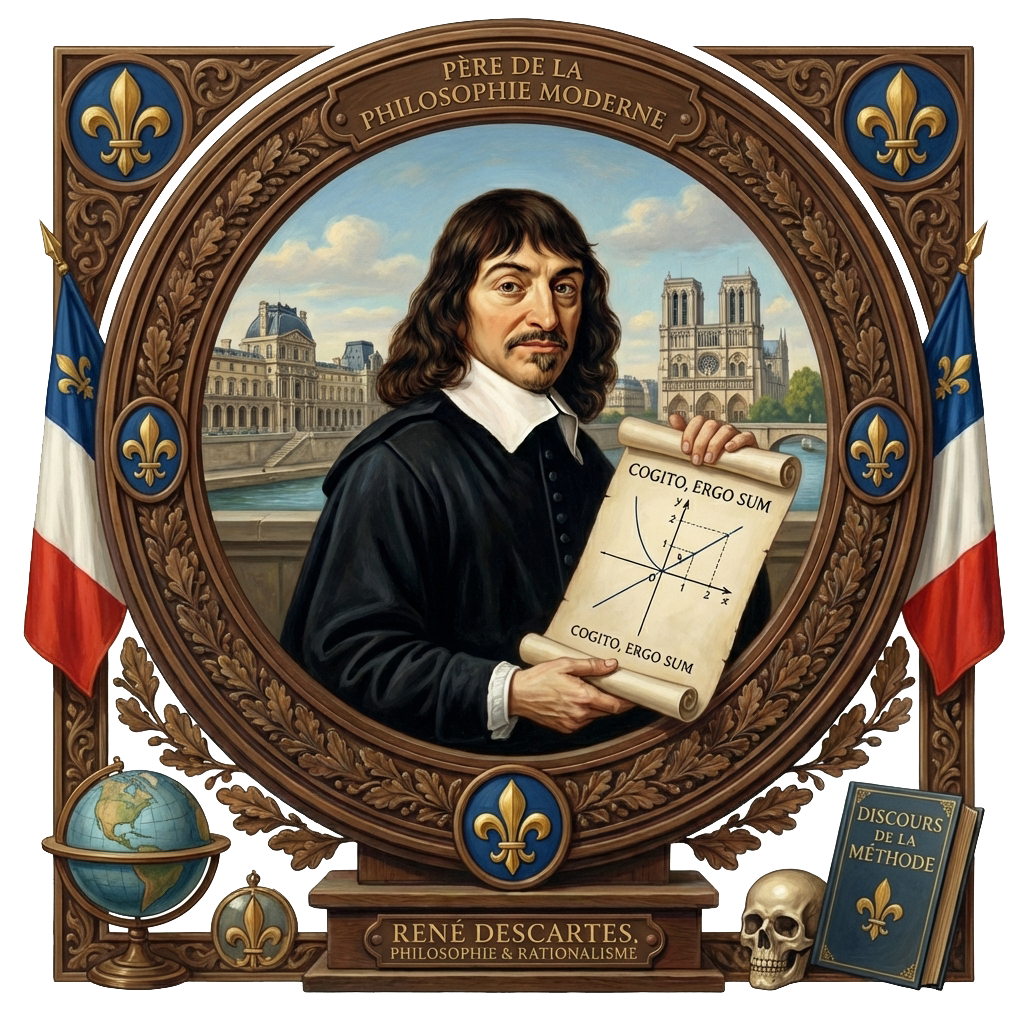
Descartes' contributions extended far beyond epistemology. In mathematics, he revolutionized the field by inventing the Cartesian coordinate system, which allowed geometric shapes to be expressed in algebraic equations, laying the groundwork for calculus. His major works, including 'Discourse on the Method' (1637) and 'Meditations on First Philosophy' (1641), introduced Cartesian dualism—the theory that the mind and body are distinct substances. This framework dominated philosophical discourse for centuries and fundamentally shaped the Scientific Revolution.
In 1649, Descartes accepted an invitation from Queen Christina of Sweden to become her philosophy tutor and organize a new scientific academy. However, the harsh Scandinavian winter and the Queen's demand for early morning lessons severely compromised his health. He contracted pneumonia and died in Stockholm in 1650 at the age of 53. Despite his relatively short life, Descartes' rigorous rationalism and mathematical innovations permanently altered the trajectory of human thought.
Portrayal characteristics
Saved editorial descriptions used for the reconstruction; these are not authenticated statements by the depicted person.
- Analytical
- Rational
- Skeptical
- Methodical
- Visionary
Images & artwork 5



Connections
Abu Ali Sina (Avicenna)
Philosophical Predecessor
Avicenna's "Floating Man" thought experiment is widely recognized as a precursor to Descartes' famous "Cogito, ergo sum."
Centuries before Descartes, Avicenna formulated a thought experiment asking readers to imagine a man suspended in a void with no sensory input, arguing that the man would still be aware of his own existence. This profound argument for the existence of the soul and self-awareness closely parallels Descartes' later epistemological foundation, "I think, therefore I am." Historians frequently note Avicenna's indirect influence on early modern European philosophy.
Baruch Spinoza
Philosophical Successor
Spinoza's early work was an exposition of Cartesian philosophy, which he later fundamentally transformed.
Spinoza's first published book was 'Principles of Cartesian Philosophy'. While he adopted Descartes' geometric method, he rejected Cartesian dualism in favor of monism, arguing that mind and body are attributes of a single substance.
Johannes Kepler
Intellectual Contemporaries
Descartes was aware of and influenced by Kepler's groundbreaking work in optics.
Kepler's 'Astronomiae Pars Optica' laid the foundation for modern optics, which Descartes further developed in his own 'Dioptrique,' though they differed on the fundamental nature of light and motion.
Baruch Spinoza
Influenced By
Spinoza's early philosophical work was a systematic exposition of Descartes' principles.
Spinoza's first published book, 'Renati Des Cartes Principia Philosophiae', was a geometric-style commentary on Descartes. While Spinoza eventually diverged significantly from Cartesian dualism, his rationalist framework was deeply rooted in the Cartesian method.
Thomas Hobbes
Philosophical Rivals
Hobbes and Descartes engaged in a famous intellectual exchange regarding the nature of the mind and matter.
Hobbes provided the 'Third Set of Objections' to Descartes' 'Meditations on First Philosophy'. Their relationship was marked by mutual respect but sharp disagreement, particularly over Descartes' dualism versus Hobbes' materialism.
John Locke
Philosophical Opponents
Locke's empiricism was developed largely as a rebuttal to Descartes' theory of innate ideas.
In 'An Essay Concerning Human Understanding', Locke explicitly challenged the Cartesian notion that the mind is born with certain ideas. This debate between Cartesian rationalism and Lockean empiricism defined much of the Enlightenment's intellectual trajectory.
Gottfried Wilhelm Leibniz
Intellectual Successor & Critic
Leibniz refined Cartesian mathematics and critiqued Descartes' physics and metaphysics.
Leibniz studied Descartes' work extensively, improving upon Cartesian algebraic notation and the laws of motion. While he admired Descartes' mechanical philosophy, he rejected Cartesian dualism in favor of his own theory of monads.
Thomas Hobbes
Intellectual Correspondents
Hobbes provided a series of formal objections to Descartes' 'Meditations on First Philosophy'.
Their exchange highlighted the fundamental divide between Hobbes' strict materialism and Descartes' mind-body dualism. Their disagreements helped define the boundaries of 17th-century rationalism and empiricism.
Alexis de Tocqueville
Philosophical Subject
Tocqueville famously analyzed American culture through the lens of René Descartes, arguing that Americans were the world's best practitioners of Cartesian philosophy.
In one of the most brilliant and counterintuitive chapters of 'Democracy in America,' Tocqueville opens Volume II by declaring that America is the one country in the world where the precepts of René Descartes are least studied but best applied. He observed that Americans, living in a democratic society free from entrenched aristocratic traditions, naturally employed Cartesian doubt. They rejected inherited authority, class-based dogma, and ancient traditions, choosing instead to rely on their own individual reason and practical experience to navigate the world. By linking the abstract epistemology of the French philosopher to the pragmatic, everyday habits of American pioneers, Tocqueville demonstrated how democratic social conditions fundamentally alter human psychology and intellectual methods.
Charles de Gaulle
Philosophical Heritage
De Gaulle frequently invoked the rationalist philosophy of René Descartes to describe the ideal French intellectual temperament, contrasting it with the ideologies of other nations.
René Descartes, the father of modern Western philosophy, left an indelible mark on French cultural identity, one that Charles de Gaulle frequently weaponized in his rhetoric. De Gaulle often spoke of 'Cartesian logic' and 'Cartesian order' as the defining characteristics of the French mind—rational, structured, and clear. When navigating complex geopolitical crises, such as the Cold War or the Algerian conflict, de Gaulle would publicly appeal to the 'Cartesian' nature of the French people, urging them to see past emotional factionalism and recognize the cold, logical necessity of his policies. By aligning his own highly strategic, unsentimental statecraft with Descartes' legacy, de Gaulle sought to elevate his political decisions from mere pragmatism to the level of profound national philosophy.
Known for
- Cogito, ergo sum
- Cartesian coordinate system
- Mind-body dualism
- Discourse on the Method
- Meditations on First Philosophy
Episodes featuring or mentioning this figure
No eligible published episode featuring this figure is currently in the library.