



Gottfried Wilhelm Leibniz
A German polymath and philosopher who independently developed differential and integral calculus.
At a glance
- Born
- 1646 CE
- Died
- 1716 CE
- Era classification
- Modern
- Homeland
- Germany
- Period
- 17th - Early 18th Century
- Field
- Mathematics & Logic
- Language
- German
- Religion
- Lutheran
- Gender
- male
Biography
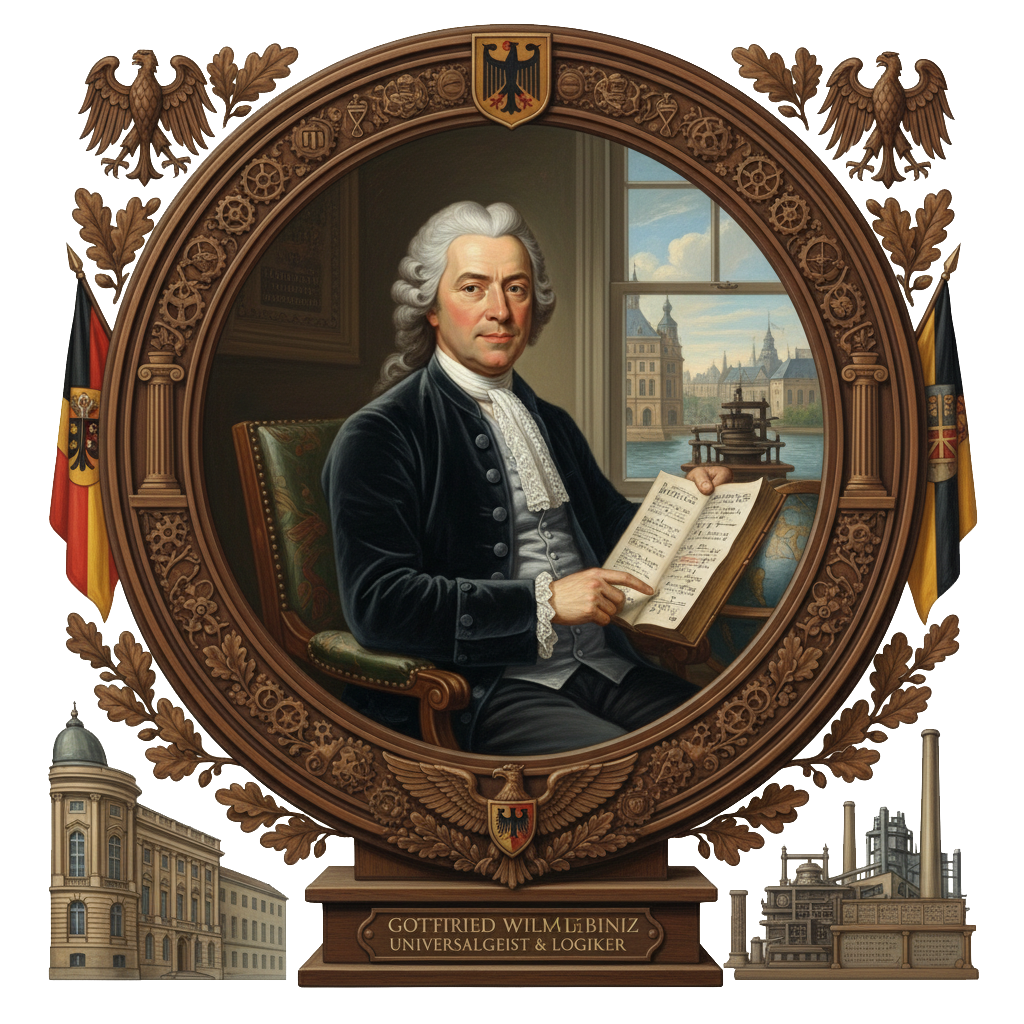
Gottfried Wilhelm Leibniz was a prominent German polymath, philosopher, mathematician, and logician. Born in Leipzig, he was a child prodigy who read extensively from his father's library. He earned a degree in law and spent much of his life working as a diplomat and librarian for the House of Hanover, which allowed him to travel and correspond with the leading intellectuals of his time.
In mathematics, Leibniz is most famous for developing the infinitesimal calculus independently of Isaac Newton. His notation, including the integral sign and the "d" for differentials, was so intuitive and practical that it remains the standard in mathematics today. He was also a pioneer in the field of mechanical calculators, inventing the Leibniz wheel and refining the binary number system, which is the foundation of modern computer architecture.
As a philosopher, Leibniz is known for his optimism, famously arguing that our universe is "the best of all possible worlds" created by God. His metaphysical system was based on "monads," indivisible and fundamental units of reality. Despite his immense contributions across multiple disciplines, he died in relative obscurity, though his reputation has grown immensely in the centuries since his death.
Portrayal characteristics
Saved editorial descriptions used for the reconstruction; these are not authenticated statements by the depicted person.
- Brilliant
- Versatile
- Optimistic
- Logical
- Innovative
Images & artwork 3


Connections
Baruch Spinoza
Intellectual Peers
Leibniz visited Spinoza in 1676 to discuss philosophy and read the manuscript of Spinoza's 'Ethics'.
The two shared a complex relationship; while Leibniz was deeply influenced by Spinoza's rationalism, he publicly distanced himself from Spinoza's perceived atheism and developed his 'Monadology' as a more religiously acceptable alternative to Spinoza's monism.
Isaac Newton
Scientific Rivals
Leibniz and Newton were embroiled in a bitter, lifelong dispute over the independent invention of infinitesimal calculus.
While modern historians agree both men invented calculus independently, the Royal Society (under Newton's presidency) officially accused Leibniz of plagiarism. The feud divided European mathematics for decades, with the Continent adopting Leibniz's superior notation while Britain stuck with Newton's.
Baruch Spinoza
Philosophical Contemporaries
Leibniz met with Spinoza in 1676 to discuss metaphysics and optics, though he later publicly distanced himself from Spinoza's views.
Leibniz spent several days in The Hague discussing the 'Ethics' with Spinoza. Although Leibniz was deeply influenced by Spinoza's rationalism, he feared being associated with Spinoza's perceived atheism and spent much of his later career trying to refute Spinozistic monism.
John Locke
Philosophical Opponents
Leibniz's 'New Essays on Human Understanding' was a comprehensive, point-by-point critique of Locke's empiricism.
Leibniz argued against Locke's 'tabula rasa' (blank slate) theory, famously adding 'except the intellect itself' to the empiricist maxim. He maintained that the mind possesses innate structures and 'petites perceptions' that Locke's sensory-based model could not account for.
Immanuel Kant
Philosophical Influence
Kant was trained in the Leibnizian-Wolffian tradition, and his 'Critique of Pure Reason' was an attempt to reconcile Leibniz's rationalism with Hume's empiricism.
Leibniz's metaphysics of monads and necessary truths provided the 'dogmatic' framework that Kant sought to transcend. Kant's distinction between analytic and synthetic judgments was a direct evolution of Leibniz's distinction between truths of reason and truths of fact.
Immanuel Kant
Philosophical Predecessor
Kant was educated in the Leibnizian-Wolffian tradition and spent much of his career critiquing its metaphysical claims.
While Kant moved away from Leibniz's rationalist metaphysics, he retained many Leibnizian concepts, such as the distinction between phenomena and noumena, while rejecting the theory of monads.
Isaac Newton
Scientific Rivals
Newton and Leibniz were embroiled in a bitter, lifelong dispute over the invention of calculus.
While both developed the mathematical system independently, the Royal Society's investigation (influenced by Newton) accused Leibniz of plagiarism, causing a deep rift between British and Continental mathematics for decades.
Peter the Great
Scientific Advisor
Leibniz met with Peter the Great several times to advise him on the modernization of Russian science and education.
Between 1711 and 1716, the two met to discuss the creation of the Russian Academy of Sciences. Leibniz's proposals for administrative and educational reform were highly influential in Peter's efforts to align Russia with European intellectual standards.
René Descartes
Intellectual Successor & Critic
Leibniz refined Cartesian mathematics and critiqued Descartes' physics and metaphysics.
Leibniz studied Descartes' work extensively, improving upon Cartesian algebraic notation and the laws of motion. While he admired Descartes' mechanical philosophy, he rejected Cartesian dualism in favor of his own theory of monads.
Known for
- Calculus
- Binary numeral system
- Monadology
- Leibniz wheel
Episodes featuring or mentioning this figure
No eligible published episode featuring this figure is currently in the library.