



John von Neumann
A brilliant polymath who made foundational contributions to mathematics, physics, computer science, and economics.
At a glance
- Born
- 1903 CE
- Died
- 1957 CE
- Era classification
- 53
- Homeland
- Hungary / United States
- Period
- 1903–1957
- Field
- Mathematics & Logic
- Language
- Hungarian, German, English
- Religion
- Catholic
- Gender
- male
Biography
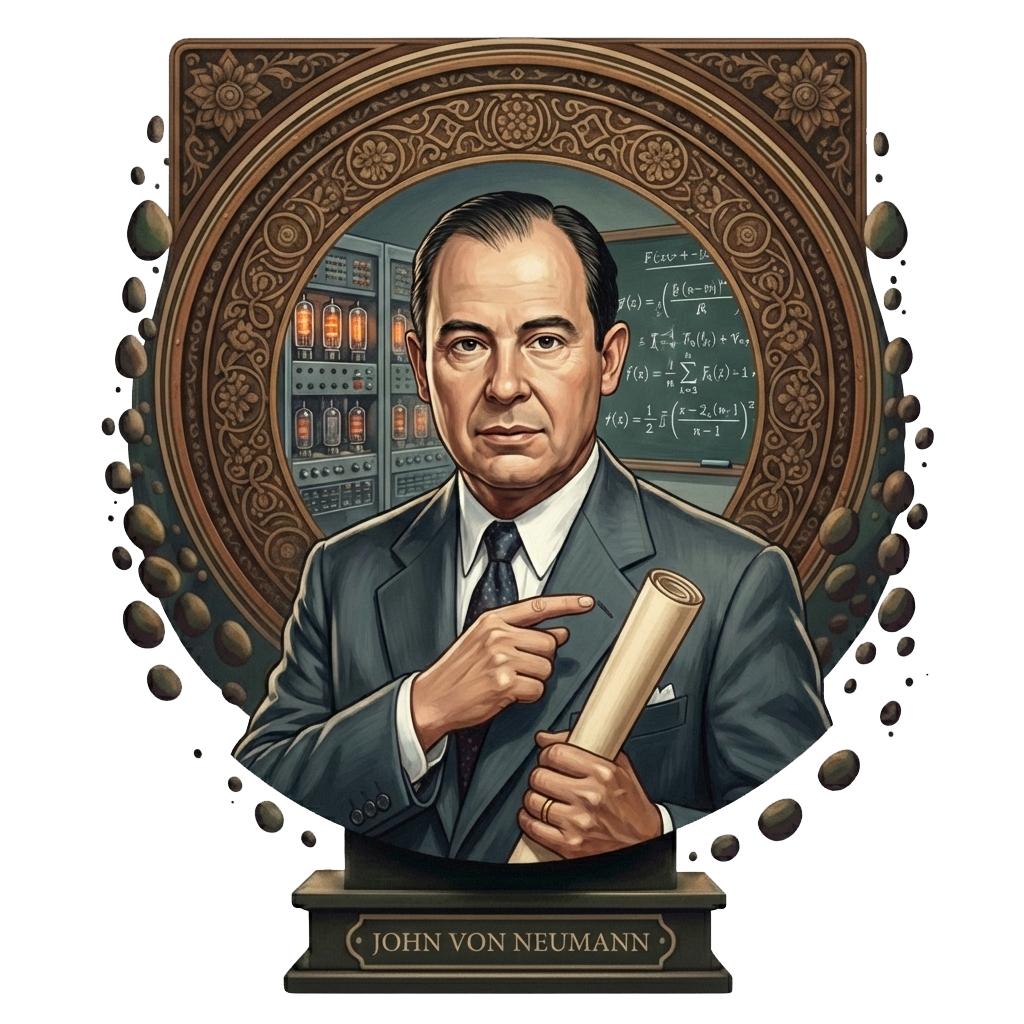
Born Neumann János Lajos in Budapest, Hungary, John von Neumann was a child prodigy who mastered calculus by age eight and published his first major mathematical paper at nineteen. He simultaneously studied chemical engineering in Zurich and completed a Ph.D. in mathematics at the University of Budapest, showcasing an extraordinary intellectual capacity that would define his entire career.
In the 1920s, von Neumann made foundational contributions to set theory and quantum mechanics in Germany. Fleeing the rise of Nazism, he emigrated to the United States in 1930, eventually becoming one of the original professors at the Institute for Advanced Study in Princeton alongside Albert Einstein. During this period, he rigorously formalized the mathematical framework of quantum mechanics.
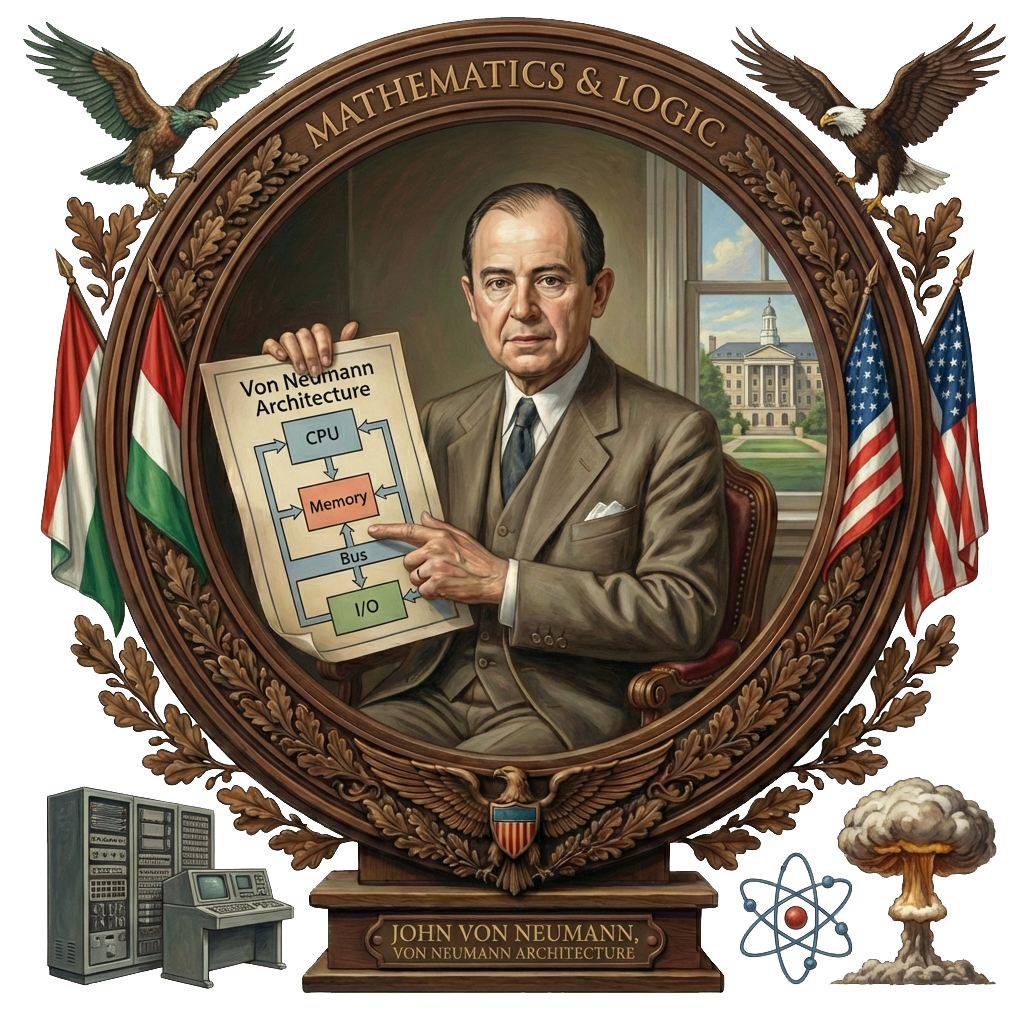
During World War II, von Neumann played a crucial role in the Manhattan Project, developing the explosive lenses used in the implosion-type nuclear weapon. His work on complex calculations led him to pioneer modern computer architecture—known as the von Neumann architecture—which remains the structural basis for almost all digital computers today.
He also co-founded the field of game theory with Oskar Morgenstern, applying mathematical models to economics and strategic decision-making, which profoundly influenced Cold War geopolitics. Serving on the Atomic Energy Commission until his premature death from cancer in 1957, von Neumann left behind an unparalleled legacy as one of the greatest and most versatile mathematicians in modern history.
Portrayal characteristics
Saved editorial descriptions used for the reconstruction; these are not authenticated statements by the depicted person.
- Polymathic
- Analytical
- Visionary
- Pragmatic
- Lightning-fast thinker
Images & artwork 4


Connections
Alan Turing
Contemporary & Peer
Von Neumann recognized Turing's theoretical work as the foundation for modern computer architecture.
Von Neumann was well-acquainted with Turing's 1936 paper on 'Computable Numbers' and even offered Turing a position as his assistant at Princeton. The 'Von Neumann architecture' was significantly influenced by Turing's concept of the Universal Turing Machine.
Claude Elwood Shannon
Scientific Contemporaries
Both Shannon and von Neumann were key figures at the Institute for Advanced Study and pioneers of the digital age.
Von Neumann's work on computer architecture and Shannon's Mathematical Theory of Communication are the two pillars of modern computing. They interacted frequently in academic circles, with von Neumann famously advising Shannon to use the term 'entropy' for his measure of information.
Geoffrey Hinton
Architectural Contrast
Hinton's connectionist approach to AI provides an alternative to the sequential logic of the Von Neumann architecture.
While traditional computing relies on the Von Neumann architecture (separate CPU and memory), Hinton's neural networks mimic the parallel processing of the biological brain. This shift from symbolic logic to distributed representations represents a fundamental departure from the computing paradigms established in the 1940s.
Alan Turing
Contemporary Peers
Both were foundational figures in the development of computer science and mathematical logic.
Von Neumann was a great admirer of Turing's 1936 paper on computable numbers and invited him to the Institute for Advanced Study in Princeton, where they discussed the future of computing machinery.
Albert Einstein
Colleagues
They were both original faculty members at the Institute for Advanced Study (IAS) in Princeton.
As colleagues at the IAS, they frequently interacted within the same intellectual circles, though their primary research focuses—quantum mechanics and relativity for Einstein, and game theory and computing for von Neumann—differed significantly.
Claude Elwood Shannon
Contemporary Allies
They were both pioneers of information theory and the early digital age.
Von Neumann and Shannon interacted during the early development of cybernetics and digital logic; von Neumann famously advised Shannon to use the term 'entropy' for his measure of information.
Known for
- Von Neumann architecture
- Game theory
- Mathematical formulation of quantum mechanics
- Manhattan Project contributions
- Cellular automata
Episodes featuring or mentioning this figure

Does Technology Make Us More Free? Alan Turing vs Hannah Arendt
Does technological progress expand the horizon of human freedom, or does it merely perfect the machinery of administrative control?