



Geoffrey Hinton
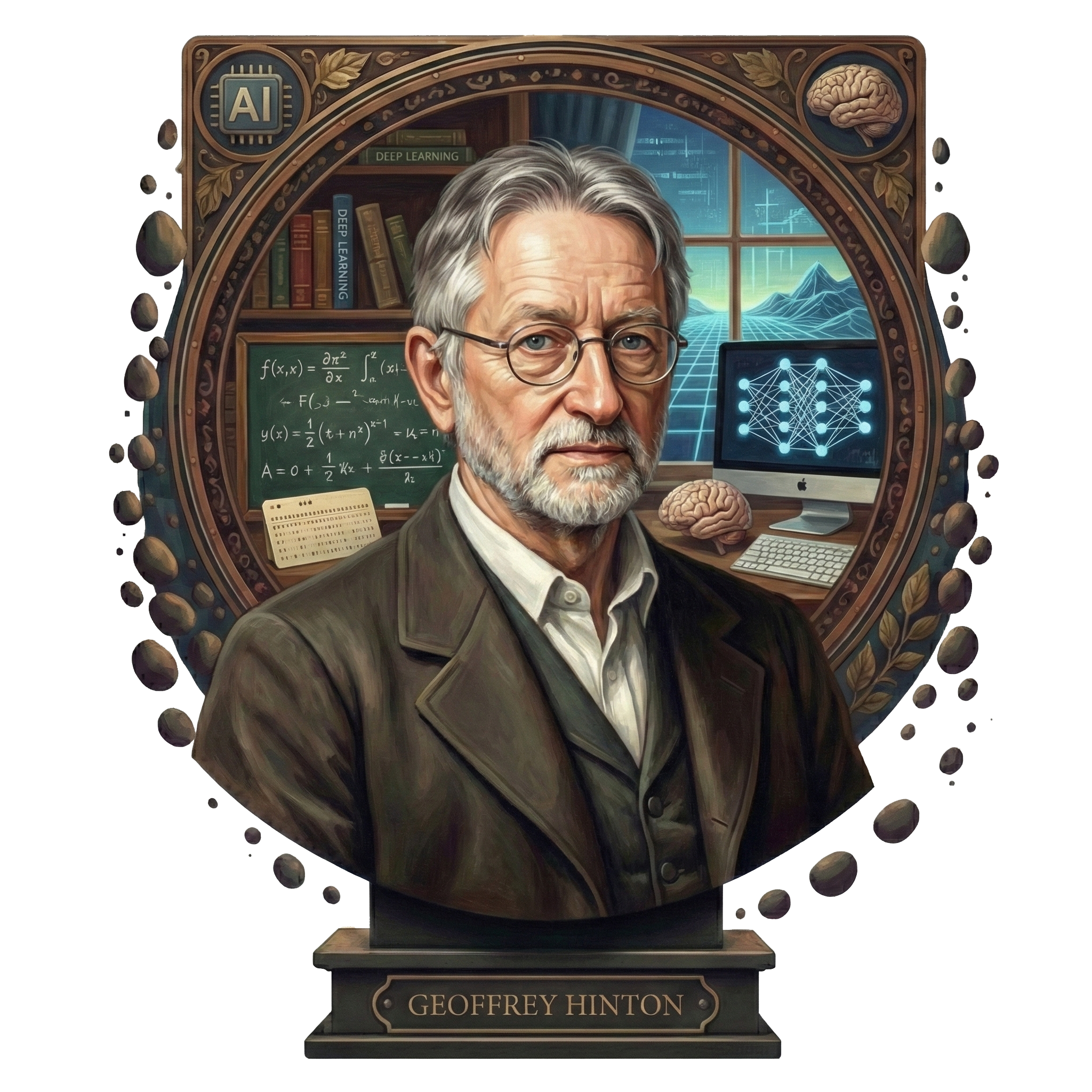
A pioneering computer scientist known as the 'Godfather of AI' for his foundational work on artificial neural networks.
At a glance
- Born
- 1947 CE
- Era classification
- 76
- Homeland
- United Kingdom / Canada
- Period
- 1947 CE - Present
- Field
- Science, Medicine & Engineering
- Language
- English
- Religion
- Atheist
- Gender
- male
Biography
Geoffrey Everest Hinton was born on December 6, 1947, in Wimbledon, London, into a family with a rich scientific heritage. He pursued his education at King's College, Cambridge, where he graduated with a degree in experimental psychology, before earning his PhD in artificial intelligence from the University of Edinburgh in 1978. During a time when neural networks were largely dismissed by the broader computer science community, Hinton remained steadfast in his belief that computers could learn in ways analogous to the human brain.
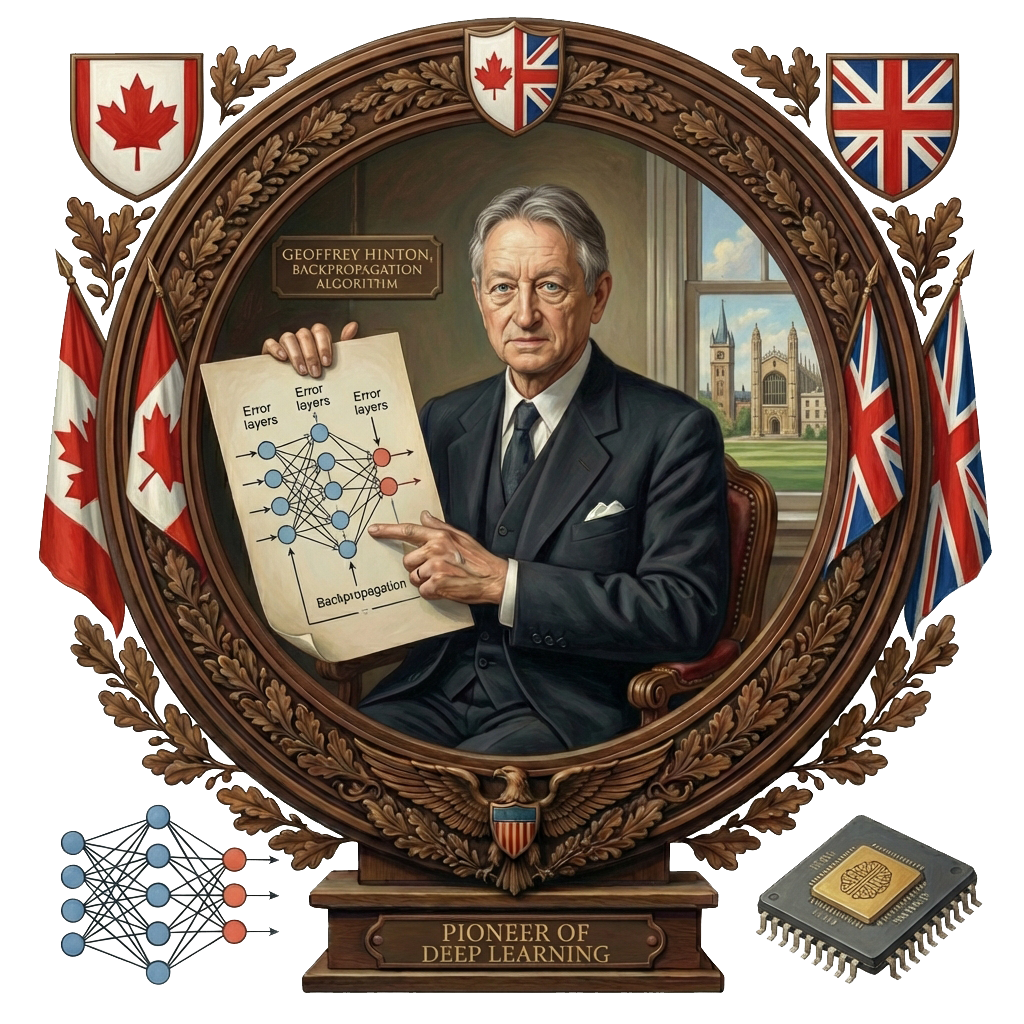
Throughout the 1980s and 1990s, Hinton made several groundbreaking contributions that would eventually revolutionize the field of machine learning. While working at Carnegie Mellon University and later the University of Toronto, he co-authored a highly influential 1986 paper demonstrating the efficacy of the backpropagation algorithm for training multi-layer neural networks. He also co-invented Boltzmann machines and played a pivotal role in the development of deep learning, laying the mathematical and conceptual groundwork for modern artificial intelligence.
Hinton's perseverance paid off in the 2010s when increased computational power and massive datasets allowed deep learning to achieve unprecedented success in computer vision and natural language processing. In 2013, he joined Google after the tech giant acquired his neural networks startup. For his monumental contributions, Hinton was awarded the 2018 A.M. Turing Award, often referred to as the 'Nobel Prize of Computing,' alongside Yoshua Bengio and Yann LeCun. In 2024, his foundational impact was further recognized when he was awarded the Nobel Prize in Physics alongside John Hopfield.
Despite his instrumental role in creating modern AI, Hinton has become one of its most prominent cautionary voices. In 2023, he made headlines by resigning from his position at Google so he could speak freely about the existential risks and ethical dangers posed by rapidly advancing artificial intelligence. His transition from an AI pioneer to a vocal advocate for AI safety underscores his deep ethical commitment and profound sense of responsibility toward the future of humanity.
Portrayal characteristics
Saved editorial descriptions used for the reconstruction; these are not authenticated statements by the depicted person.
- Visionary
- Analytical
- Principled
- Persistent
- Ethically conscious
Images & artwork 4
Connections
Alan Turing
Intellectual Successor
Hinton's development of deep learning and neural networks fulfills Turing's 1950 vision of creating machines that can learn from experience.
Turing's 'Computing Machinery and Intelligence' proposed that a machine could be taught rather than just programmed. Hinton's work on backpropagation and connectionism provided the practical mathematical framework to realize Turing's theoretical dream of a 'child machine' that learns.
John von Neumann
Architectural Contrast
Hinton's connectionist approach to AI provides an alternative to the sequential logic of the Von Neumann architecture.
While traditional computing relies on the Von Neumann architecture (separate CPU and memory), Hinton's neural networks mimic the parallel processing of the biological brain. This shift from symbolic logic to distributed representations represents a fundamental departure from the computing paradigms established in the 1940s.
Claude Elwood Shannon
Theoretical Influence
Hinton's work on restricted Boltzmann machines and information-theoretic learning builds upon the foundations of information theory established by Shannon.
Hinton utilized concepts like entropy and information gain, pioneered by Shannon, to develop algorithms that minimize 'surprise' or error in data. This mathematical bridge between communication theory and machine learning is central to the efficiency of modern AI models.
OpenAI GPT 5.2 Pro
Technological Lineage
Hinton's pioneering research in deep learning and backpropagation is the fundamental technology that enables GPT models.
As a primary architect of the neural network revolution, Hinton's work at the University of Toronto and Google directly led to the transformer architectures used by OpenAI.
Known for
- Backpropagation algorithm
- Deep learning pioneer
- Boltzmann machines
- 2018 Turing Award
- 2024 Nobel Prize in Physics
- Advocacy for AI safety
Episodes featuring or mentioning this figure
No eligible published episode featuring this figure is currently in the library.