



Isaac Newton
English mathematician and physicist who formulated the laws of motion and universal gravitation.
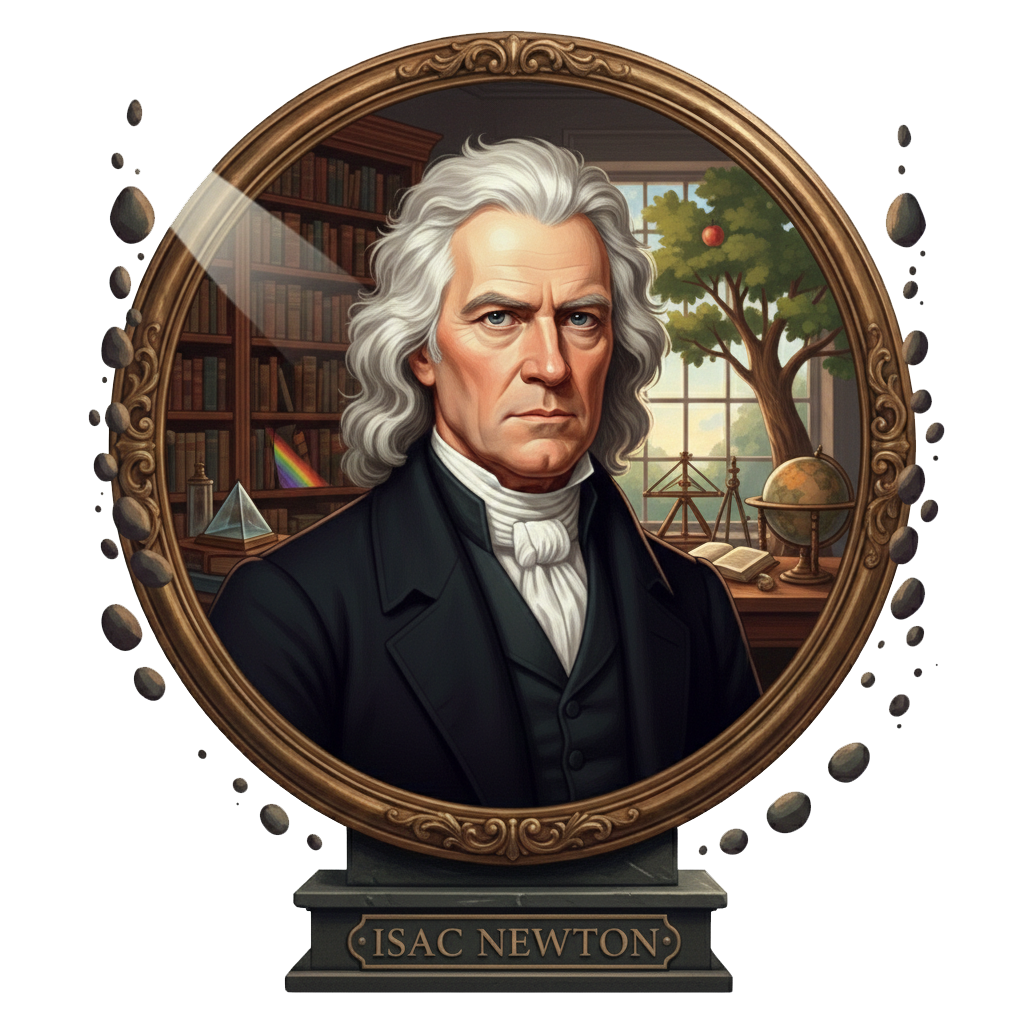
At a glance
- Born
- 1643 CE
- Died
- 1727 CE
- Era classification
- 84
- Homeland
- United Kingdom
- Period
- 1643–1727 CE
- Field
- Science, Medicine & Engineering
- Language
- English
- Religion
- Christian (Arian)
- Gender
- male
Biography
Isaac Newton was born prematurely on Christmas Day 1642 (Old Style) in Woolsthorpe, Lincolnshire. Raised by his grandmother after his father's death and mother's remarriage, he developed a solitary and introspective nature. He attended Trinity College, Cambridge, where he was exposed to the scientific revolution's early ideas. When the Great Plague closed the university in 1665, Newton returned home for two years, entering a miraculous period of immense intellectual productivity where he laid the groundwork for his theories on calculus, optics, and gravity.
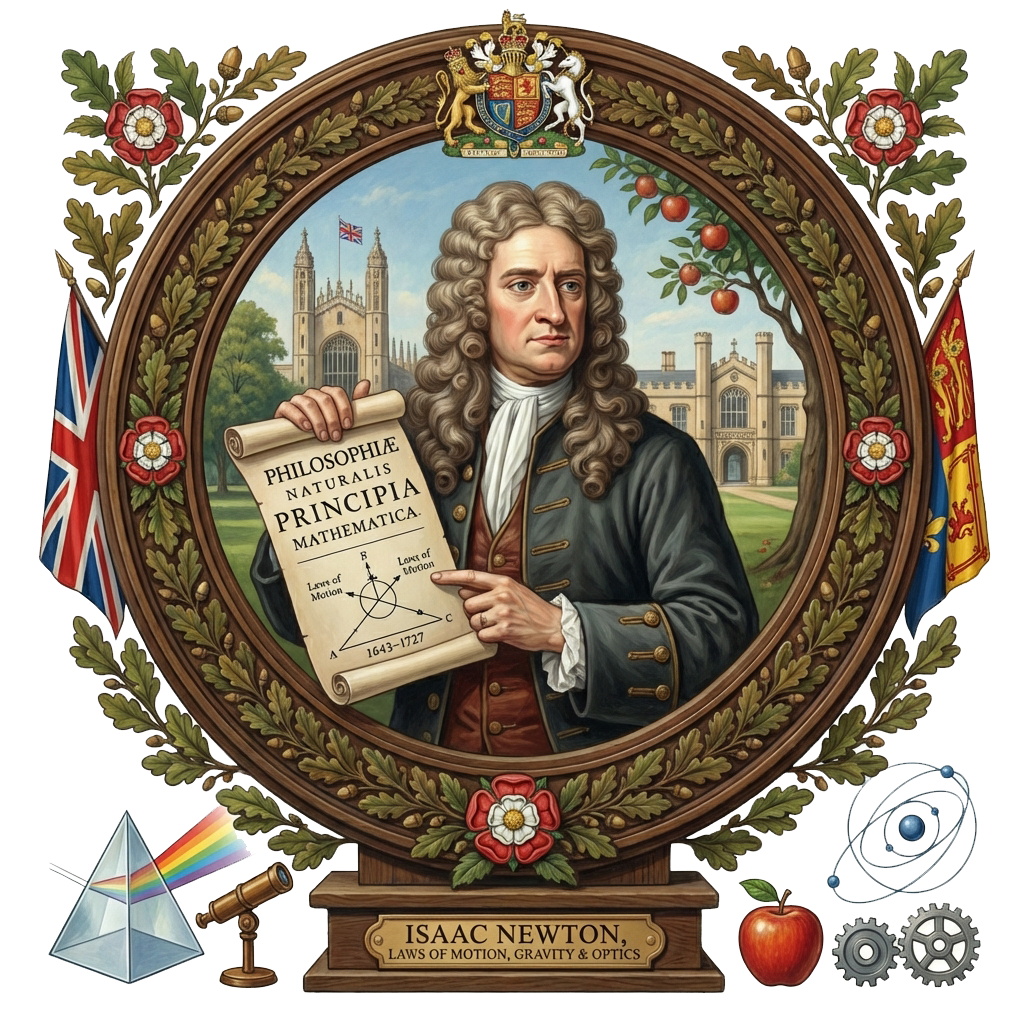
In 1687, Newton published his magnum opus, 'Philosophiæ Naturalis Principia Mathematica' (Mathematical Principles of Natural Philosophy). This monumental work established the foundations of classical mechanics. In it, he formulated the three laws of motion and the law of universal gravitation, mathematically proving that the same natural laws govern both celestial bodies and earthly objects. This unified the cosmos under a single, predictable mathematical framework.
Beyond mechanics, Newton made groundbreaking contributions to optics and mathematics. He built the first practical reflecting telescope and developed a comprehensive theory of color, demonstrating that a prism decomposes white light into the visible spectrum. In mathematics, he shares the credit with Gottfried Wilhelm Leibniz for the development of infinitesimal calculus, though their independent discoveries sparked a bitter and lifelong priority dispute.
In his later years, Newton largely stepped away from active scientific discovery to assume administrative roles. He served as Warden and later Master of the Royal Mint, where he aggressively prosecuted counterfeiters, and was President of the Royal Society. Knighted by Queen Anne in 1705, he died a national hero in 1727. Privately, Newton was deeply devoted to alchemy and unorthodox Christian theology, writing extensively on biblical prophecy and secretly holding anti-Trinitarian (Arian) beliefs.
Portrayal characteristics
Saved editorial descriptions used for the reconstruction; these are not authenticated statements by the depicted person.
- Analytical
- Obsessive
- Solitary
- Brilliant
- Vindictive
- Introspective
Images & artwork 4


Connections
Albert Einstein
Scientific Successor
Einstein's General Relativity fundamentally transformed the understanding of gravity established by Newton.
Einstein's work showed that gravity is not a force acting at a distance as Newton proposed, but a curvature of spacetime. Despite this, Einstein held Newton in the highest regard, keeping a portrait of him in his study and acknowledging that his own work was only possible because of the foundations Newton laid.
Carl Friedrich Gauss
Influenced By
Gauss considered Newton the greatest mathematician and built extensively upon his work.
Gauss frequently referred to Newton as 'Summus' (the greatest) and modeled his rigorous mathematical style after Newton's 'Principia.' His work in celestial mechanics, particularly the calculation of the orbit of Ceres, was a direct evolution of Newtonian physics.
Euclid of Alexandria
Influenced (Methodology)
Newton modeled the structure of his 'Principia Mathematica' on Euclid's geometric proofs.
Newton held Euclid in the highest regard, choosing to present his revolutionary laws of motion and universal gravitation in the style of Euclidean geometry. By using axioms and propositions, Newton aimed to give his physics the same absolute certainty found in Euclid's mathematics.
Galileo Galilei
Scientific Successor
Newton's laws of motion and universal gravitation were built directly upon Galileo's work on inertia and falling bodies.
Newton famously stated he 'stood on the shoulders of giants,' referring in part to Galileo. Newton's First Law of Motion is a formalization of Galileo's concept of inertia, and Newton's mathematical treatment of gravity unified Galileo's terrestrial mechanics with Kepler's celestial laws.
Gottfried Wilhelm Leibniz
Scientific Rivals
Leibniz and Newton were embroiled in a bitter, lifelong dispute over the independent invention of infinitesimal calculus.
While modern historians agree both men invented calculus independently, the Royal Society (under Newton's presidency) officially accused Leibniz of plagiarism. The feud divided European mathematics for decades, with the Continent adopting Leibniz's superior notation while Britain stuck with Newton's.
Immanuel Kant
Scientific Influence
Kant's early work and his mature epistemology were heavily focused on providing a philosophical foundation for Newtonian physics.
Kant viewed Newton's laws as the definitive model of scientific knowledge and sought to explain how synthetic a priori judgments made such universal laws of nature possible.
Gottfried Wilhelm Leibniz
Scientific Rivals
Newton and Leibniz were embroiled in a bitter, lifelong dispute over the invention of calculus.
While both developed the mathematical system independently, the Royal Society's investigation (influenced by Newton) accused Leibniz of plagiarism, causing a deep rift between British and Continental mathematics for decades.
Galileo Galilei
Scientific Predecessor
Newton's first law of motion was a direct refinement and formalization of Galileo's principle of inertia.
Newton famously stated, 'If I have seen further it is by standing on the shoulders of Giants,' referring to Galileo's foundational work on kinematics and the motion of falling bodies.
Johannes Kepler
Scientific Predecessor
Newton used his law of universal gravitation to mathematically prove and explain Kepler's laws of planetary motion.
By showing that the same force governing a falling apple also governed the orbits of planets, Newton unified terrestrial and celestial mechanics, validating Kepler's elliptical orbits.
Albert Einstein
Scientific Successor
Einstein's theory of General Relativity eventually superseded Newton's law of universal gravitation.
While Newtonian mechanics remains accurate for most everyday applications, Einstein demonstrated that gravity is the curvature of spacetime rather than a direct force, resolving anomalies in Newton's model like the orbit of Mercury.
John Locke
Contemporary Allies
Newton and Locke were close friends who shared interests in theology, science, and the limits of human knowledge.
Locke was greatly influenced by Newton's empirical success, describing himself as an 'under-labourer' clearing the ground for 'the incomparable Mr. Newton' in his philosophical writings.
Johannes Kepler
Scientific Successor
Newton's law of universal gravitation provided the physical explanation for Kepler's three laws of planetary motion.
Newton used Kepler's empirical laws as the primary evidence for his inverse-square law of gravity, effectively unifying Kepler's celestial mechanics with terrestrial physics in the 'Principia Mathematica.'
John Locke
Intellectual Peers
Locke and Newton were close friends and fellow members of the Royal Society who shared interests in theology and science.
Locke was one of the few people Newton trusted with his private theological manuscripts, and Locke's 'An Essay Concerning Human Understanding' was deeply influenced by the empirical, scientific method championed by Newton.
James Clerk Maxwell
Scientific Successors
Maxwell's unification of electricity, magnetism, and light is regarded as the second great unification in physics after Newton's work.
While Newton unified terrestrial and celestial mechanics under the law of universal gravitation, Maxwell's field equations unified the previously separate forces of electricity and magnetism into a single electromagnetic theory.
Stephen Hawking
Lucasian Professor Successor
Hawking held the Lucasian Chair of Mathematics at Cambridge, the same prestigious position once held by Isaac Newton.
Hawking frequently referenced Newton's legacy in his writing, seeing himself as part of a long lineage of British physicists who transformed our understanding of gravity and the cosmos.
Voltaire
Intellectual Proponent
Voltaire was instrumental in popularizing Newtonian physics in France, moving the intellectual climate away from Cartesianism.
After witnessing Newton's high social standing in England, Voltaire wrote 'Elements of the Philosophy of Newton' with Émilie du Châtelet to explain and defend Newton's theories of gravity and optics.
Known for
- Laws of Motion
- Law of Universal Gravitation
- Development of Calculus
- Principia Mathematica
- Reflecting Telescope
- Theory of Color
Episodes featuring or mentioning this figure
No eligible published episode featuring this figure is currently in the library.