



Jean-Baptiste Lamarck
A pioneering French naturalist who formulated the first comprehensive theory of biological evolution.
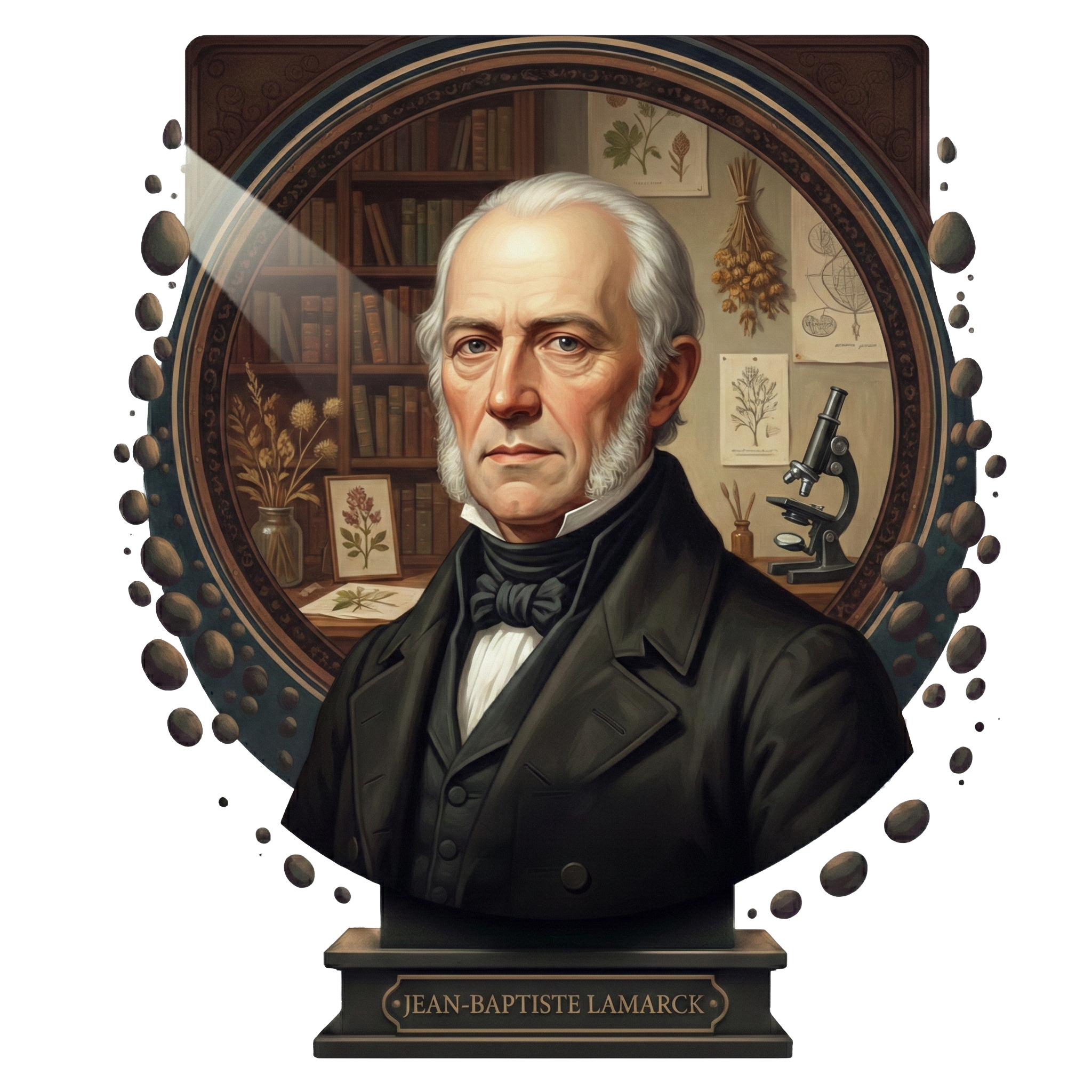
At a glance
- Born
- August 1, 1744 CE
- Died
- December 18, 1829 CE
- Era classification
- 85
- Homeland
- France
- Period
- 1744–1829
- Field
- Science, Medicine & Engineering
- Language
- French
- Religion
- Deist
- Gender
- male
Biography
Jean-Baptiste Pierre Antoine de Monet, chevalier de Lamarck, was born in Picardy, France. He initially pursued a military career, serving in the French army during the Pomeranian War. After an injury forced him to resign, he turned his attention to medicine and botany in Paris. His meticulous study of plants culminated in the publication of 'Flore françoise' (1778), a work that brought him to the attention of the influential Comte de Buffon and secured his election to the French Academy of Sciences.
In 1793, following the French Revolution and the establishment of the Muséum national d'Histoire naturelle, Lamarck was appointed as a professor of zoology. He was specifically placed in charge of the study of insects and worms, a group of animals he would later classify under the term 'invertebrates'—a word he coined himself. Over the years, he meticulously organized and classified these vast and previously neglected groups of animals, making profound contributions to invertebrate paleontology and taxonomy.
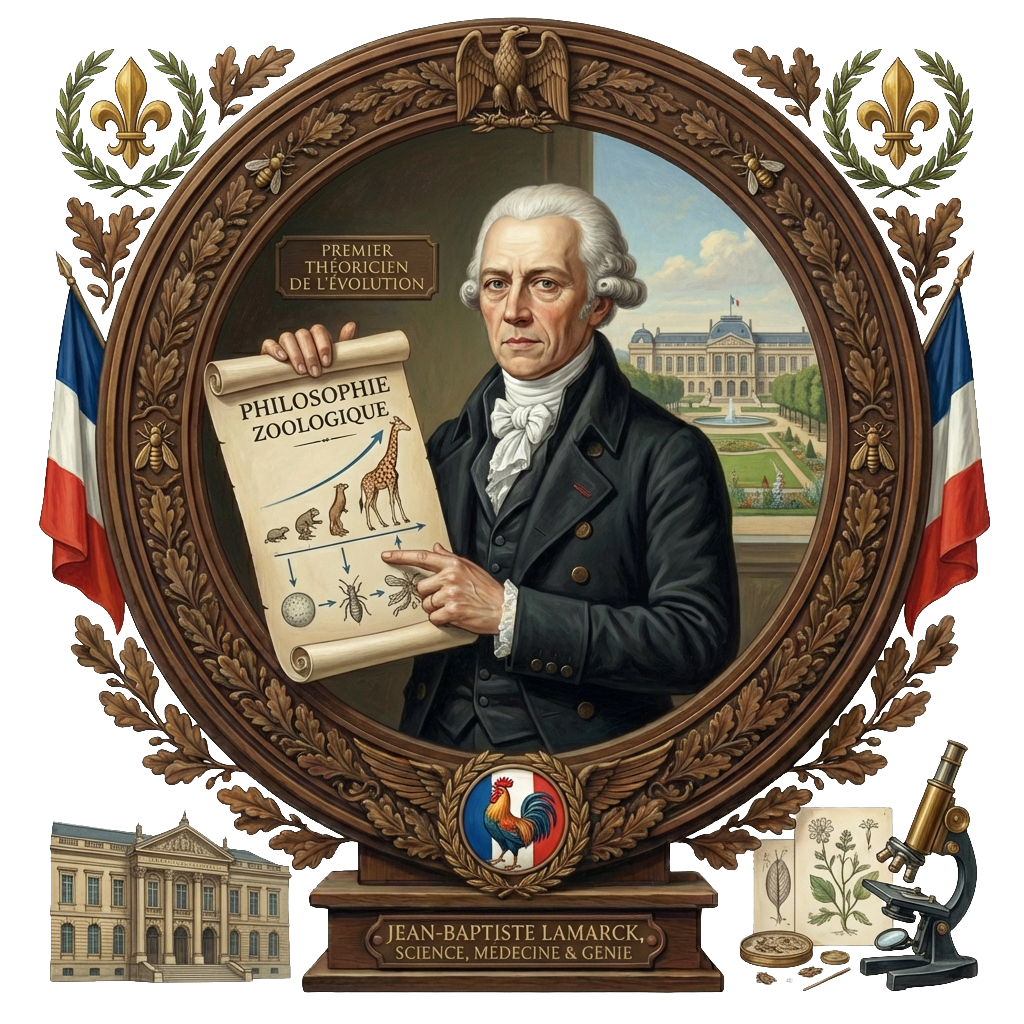
Lamarck is most famously remembered for his 1809 magnum opus, 'Philosophie zoologique', in which he proposed the first fully formed, cohesive theory of biological evolution. He argued that life was not fixed but evolved continuously toward greater complexity in response to environmental changes. His proposed mechanism, often referred to as Lamarckism, posited the inheritance of acquired characteristics. He suggested that traits developed or lost during an organism's lifetime through use or disuse could be passed directly to its offspring.
Although his specific mechanism of inheritance was largely superseded by Charles Darwin's theory of natural selection and later Mendelian genetics, Lamarck's foundational idea that environments shape biological change was revolutionary. He spent his final years blind and in poverty, largely unappreciated by his contemporaries. However, modern science increasingly recognizes his pioneering role in evolutionary biology, his immense contributions to taxonomy, and the conceptual parallels between his theories and modern epigenetics.
Portrayal characteristics
Saved editorial descriptions used for the reconstruction; these are not authenticated statements by the depicted person.
- Observant
- Innovative
- Resilient
- Methodical
- Visionary
Images & artwork 4


Connections
Charles Darwin
Scientific Predecessor
Darwin built upon the evolutionary concepts first popularized by Lamarck, though he rejected Lamarck's specific mechanisms.
Jean-Baptiste Lamarck was one of the first scientists to propose that species change over time through natural processes. While Darwin's theory of natural selection eventually superseded Lamarckism, Darwin credited him with being the first to bring the idea of evolution to the attention of the scientific community.
Charles Darwin
Evolutionary Predecessors
Lamarck proposed an early theory of evolution that Darwin later refined and replaced with the theory of natural selection.
In 'On the Origin of Species', Darwin credited Lamarck as the first person whose views on the subject of evolution excited significant attention. Although Lamarck's 'inheritance of acquired characteristics' was eventually superseded, he paved the way for Darwin's biological breakthroughs.
Napoleon Bonaparte
Subject & Sovereign
Lamarck served as a professor at the Muséum National d'Histoire Naturelle during Napoleon's reign.
Napoleon famously dismissed Lamarck's work; when Lamarck attempted to present the Emperor with a copy of his 'Philosophie Zoologique', Napoleon publicly rebuked him, reflecting the era's skepticism toward early evolutionary ideas.
Napoleon Bonaparte
Contemporary Critic
Napoleon was a prominent critic of Lamarck's early theories of evolution.
When Lamarck presented his work 'Philosophie Zoologique' to Napoleon in 1809, the Emperor publicly ridiculed him, dismissing his ideas as 'absurd.' This royal disapproval significantly hindered the early acceptance of Lamarckian evolutionary theory in France.
Known for
- First comprehensive theory of evolution
- Inheritance of acquired characteristics
- Coining the term 'biology'
- Coining the term 'invertebrate'
- Philosophie zoologique (1809)
Episodes featuring or mentioning this figure
No eligible published episode featuring this figure is currently in the library.