



Charles Darwin
English naturalist whose theory of evolution by natural selection became the foundation of modern evolutionary studies.
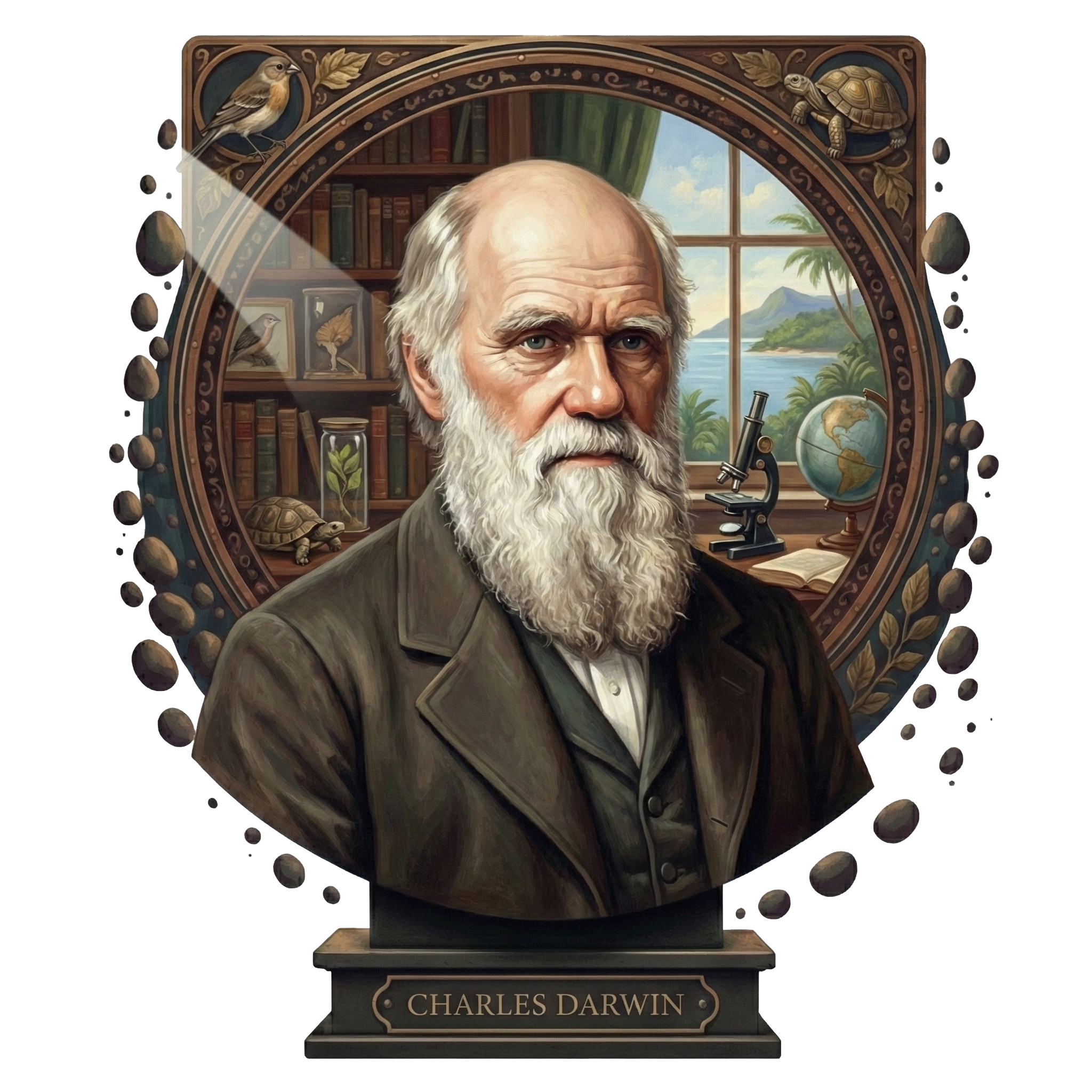
At a glance
- Born
- 1809 CE
- Died
- 1882 CE
- Era classification
- 73
- Homeland
- United Kingdom
- Period
- 1809–1882
- Field
- Science, Medicine & Engineering
- Language
- English
- Religion
- Agnostic
- Gender
- male
Biography
Charles Robert Darwin was born in 1809 in Shrewsbury, England, into a wealthy and influential family. Though initially sent to the University of Edinburgh to study medicine and later to Cambridge to prepare for a career as an Anglican clergyman, Darwin's true passion lay in the natural sciences. Mentored by botanist John Stevens Henslow, he developed a keen interest in geology, botany, and the meticulous observation of the natural world.
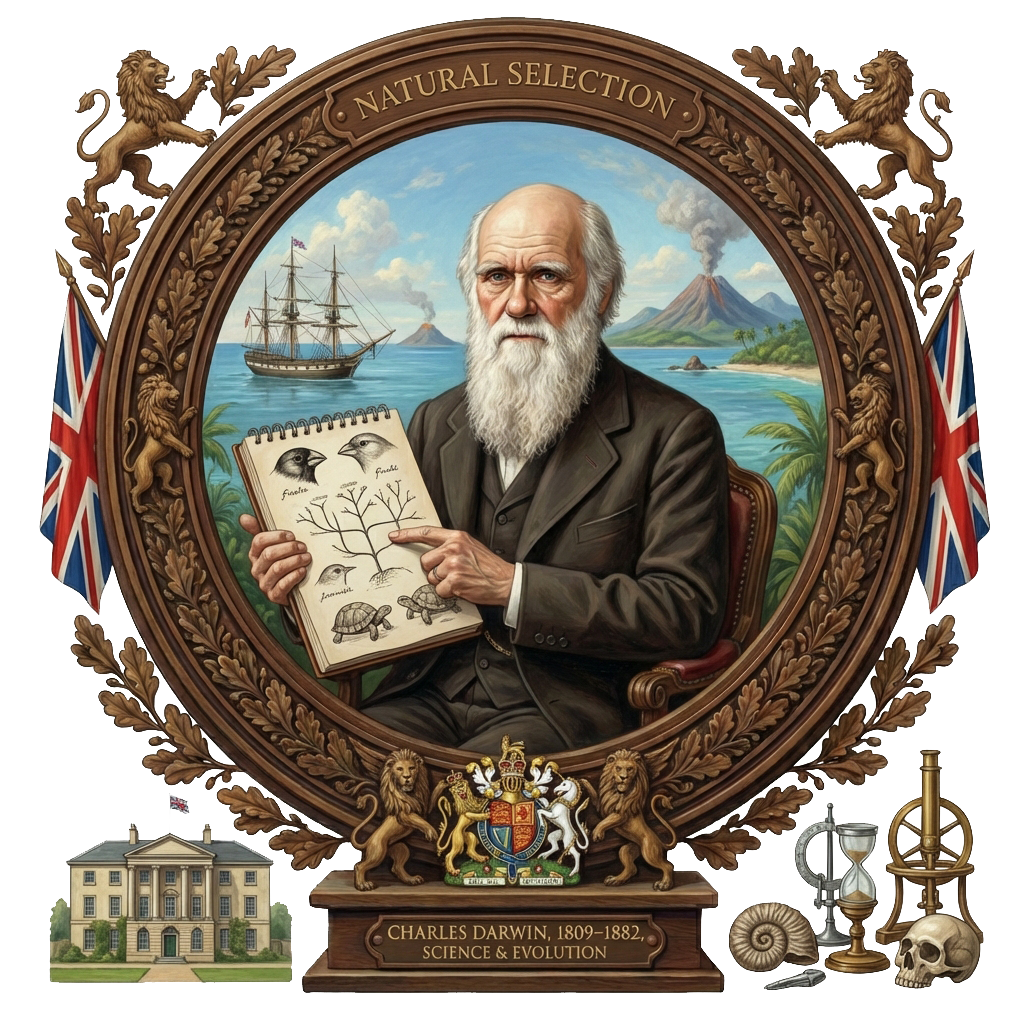
In 1831, Darwin embarked on a transformative five-year voyage aboard the HMS Beagle. Serving as the ship's naturalist, he explored the coastlines of South America, Australia, and the southern tip of Africa. His observations of diverse flora, fauna, and geological formations, particularly the unique finches and tortoises of the Galápagos Islands, profoundly challenged his understanding of the immutability of species. He collected thousands of specimens that would later serve as the empirical foundation for his groundbreaking theories.
Upon returning to England, Darwin spent over two decades analyzing his findings and conducting further experiments. Influenced by Thomas Malthus's writings on population growth, he formulated the mechanism of natural selection, proposing that organisms with traits best suited to their environments are more likely to survive and reproduce. Despite knowing the controversial nature of his ideas, he meticulously gathered evidence to build an airtight case for his theory.
Prompted by a letter from Alfred Russel Wallace, who had independently conceived a similar theory, Darwin published 'On the Origin of Species' in 1859. The book fundamentally revolutionized biology and altered humanity's understanding of its place in the natural order. Darwin continued to write and research until his death in 1882, publishing influential works like 'The Descent of Man,' and leaving a legacy as one of the most important figures in the history of science.
Portrayal characteristics
Saved editorial descriptions used for the reconstruction; these are not authenticated statements by the depicted person.
- Meticulous
- Observant
- Patient
- Inquisitive
- Methodical
- Humble
Images & artwork 4


Connections
Jean-Baptiste Lamarck
Scientific Predecessor
Darwin built upon the evolutionary concepts first popularized by Lamarck, though he rejected Lamarck's specific mechanisms.
Jean-Baptiste Lamarck was one of the first scientists to propose that species change over time through natural processes. While Darwin's theory of natural selection eventually superseded Lamarckism, Darwin credited him with being the first to bring the idea of evolution to the attention of the scientific community.
Abraham Lincoln
Contemporary Peers
Darwin and Lincoln were born on the exact same day, February 12, 1809, and both transformed the 19th-century world.
The coincidence of their births is frequently cited by historians to illustrate the parallel shifts in science and politics during the era. While Darwin revolutionized the understanding of human origins, Lincoln redefined the concepts of liberty and union in the United States.
Karl Marx
Mutual Admiration
Marx was a great admirer of Darwin's work, seeing 'On the Origin of Species' as providing a biological foundation for his own theories.
Marx believed that Darwin's work on natural selection mirrored his own views on the struggle for existence within human society. He even sent Darwin a signed copy of 'Das Kapital', although Darwin's response was polite but distant, as he preferred to avoid political and religious controversy.
Ilya Mechnikov
Influenced By
Mechnikov applied Darwinian evolutionary theory to the study of the immune system.
Mechnikov's discovery of phagocytosis (the process by which cells ingest foreign particles) was framed as an evolutionary survival mechanism. He viewed the struggle between microbes and the body's cells through a Darwinian lens of natural selection and adaptation.
James Dewey Watson
Scientific Legacy
Watson's discovery of the DNA structure provided the molecular mechanism for Darwin's theory of evolution.
While Darwin proposed natural selection and inheritance, he lacked knowledge of the physical medium of heredity. Watson and Crick's work revealed how genetic information is stored and replicated, confirming the biological basis for Darwinian evolution.
Jean-Baptiste Lamarck
Evolutionary Predecessors
Lamarck proposed an early theory of evolution that Darwin later refined and replaced with the theory of natural selection.
In 'On the Origin of Species', Darwin credited Lamarck as the first person whose views on the subject of evolution excited significant attention. Although Lamarck's 'inheritance of acquired characteristics' was eventually superseded, he paved the way for Darwin's biological breakthroughs.
Karl Marx
Influenced By
Marx saw Darwin's theory of evolution as a biological parallel to his own theory of class struggle.
Marx was an avid reader of 'On the Origin of Species' and wrote to Engels that Darwin's work provided the 'natural-history foundation' for their view of human social development.
Known for
- Theory of Evolution
- Natural Selection
- On the Origin of Species
- The Voyage of the Beagle
- The Descent of Man
Episodes featuring or mentioning this figure
No eligible published episode featuring this figure is currently in the library.