



Karl Marx
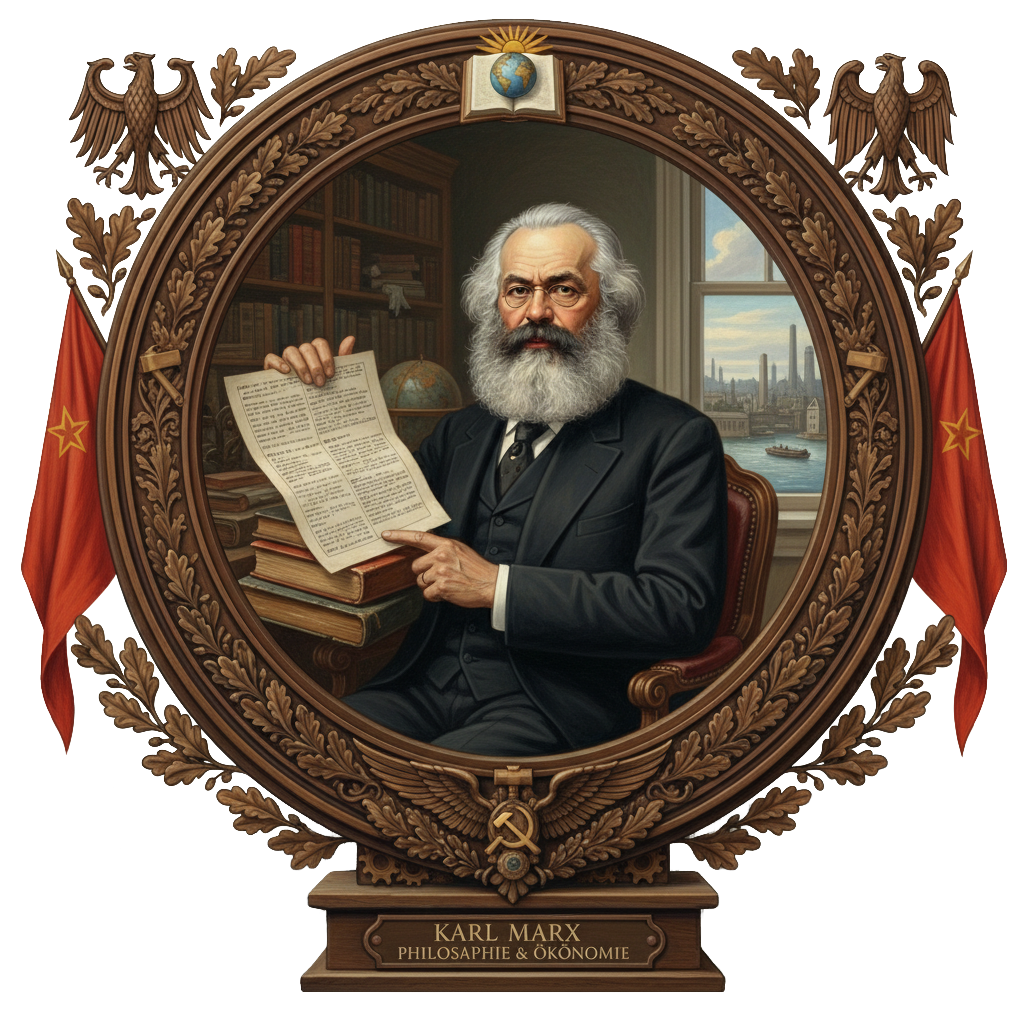
A German philosopher and economist whose ideas laid the foundation for modern communism and socialist theory.
At a glance
- Born
- 1818 CE
- Died
- 1883 CE
- Era classification
- Modern
- Homeland
- Germany
- Period
- 19th Century
- Field
- Philosophy & Ideology
- Language
- German
- Religion
- Atheist
- Gender
- male
Biography
Karl Marx was a philosopher, economist, historian, and political theorist whose radical ideas profoundly shaped the political landscape of the 19th and 20th centuries. Born in Trier, Germany, to a middle-class family, he studied law and philosophy at the universities of Bonn and Berlin. His early exposure to Hegelian philosophy heavily influenced his later intellectual developments.
Marx is best known for his critique of capitalism, which he articulated in his magnum opus, "Das Kapital." He argued that capitalism is inherently exploitative, driven by class struggle between the bourgeoisie, who own the means of production, and the proletariat, who sell their labor. His collaboration with Friedrich Engels resulted in the 1848 publication of "The Communist Manifesto," a seminal text that urged the working classes to unite and overthrow capitalist systems.
Throughout his life, Marx faced exile due to his revolutionary writings, eventually settling in London where he continued his research at the British Museum. Although his ideas did not immediately spark the global revolution he envisioned during his lifetime, Marxist theory became the ideological bedrock for numerous socialist and communist movements worldwide, fundamentally altering global history.
Portrayal characteristics
Saved editorial descriptions used for the reconstruction; these are not authenticated statements by the depicted person.
- Analytical
- Revolutionary
- Critical
- Determined
- Visionary
Images & artwork 3
Connections
Charles Darwin
Mutual Admiration
Marx was a great admirer of Darwin's work, seeing 'On the Origin of Species' as providing a biological foundation for his own theories.
Marx believed that Darwin's work on natural selection mirrored his own views on the struggle for existence within human society. He even sent Darwin a signed copy of 'Das Kapital', although Darwin's response was polite but distant, as he preferred to avoid political and religious controversy.
Vladimir Lenin
Ideological Successor
Lenin adapted Marx's theories into a practical political framework for the Russian Revolution.
While they never met, Lenin's 'Marxism-Leninism' became the official state ideology of the Soviet Union, directly applying Marx's critique of capitalism to the seizure of state power by the proletariat.
Charles Darwin
Influenced By
Marx saw Darwin's theory of evolution as a biological parallel to his own theory of class struggle.
Marx was an avid reader of 'On the Origin of Species' and wrote to Engels that Darwin's work provided the 'natural-history foundation' for their view of human social development.
Immanuel Kant
Philosophical Precursor
Marx's dialectical method was rooted in the German Idealist tradition founded by Kant.
Marx's early education was steeped in Kantian philosophy, and his eventual critique of Hegel was a development of the critical tradition that Kant initiated regarding the limits of reason and the nature of reality.
Otto von Bismarck
Political Opponents
Bismarck implemented the world's first modern welfare state to neutralize the socialist movement led by Marx's followers.
Despite their ideological enmity, Bismarck's 'State Socialism' (health insurance and pensions) was a pragmatic strategy to prevent the proletarian revolution that Marx advocated.
Vladimir Lenin
Ideological Successor
Lenin adapted Marx's theories into a practical framework for revolution, creating the ideology known as Marxism-Leninism.
While Marx predicted revolutions in advanced industrial societies, Lenin argued that a 'vanguard party' could trigger a revolution in a less developed nation like Russia. His life's work was dedicated to realizing Marx's vision of a classless society.
Mohammad Reza Pahlavi
Ideological Opponents
The Shah was a staunch anti-communist who viewed Marxist ideology as an existential threat to his monarchy. He ruthlessly suppressed Marxist groups in Iran, aligning his regime firmly with the capitalist West.
Mohammad Reza Pahlavi's reign was defined by his fierce opposition to the ideology of Karl Marx and its political manifestations. Sharing a border with the Soviet Union, the Shah viewed communism not just as an ideological rival, but as a direct geopolitical and existential threat to the Iranian monarchy. Throughout his rule, he utilized his brutal domestic intelligence agency, SAVAK, to hunt down, imprison, and execute members of the Tudeh Party (Iran's communist party) and various Marxist-Leninist guerrilla groups, such as the Fedaiyan-e Khalq. The Shah's 'White Revolution'—a massive program of land reform and modernization—was explicitly designed as a preemptive, top-down 'bloodless' revolution to undercut the appeal of Marxist class warfare among the Iranian peasantry and working class. By firmly aligning Iran with the United States and the capitalist bloc during the Cold War, the Shah positioned himself as a primary bulwark against Marxist expansion in the Middle East, making him a prime target for leftist revolutionaries who eventually joined forces with Islamists to overthrow him in 1979.
Alexis de Tocqueville
Ideological Opponents & Contemporaries
As contemporaries who both analyzed the 1848 revolutions, Tocqueville and Marx represent the two great, opposing ideological poles of the 19th century: classical liberalism and communism.
Tocqueville and Karl Marx were both in Paris during the turbulent Revolution of 1848, and both wrote seminal accounts of the events (Tocqueville in his 'Recollections' and Marx in 'The Eighteenth Brumaire of Louis Bonaparte'). They observed the exact same historical phenomena but drew diametrically opposed conclusions. Marx viewed the uprising as a necessary step in the class struggle toward a communist utopia, despising the bourgeoisie. Tocqueville, an aristocratic liberal serving in the French government, viewed the socialist uprising as a terrifying threat to liberty and property, actively supporting its suppression to save the republic. While Marx believed the ultimate historical conflict was between classes (capital and labor), Tocqueville believed the defining struggle of modernity was the tension between equality and liberty.
Charles de Gaulle
Ideological Opponents
De Gaulle was a staunch conservative and nationalist whose political career was largely defined by his opposition to Marxist ideology and the French Communist Party, though he pragmatically engaged with Marxist states.
Charles de Gaulle's worldview was fundamentally opposed to the doctrines of Karl Marx. Where Marx emphasized class struggle and international proletarian solidarity, de Gaulle believed in the primacy of the nation-state, social cohesion, and French grandeur. Following World War II, the French Communist Party (PCF), heavily influenced by Marxist-Leninist ideology, emerged as one of the strongest political forces in France. De Gaulle viewed them as a direct threat to French sovereignty, famously referring to them as 'separatists' whose true loyalty lay with Moscow. During the May 1968 protests, which were driven by Marxist, Maoist, and anarchist student groups, de Gaulle faced the greatest domestic crisis of his presidency, ultimately rallying the conservative 'silent majority' to defeat the radical left. Despite his fierce anti-Marxism at home, de Gaulle's foreign policy was highly pragmatic; he recognized the Soviet Union and Communist China, believing that national interests always superseded Marxist ideology in geopolitics.
Known for
- The Communist Manifesto
- Das Kapital
- Historical Materialism
- Marxism
Episodes featuring or mentioning this figure
No eligible published episode featuring this figure is currently in the library.