



Vladimir Lenin
Russian revolutionary, politician, and political theorist who served as the first head of government of Soviet Russia.
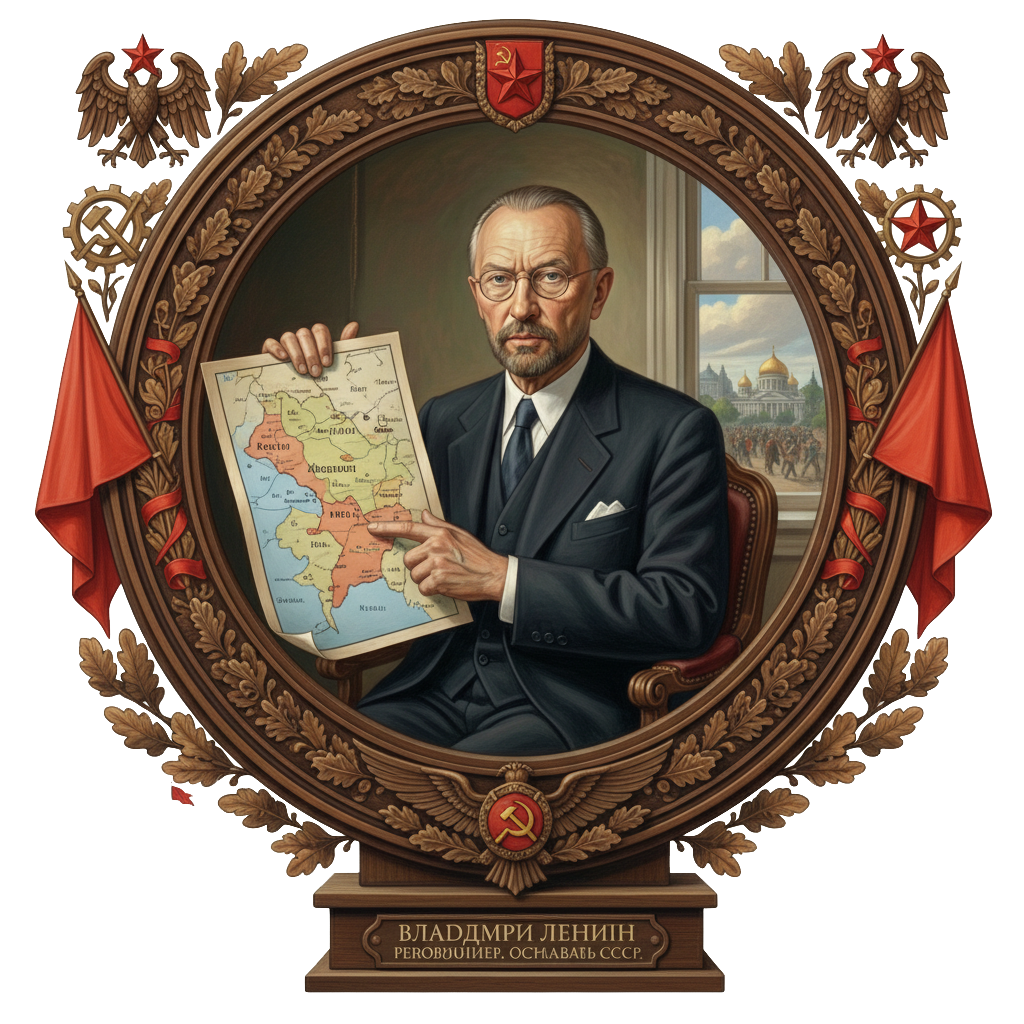
At a glance
- Born
- 1870 CE
- Died
- 1924 CE
- Era classification
- Modern
- Homeland
- Russia
- Period
- Late 19th - Early 20th Century
- Field
- Politics & Leadership
- Language
- Russian
- Religion
- Atheist
- Gender
- male
Biography
Vladimir Ilyich Ulyanov, better known as Vladimir Lenin, was a Russian revolutionary, politician, and political theorist. He served as the first and founding head of government of Soviet Russia from 1917 to 1924 and of the Soviet Union from 1922 to 1924. Under his administration, Russia, and later the Soviet Union, became a one-party socialist state governed by the Communist Party.
Ideologically a Marxist, Lenin developed political theories known as Leninism. He played a leading role in the October Revolution of 1917, which overthrew the Provisional Government and established Soviet power. His leadership during the subsequent Russian Civil War ensured the survival of the Bolshevik regime. He implemented policies such as the New Economic Policy (NEP) to rebuild the devastated economy.
Lenin is widely considered one of the most significant and influential figures of the 20th century. He was the posthumous subject of a pervasive personality cult within the Soviet Union until its dissolution in 1991. While his supporters view him as a champion of socialism and the working class, critics accuse him of establishing a totalitarian dictatorship responsible for mass political repression and human rights abuses.
Portrayal characteristics
Saved editorial descriptions used for the reconstruction; these are not authenticated statements by the depicted person.
- Revolutionary
- Strategic
- Ideological
- Charismatic
- Ruthless
Images & artwork 3
Connections
Karl Marx
Ideological Successor
Lenin adapted Marx's theories into a practical political framework for the Russian Revolution.
While they never met, Lenin's 'Marxism-Leninism' became the official state ideology of the Soviet Union, directly applying Marx's critique of capitalism to the seizure of state power by the proletariat.
Leo Tolstoy
Subject of Analysis
Lenin wrote several influential essays analyzing Tolstoy's role in the Russian revolutionary movement.
Lenin described Tolstoy as the 'mirror of the Russian revolution,' arguing that his work reflected the contradictions and grievances of the Russian peasantry. While Lenin disagreed with Tolstoy's pacifism, he recognized the power of Tolstoy's critique of the Tsarist state.
Mykhailo Hrushevsky
Political Rivals
Hrushevsky, as head of the Ukrainian Central Rada, was a direct political opponent of Lenin's Bolshevik government.
Following the 1917 Revolution, Hrushevsky led the push for Ukrainian autonomy and later independence, which clashed with Lenin's vision of a centralized Soviet state. This rivalry culminated in the Soviet-Ukrainian War and the eventual forced incorporation of Ukraine into the USSR.
Mikhail Gorbachev
Political Successor & Reformer
Gorbachev was the final leader of the Soviet state founded by Lenin, attempting to reform the system while claiming to return to Leninist roots.
As General Secretary, Gorbachev introduced Glasnost and Perestroika to modernize the USSR. He often cited Lenin's 'New Economic Policy' as a historical justification for introducing market elements into the socialist economy.
Karl Marx
Ideological Successor
Lenin adapted Marx's theories into a practical framework for revolution, creating the ideology known as Marxism-Leninism.
While Marx predicted revolutions in advanced industrial societies, Lenin argued that a 'vanguard party' could trigger a revolution in a less developed nation like Russia. His life's work was dedicated to realizing Marx's vision of a classless society.
Leo Tolstoy
Cultural Subject
Lenin wrote several influential essays analyzing Tolstoy's work as a reflection of the Russian revolutionary spirit.
In his essay 'Leo Tolstoy as the Mirror of the Russian Revolution,' Lenin praised Tolstoy's realistic depiction of the peasantry while critiquing his philosophy of non-violent resistance as 'reactionary'.
Ivan Pavlov
State-Supported Scientist
Despite Pavlov's open criticism of the Bolshevik regime, Lenin ensured the scientist received significant state funding.
Lenin recognized Pavlov's international prestige and believed his research on conditioned reflexes provided a materialist basis for understanding human behavior, which aligned with Soviet ideology.
Yuri Gagarin
Ideological Successor
Gagarin was a dedicated member of the Communist Party and his flight was presented as the fulfillment of the scientific and social progress envisioned by Lenin.
As a Soviet hero, Gagarin's identity was inextricably linked to the state founded by Lenin. He was frequently used in state propaganda to validate Leninist ideology, and he was eventually interred in the Kremlin Wall Necropolis, the Soviet Union's highest honor for its most significant figures.
Charles de Gaulle
Military Opponents (Indirect)
Early in his military career, de Gaulle fought against Lenin's Bolshevik forces during the Polish-Soviet War, an experience that cemented his lifelong anti-communism.
In 1919, a young Captain Charles de Gaulle volunteered to serve in the French military mission to Poland. At the time, Vladimir Lenin's newly established Soviet state was attempting to export the Bolshevik revolution westward, leading to the Polish-Soviet War. De Gaulle served as an infantry instructor for the Polish army and saw direct combat against the Red Army near the Zbrucz River, earning Poland's highest military decoration, the Virtuti Militari. This direct confrontation with Lenin's forces profoundly shaped de Gaulle's worldview. It solidified his deep-seated anti-communism and his belief in the enduring power of nationalism over international class solidarity. While Lenin viewed the conflict as a stepping stone to global revolution, de Gaulle saw it as a defense of Western civilization and national sovereignty, themes that would dominate his leadership of France decades later.
Known for
- October Revolution
- Founding the Soviet Union
- Leninism
- Bolshevik leader
Episodes featuring or mentioning this figure
No eligible published episode featuring this figure is currently in the library.