



Yuri Gagarin
Soviet pilot and cosmonaut who became the first human to journey into outer space.
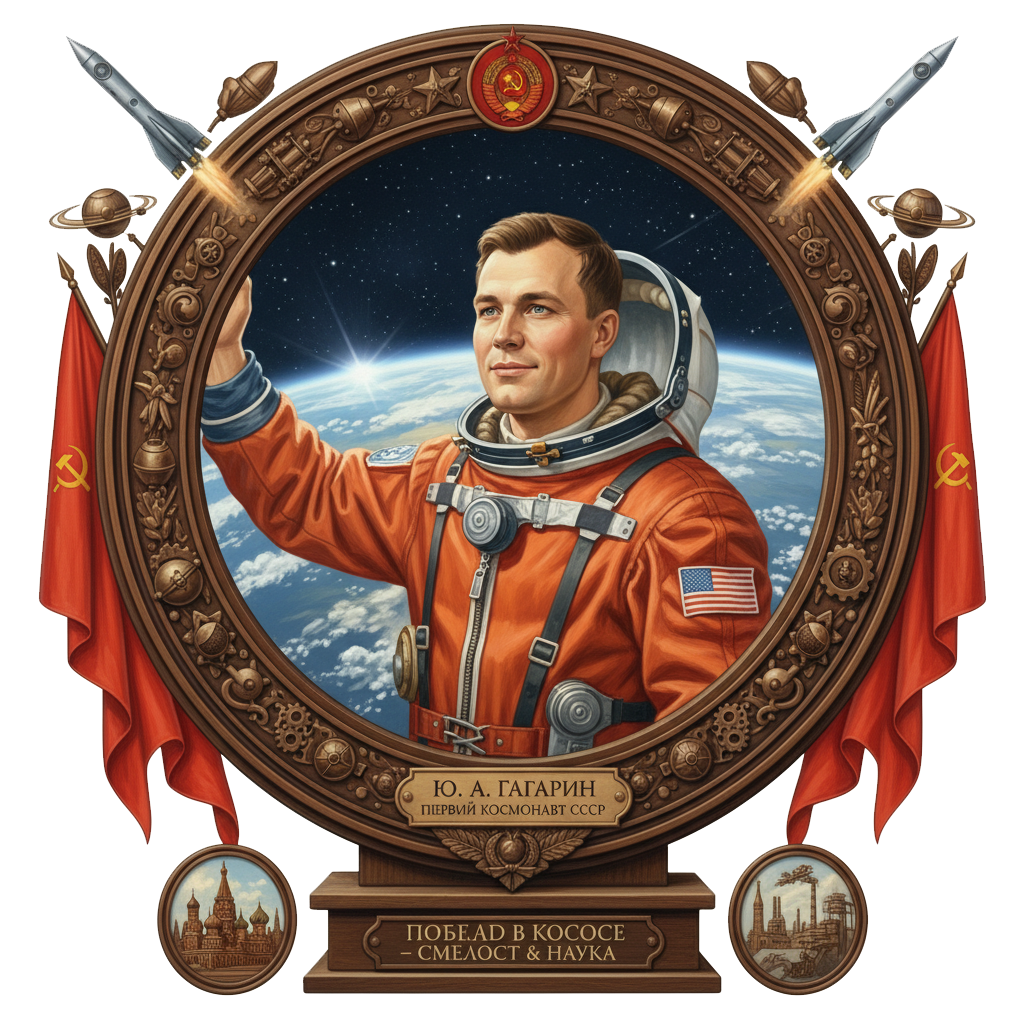
At a glance
- Born
- 1934 CE
- Died
- 1968 CE
- Era classification
- Modern
- Homeland
- Soviet Union (Russia)
- Period
- 20th Century
- Field
- Science & Innovation
- Language
- Russian
- Religion
- Atheist
- Gender
- male
Biography
Yuri Alekseyevich Gagarin was a Soviet pilot and cosmonaut who became the first human to journey into outer space. On April 12, 1961, his Vostok 1 spacecraft completed one orbit of the Earth, a milestone in the Space Race that made him an international celebrity. He was awarded many medals and titles, including Hero of the Soviet Union, the nation's highest honor.
Born to a working-class family in the village of Klushino, Gagarin joined the Soviet Air Forces and was selected for the nascent Soviet space program. His charm, physical fitness, and psychological resilience made him the ideal candidate for the historic flight. Following his successful mission, Gagarin toured the world to promote the Soviet achievement, becoming a symbol of human exploration and technological progress.
Tragically, Gagarin's life was cut short when he died in a routine training flight crash in 1968 at the age of 34. His death was mourned globally, and his legacy as a pioneer of space exploration endures. He remains a revered figure in Russia and a universal icon of humanity's quest to reach the stars.
Portrayal characteristics
Saved editorial descriptions used for the reconstruction; these are not authenticated statements by the depicted person.
- Courageous
- Charismatic
- Pioneering
- Resilient
- Humble
Images & artwork 3


Connections
Vladimir Lenin
Ideological Successor
Gagarin was a dedicated member of the Communist Party and his flight was presented as the fulfillment of the scientific and social progress envisioned by Lenin.
As a Soviet hero, Gagarin's identity was inextricably linked to the state founded by Lenin. He was frequently used in state propaganda to validate Leninist ideology, and he was eventually interred in the Kremlin Wall Necropolis, the Soviet Union's highest honor for its most significant figures.
Pablo Picasso
Artistic Tribute
Picasso, a prominent supporter of the Communist movement, created a celebrated portrait of Gagarin shortly after his 1961 spaceflight.
Following the Vostok 1 mission, Picasso was commissioned by the French Communist newspaper 'L'Humanité' to draw the cosmonaut. The resulting charcoal sketch became an iconic image in the Eastern Bloc, symbolizing the intersection of modern art and Soviet scientific triumph.
Mikhail Gorbachev
Historical Legacy
As the final leader of the Soviet Union, Gorbachev oversaw the declassification of many details regarding Gagarin’s mission and his tragic death in 1968.
For decades, the Soviet government maintained strict secrecy over the technical failures of the space program and the risks Gagarin faced. Under Gorbachev’s policy of Glasnost, the public finally learned the full truth about the circumstances surrounding the plane crash that took Gagarin's life.
Alexander Pushkin
Influenced By
Gagarin was a lifelong admirer of Alexander Pushkin's poetry, which he cited as a source of personal inspiration and a symbol of Russian national identity.
During his training and even in space, Gagarin reportedly found inspiration in Pushkin's poetry, which he viewed as the pinnacle of Russian culture. This connection was often highlighted by Soviet biographers to portray Gagarin as a culturally well-rounded 'New Soviet Man' who embodied the best of his nation's history.
Ivan Pavlov
Influenced By
The Soviet space program, which launched Gagarin, relied heavily on the physiological research and animal testing methods pioneered by Ivan Pavlov.
Pavlov’s work on the nervous system and conditioned reflexes provided the foundational science for training both the space dogs and the first cosmonauts. Gagarin’s successful mission was the culmination of decades of biological research that began with Pavlov’s experiments, ensuring the pilot could withstand the psychological and physical stresses of space.
Charles de Gaulle
Cold War Diplomacy & Space Age Encounters
De Gaulle hosted Yuri Gagarin in Paris as part of his broader strategy to engage with the Soviet Union and assert French independence from the United States during the Cold War.
In the early 1960s, Charles de Gaulle sought to carve out an independent geopolitical role for France, famously distancing the country from American hegemony and NATO's integrated command. As part of this strategy, he pursued a policy of détente with the Soviet Union. When Yuri Gagarin, the first human in space, embarked on his global goodwill tour, de Gaulle welcomed him to Paris in 1961. De Gaulle, who was deeply invested in modernizing France's own scientific and aerospace capabilities, recognized the immense propaganda value of Gagarin's achievement. By warmly receiving the Soviet cosmonaut, de Gaulle signaled to Washington that France would chart its own course in the Cold War, using the triumphs of the Space Age as a backdrop for his vision of a multipolar world.
Known for
- First human in space
- Vostok 1 mission
- Hero of the Soviet Union
- Space Race pioneer
Episodes featuring or mentioning this figure
No eligible published episode featuring this figure is currently in the library.