



Pablo Picasso
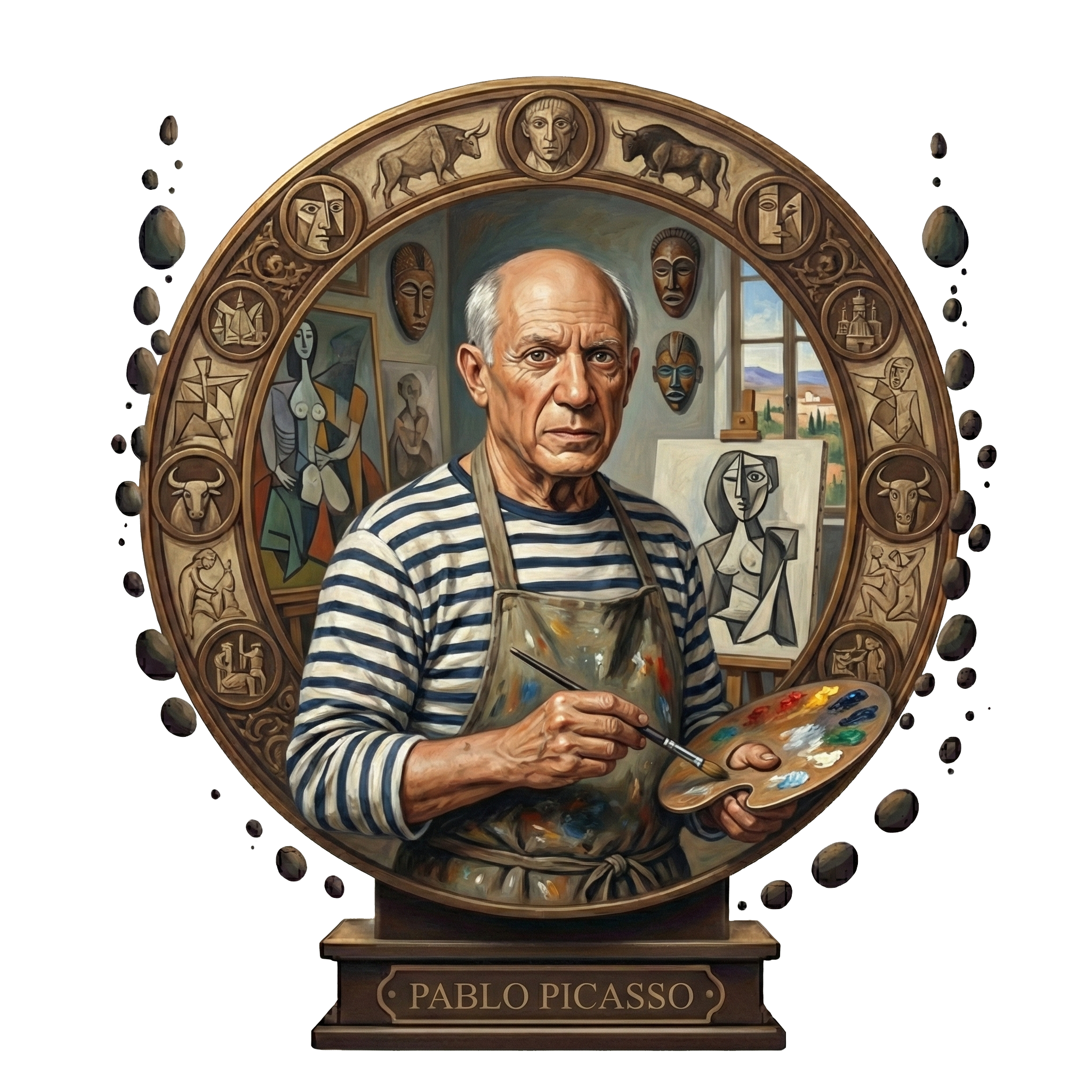
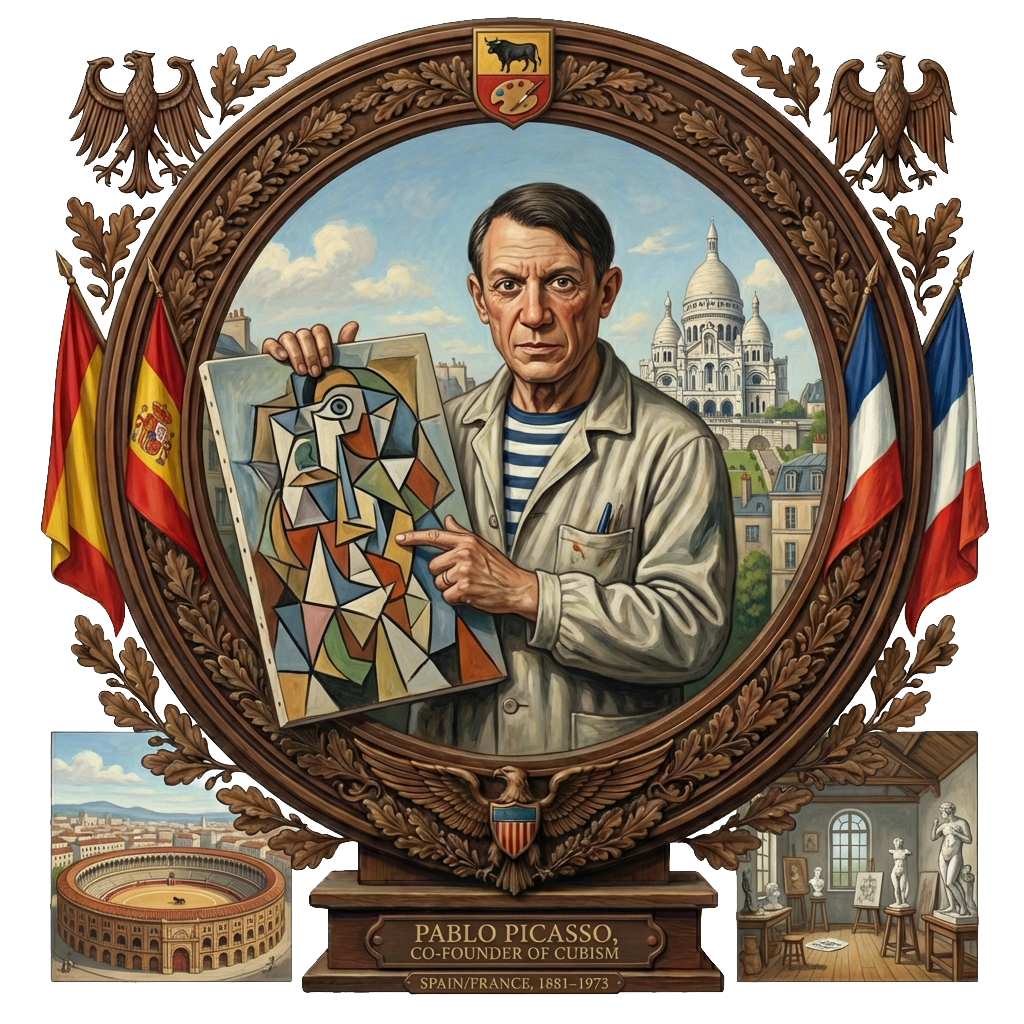
Spanish painter and sculptor who co-founded the Cubist movement and revolutionized 20th-century modern art.
At a glance
- Born
- 1881 CE
- Died
- 1973 CE
- Era classification
- 91
- Homeland
- Spain/France
- Period
- 1881–1973
- Field
- Arts & Architecture
- Language
- Spanish
- Religion
- Atheist
- Gender
- male
Biography
Born in Málaga, Spain, in 1881, Pablo Ruiz Picasso demonstrated extraordinary artistic talent from a young age. Trained by his father, an art teacher, Picasso quickly surpassed him, mastering classical techniques before moving to Paris in 1904, which was then the epicenter of the European avant-garde.
His early work in Paris, characterized by the somber Blue Period and the more cheerful Rose Period, gave way to radical experimentation. Alongside Georges Braque, Picasso co-founded Cubism, a revolutionary approach to representing reality that shattered traditional perspective and depicted subjects from multiple viewpoints simultaneously, as seen in his groundbreaking 1907 masterpiece 'Les Demoiselles d'Avignon'.
Throughout his incredibly prolific, seven-decade career, Picasso constantly reinvented his style, exploring Neoclassicism, Surrealism, and sculpture. His passionate anti-war stance was immortalized in 'Guernica' (1937), a monumental painting depicting the bombing of a Basque town during the Spanish Civil War. Leaving behind tens of thousands of artworks, Picasso remains one of the most influential and celebrated artists in human history.
Portrayal characteristics
Saved editorial descriptions used for the reconstruction; these are not authenticated statements by the depicted person.
- Innovative
- Prolific
- Passionate
- Rebellious
- Visionary
Images & artwork 5
Connections
Diego Rivera
Artistic Contemporaries & Friends
Rivera and Picasso were colleagues in the Parisian avant-garde scene, where Rivera was a significant contributor to Cubism.
During his years in Europe, Rivera was close friends with Picasso and adopted the Cubist style for several years. Their relationship cooled after Rivera accused Picasso of plagiarizing his techniques, but they remained the two most influential figures in their respective artistic spheres.
Frida Kahlo
Mutual Admirers
Picasso met Kahlo in Paris and expressed great admiration for her portraiture skills.
When Kahlo traveled to Paris in 1939 for an exhibition, she met Picasso, who was so impressed by her talent that he claimed neither he nor Derain could paint a head as well as she could. He famously gifted her a pair of earrings shaped like ivory hands.
Diego Rivera
Contemporary Rivals
Picasso and Rivera were close friends and artistic rivals in Paris during the early 20th century.
During his 'Cubist period' in Paris, Rivera was deeply influenced by Picasso's innovations. Their relationship was marked by mutual respect and occasional friction as Rivera eventually moved toward Muralism while Picasso continued to redefine European modernism.
Frida Kahlo
Contemporary Peers
Picasso was an admirer of Kahlo's work and met her during her 1939 exhibition in Paris.
Picasso famously praised Kahlo's portraiture skills, stating in a letter to Diego Rivera that neither he nor other masters could paint a head as well as she could. He gifted her a pair of ivory hand-shaped earrings that she frequently wore in her self-portraits.
Yuri Gagarin
Artistic Tribute
Picasso, a prominent supporter of the Communist movement, created a celebrated portrait of Gagarin shortly after his 1961 spaceflight.
Following the Vostok 1 mission, Picasso was commissioned by the French Communist newspaper 'L'Humanité' to draw the cosmonaut. The resulting charcoal sketch became an iconic image in the Eastern Bloc, symbolizing the intersection of modern art and Soviet scientific triumph.
Charles de Gaulle
Cultural Contemporaries & Political Opposites
De Gaulle and Picasso were the two most towering figures in post-war France, yet they represented entirely opposite ends of the political and cultural spectrum—de Gaulle as the conservative nationalist, Picasso as the radical communist.
In the decades following World War II, Charles de Gaulle and Pablo Picasso dominated the French national consciousness in politics and art, respectively. However, their worldviews were diametrically opposed. De Gaulle was a devout Catholic, a military man, and the embodiment of traditional French patriotism. Picasso, who lived in France for most of his life, was an avant-garde provocateur and a prominent member of the French Communist Party. While de Gaulle was working to rebuild the French state and suppress communist influence during the early Cold War, Picasso was drawing the 'Dove of Peace' for Soviet-backed peace congresses. Despite their profound ideological differences, both men were fiercely independent and anti-fascist. De Gaulle's government recognized Picasso's unparalleled cultural importance, and despite Picasso's communism, the Gaullist state eventually facilitated massive exhibitions of his work, acknowledging that Picasso's genius contributed to the global grandeur of France.
Known for
- Co-founding Cubism
- Les Demoiselles d'Avignon
- Guernica
- Pioneering constructed sculpture
- Blue and Rose Periods
Episodes featuring or mentioning this figure
No eligible published episode featuring this figure is currently in the library.