



Frida Kahlo
A globally renowned Mexican painter known for her uncompromising and brilliantly colored self-portraits.
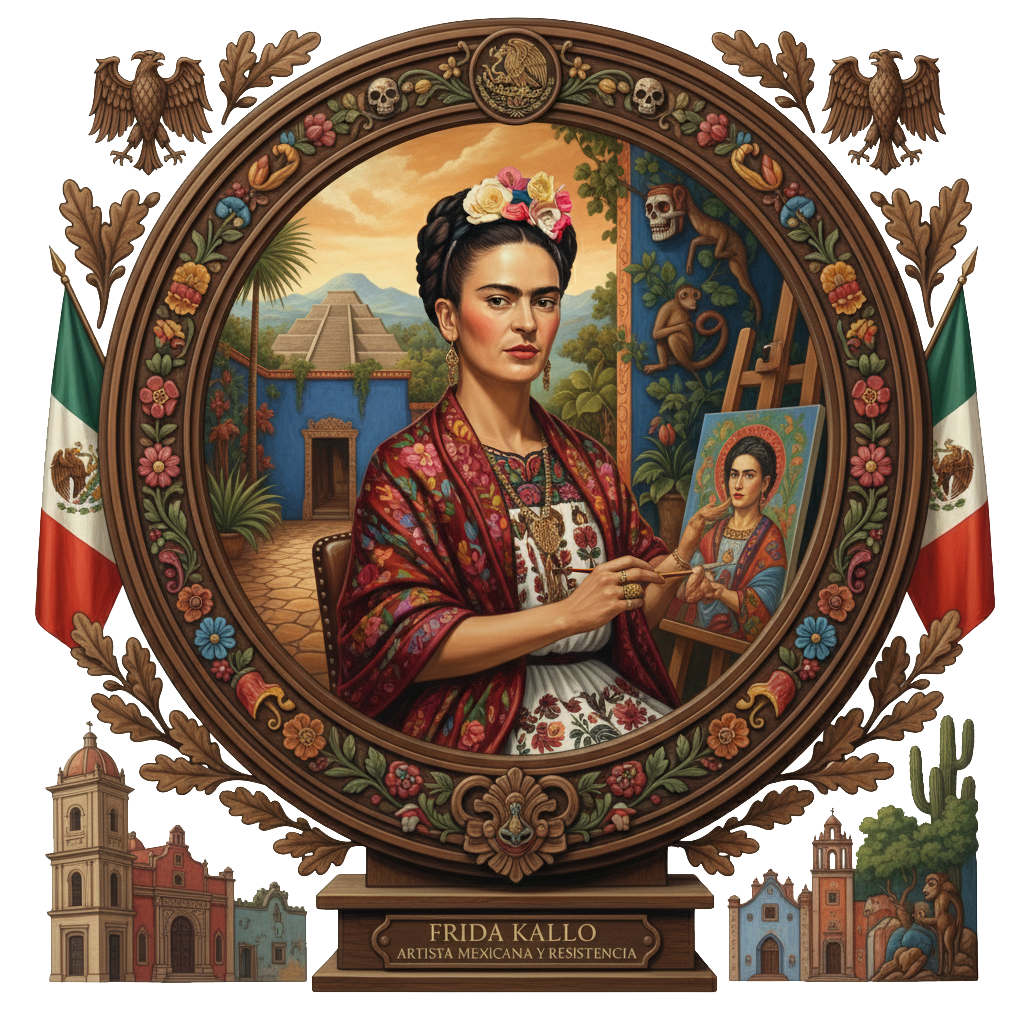
At a glance
- Born
- 1907 CE
- Died
- 1954 CE
- Era classification
- Modern
- Homeland
- Mexico
- Period
- 20th Century
- Field
- Arts & Architecture
- Language
- Spanish
- Religion
- Atheist
- Gender
- female
Biography
Magdalena Carmen Frida Kahlo y Calderón was a Mexican painter known for her many portraits, self-portraits, and works inspired by the nature and artifacts of Mexico. Inspired by the country's popular culture, she employed a naïve folk art style to explore questions of identity, postcolonialism, gender, class, and race in Mexican society.
Her paintings often had strong autobiographical elements and mixed realism with fantasy. In addition to belonging to the post-revolutionary Mexicayotl movement, which sought to define a Mexican identity, Kahlo has been described as a surrealist or magical realist.
She suffered lifelong health problems due to a traffic accident in her youth, which heavily influenced her artwork. Today, she is remembered not only as a great artist but also as an icon for Chicanos, the feminism movement, and the LGBTQ+ community.
Portrayal characteristics
Saved editorial descriptions used for the reconstruction; these are not authenticated statements by the depicted person.
- Resilient
- Passionate
- Unconventional
- Expressive
- Iconic
Images & artwork 3


Connections
Diego Rivera
Spouses & Artistic Collaborators
Rivera and Kahlo had a volatile and legendary marriage, deeply influencing each other's art and political activism.
The two artists married in 1929, divorced in 1939, and remarried in 1940. Their relationship was central to the Mexican muralism movement and the international Communist movement, with Rivera encouraging Kahlo's unique artistic voice.
Diego Rivera
Spouses & Artistic Partners
Kahlo and Rivera had a volatile, world-famous marriage and were central figures in the Mexican Muralism movement.
Rivera was Kahlo's greatest supporter and critic, and their relationship deeply influenced the themes of pain and identity in her art. They shared a commitment to communism and the promotion of 'Mexicanidad,' a movement celebrating indigenous Mexican culture.
Lázaro Cárdenas
Political Supporters
Kahlo and Rivera were vocal supporters of President Cárdenas's socialist and nationalist reforms in Mexico.
During Cárdenas's presidency, Kahlo and Rivera used their influence to secure political asylum for Leon Trotsky. Cárdenas's focus on land reform and indigenous rights aligned with the political themes found in Kahlo's life and social circles.
Pablo Picasso
Mutual Admirers
Picasso met Kahlo in Paris and expressed great admiration for her portraiture skills.
When Kahlo traveled to Paris in 1939 for an exhibition, she met Picasso, who was so impressed by her talent that he claimed neither he nor Derain could paint a head as well as she could. He famously gifted her a pair of earrings shaped like ivory hands.
Lázaro Cárdenas
Contemporary Intellectual Circle
Kahlo was a prominent figure in the Mexican artistic and political scene during Cárdenas's presidency and shared his revolutionary ideals.
Cárdenas's administration fostered a nationalist cultural environment in which Kahlo and her husband Diego Rivera thrived. Their social and political circles often overlapped with the administration's efforts to promote Mexican identity and social justice.
Octavio Paz
Contemporary Intellectuals
Paz was a younger contemporary of Kahlo and moved within the same elite artistic and intellectual circles of Mexico City.
Paz's writings on Mexican identity, particularly in 'The Labyrinth of Solitude', share thematic ground with Kahlo's exploration of 'Mexicanidad' and personal suffering. Both figures are now viewed as the twin pillars of 20th-century Mexican art and literature.
Pablo Picasso
Contemporary Peers
Picasso was an admirer of Kahlo's work and met her during her 1939 exhibition in Paris.
Picasso famously praised Kahlo's portraiture skills, stating in a letter to Diego Rivera that neither he nor other masters could paint a head as well as she could. He gifted her a pair of ivory hand-shaped earrings that she frequently wore in her self-portraits.
Known for
- Surrealist self-portraits
- Feminist icon
- Mexican folk art influence
- The Two Fridas
Episodes featuring or mentioning this figure
No eligible published episode featuring this figure is currently in the library.