



Ludwig van Beethoven
A brilliant German composer and pianist whose works bridge the Classical and Romantic eras of Western music.
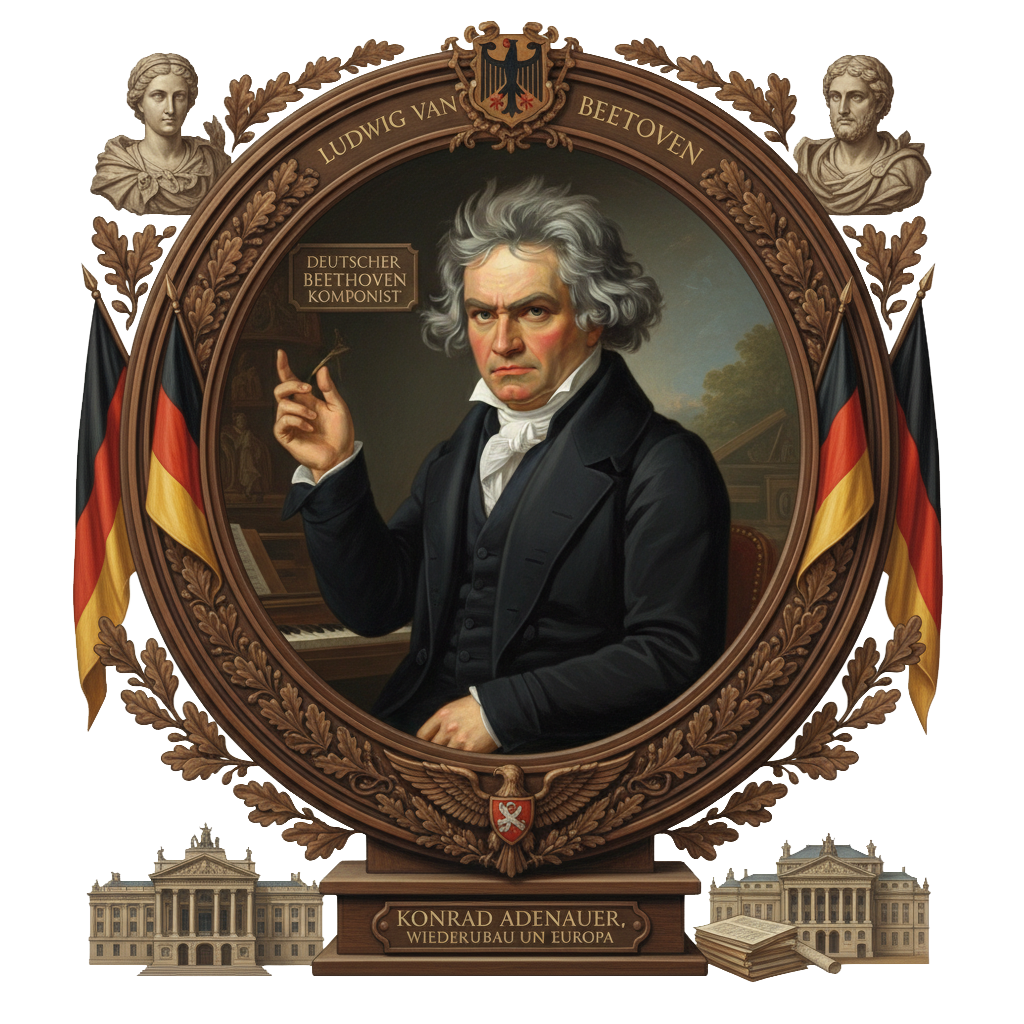
At a glance
- Born
- 1770 CE
- Died
- 1827 CE
- Era classification
- Modern
- Homeland
- Germany
- Period
- Late 18th - Early 19th Century
- Field
- Arts & Architecture
- Language
- German
- Religion
- Catholic
- Gender
- male
Biography
Ludwig van Beethoven was a German composer and pianist who remains one of the most admired and frequently performed composers in the history of Western music. Born in Bonn, his musical talent was recognized early, and he was initially taught by his father. He moved to Vienna in his early twenties, where he studied with Joseph Haydn and quickly established a reputation as a virtuoso pianist.
Beethoven's career is typically divided into three periods. His early period was heavily influenced by his predecessors Mozart and Haydn. During his middle period, often called the "Heroic" phase, he composed large-scale works that expressed heroism and struggle, including his famous Third and Fifth Symphonies. This period coincided with the onset of his tragic hearing loss, a devastating affliction that eventually left him almost completely deaf.
Despite his profound deafness, Beethoven's late period produced some of his most innovative and deeply personal works, such as the Ninth Symphony and the late string quartets. His ability to compose masterpieces without being able to hear them is considered one of the greatest feats of human genius. His legacy fundamentally transformed the symphony and paved the way for the Romantic era in music.
Portrayal characteristics
Saved editorial descriptions used for the reconstruction; these are not authenticated statements by the depicted person.
- Passionate
- Resilient
- Innovative
- Temperamental
- Genius
Images & artwork 3


Connections
Johann Sebastian Bach
Musical Influence
Beethoven was a profound admirer of Bach, famously stating, 'Not Brook (Bach) but Ocean should be his name.'
Beethoven studied Bach's 'The Well-Tempered Clavier' from a young age, and the contrapuntal complexity of Bach's work deeply informed Beethoven's late-period compositions, such as his fugues.
Johann Wolfgang von Goethe
Contemporary Admirers
Goethe and Beethoven met in 1812, though they had a complex relationship due to their differing temperaments.
Beethoven deeply admired Goethe's poetry and set several of his works to music, most notably the 'Egmont' overture. While they respected each other's genius, Goethe found Beethoven's personality 'untamed,' while Beethoven found Goethe too courtly.
Napoleon Bonaparte
Disillusioned Admirer
Beethoven initially admired Napoleon as a champion of revolutionary ideals but famously revoked his dedication of the 'Eroica' Symphony.
When Napoleon declared himself Emperor in 1804, Beethoven was so enraged by the betrayal of republican values that he scratched out the dedication to Bonaparte on his Third Symphony. This act symbolized Beethoven's complex relationship with the political upheavals of his time.
Johann Wolfgang von Goethe
Contemporary Admirers
Beethoven and Goethe met in 1812 and held a complex mutual respect for each other's genius, despite personality clashes.
Beethoven set several of Goethe's poems to music, including the 'Egmont' overture, and deeply admired Goethe's intellect. However, during their meeting in Teplitz, Goethe found Beethoven's personality 'untamed,' while Beethoven found Goethe too deferential to the aristocracy.
Johann Sebastian Bach
Influenced By
Beethoven studied Bach's keyboard works from a young age and considered him a foundational master of harmony.
Beethoven famously remarked that Bach's name (meaning 'brook') should have been 'Meer' (sea) because of his vast musical depth. He frequently incorporated Bach-inspired counterpoint and fugal structures into his late works, such as the 'Grosse Fuge'.
Immanuel Kant
Philosophical Influence
Beethoven was deeply influenced by Kant's Enlightenment philosophy, particularly regarding morality and the sublime.
Beethoven's personal notebooks contain quotes from Kant, and he was known to discuss Kantian ethics with his friends. The composer's belief in the 'moral law within us' is often cited as a driving force behind the heroic and ethical themes in his music.
Napoleon Bonaparte
Former Dedicatee
Beethoven originally dedicated his Third Symphony to Napoleon before rescinding it in anger.
Beethoven admired Napoleon as a champion of revolutionary ideals, but when Napoleon declared himself Emperor in 1804, Beethoven famously scratched out the dedication on the score of the 'Eroica' symphony, declaring that Napoleon would become a tyrant.
Known for
- Symphony No. 9
- Symphony No. 5
- Moonlight Sonata
- Für Elise
Episodes featuring or mentioning this figure
No eligible published episode featuring this figure is currently in the library.