



Michelangelo
Italian Renaissance sculptor, painter, architect, and poet who profoundly influenced Western art.
At a glance
- Born
- 1475 CE
- Died
- 1564 CE
- Era classification
- 88
- Homeland
- Italy
- Period
- 1475–1564 CE
- Field
- Arts & Architecture
- Language
- Italian
- Religion
- Catholic
- Gender
- male
Biography
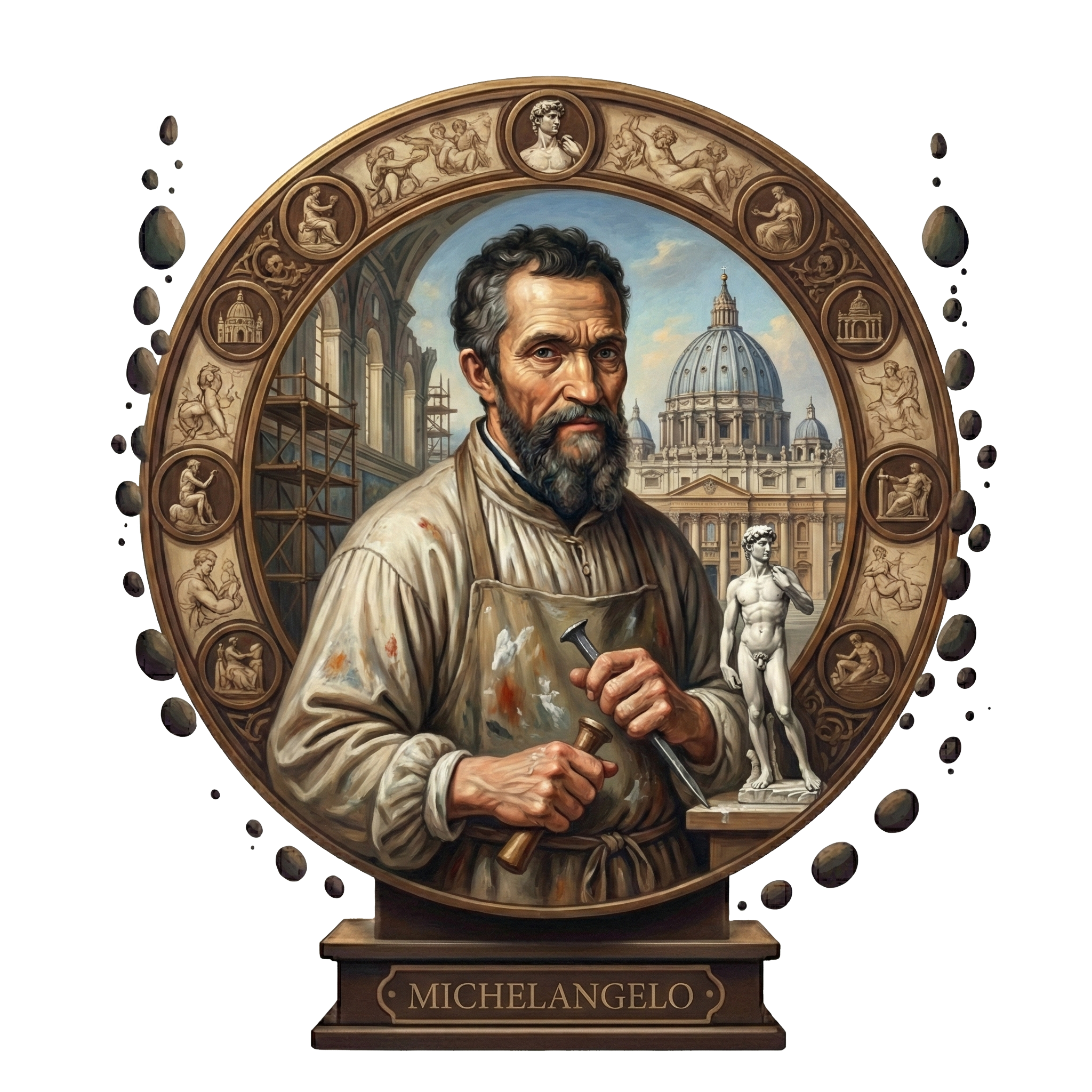
Michelangelo di Lodovico Buonarroti Simoni was born in 1475 in Caprese, within the Republic of Florence. Recognizing his extraordinary talent early on, his father apprenticed him to the painter Domenico Ghirlandaio. He later studied at the humanist academy founded by the Medici family, where he was deeply influenced by prominent philosophers and the classical antiquities housed in the Medici gardens, shaping his lifelong devotion to the beauty of the human form.
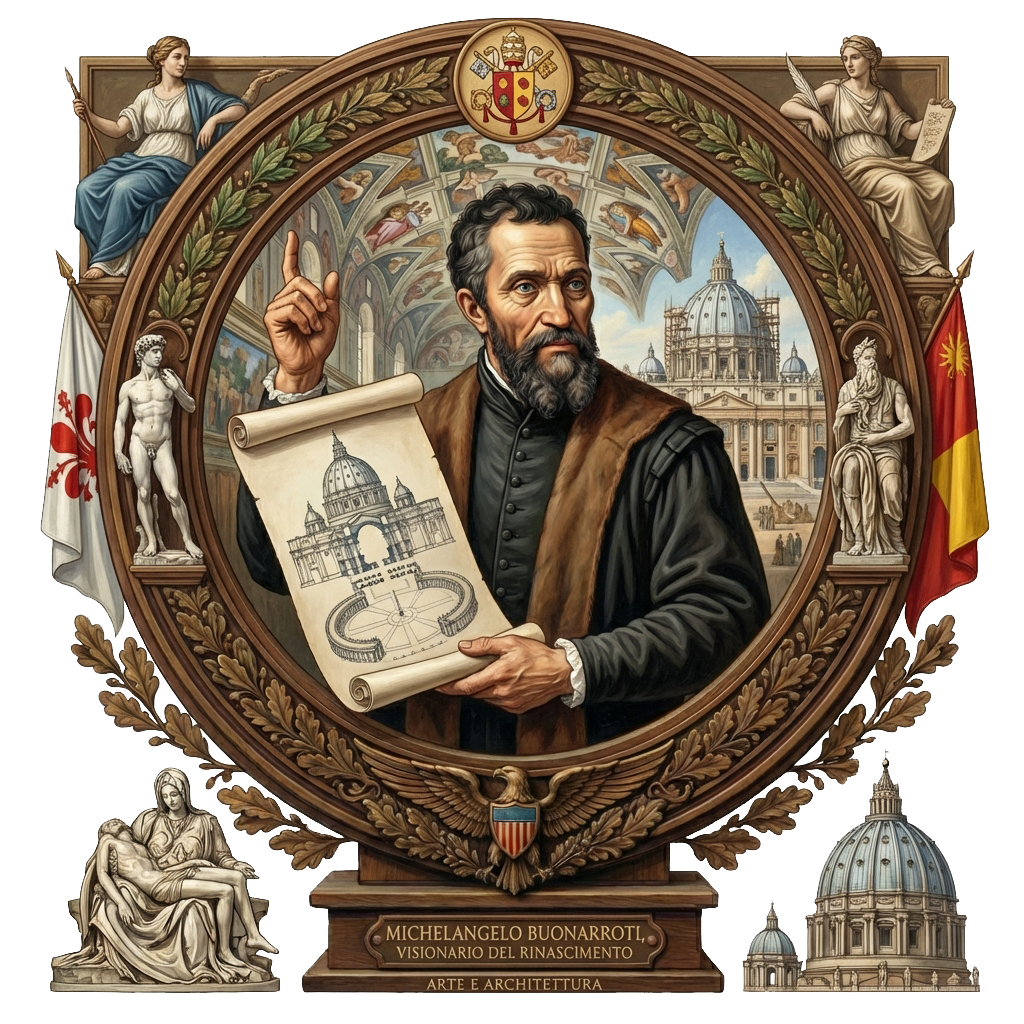
In 1499, at the age of 24, Michelangelo completed the 'Pietà' in Rome, a masterful marble sculpture of the Virgin Mary holding the dead body of Jesus that immediately established his reputation as a premier sculptor. Returning to Florence, he was commissioned to carve the colossal marble statue of 'David' (completed in 1504). This masterpiece of Renaissance art became a symbol of Florentine liberty and showcased his unparalleled understanding of human anatomy and psychological intensity.
Though he considered himself primarily a sculptor, Michelangelo was commissioned by Pope Julius II in 1508 to paint the ceiling of the Sistine Chapel. Over four grueling years, he created one of the most complex and monumental fresco cycles in the history of Western art, featuring the iconic 'Creation of Adam'. Decades later, he returned to the chapel to paint 'The Last Judgment' on the altar wall, a work that reflected the religious turbulence of the era.
In his later years, Michelangelo dedicated much of his time to architecture and poetry. He was appointed the chief architect of St. Peter's Basilica in 1546, designing its magnificent dome, which was completed after his death. Revered by his contemporaries as 'Il Divino' (The Divine One), Michelangelo was the first Western artist to have his biography published while he was alive, leaving a legacy that permanently altered the trajectory of European art.
Portrayal characteristics
Saved editorial descriptions used for the reconstruction; these are not authenticated statements by the depicted person.
- Perfectionist
- Visionary
- Intense
- Solitary
- Devout
Images & artwork 4
Connections
Leonardo da Vinci
Artistic Rivals
The two giants of the High Renaissance had a well-documented personal and professional rivalry in Florence.
They competed for major commissions, most notably the battle frescos for the Palazzo Vecchio, and held starkly different views on art and sculpture. Their rivalry was fueled by contrasting personalities—Leonardo being the polished courtier and Michelangelo the brooding, solitary genius.
Leonardo da Vinci
Artistic Rivals
The two greatest masters of the High Renaissance shared a famous and bitter personal rivalry in Florence and Rome.
Their mutual dislike was well-documented, characterized by public insults and a competition for commissions, such as the planned battle frescoes for the Palazzo Vecchio in Florence.
Niccolò Machiavelli
Contemporary Florentines
Both men were prominent citizens of Florence during its transition between the Medici rule and the Republic.
While their direct interactions are less documented, they moved in the same political and social circles; Michelangelo even worked on the city's fortifications during the same period Machiavelli was active in Florentine defense.
Mimar Sinan
Architectural Counterparts
Sinan is often historically compared to Michelangelo as the preeminent imperial architect of his respective empire.
While they never met, they were contemporaries who both mastered the use of the great dome—Michelangelo with St. Peter's Basilica and Sinan with the Süleymaniye and Selimiye Mosques.
Niccolò Machiavelli
Contemporary Florentines
Machiavelli and Michelangelo were both prominent figures in the political and cultural life of Renaissance Florence.
While their direct interactions are less documented than those with Leonardo, they both served the Florentine Republic during the same period. Machiavelli was a high-ranking diplomat while Michelangelo worked on major civic commissions like the 'David'.
Known for
- Statue of David
- Sistine Chapel ceiling
- The Pietà
- St. Peter's Basilica dome
- The Last Judgment fresco
Episodes featuring or mentioning this figure
No eligible published episode featuring this figure is currently in the library.