



Immanuel Kant
A central figure in modern philosophy who synthesized early modern rationalism and empiricism.

At a glance
- Born
- 1724 CE
- Died
- 1804 CE
- Era classification
- 79
- Homeland
- Prussia (Germany)
- Period
- 1724–1804
- Field
- Philosophy & Ideology
- Language
- German
- Religion
- Lutheran (Deist)
- Gender
- male
Biography
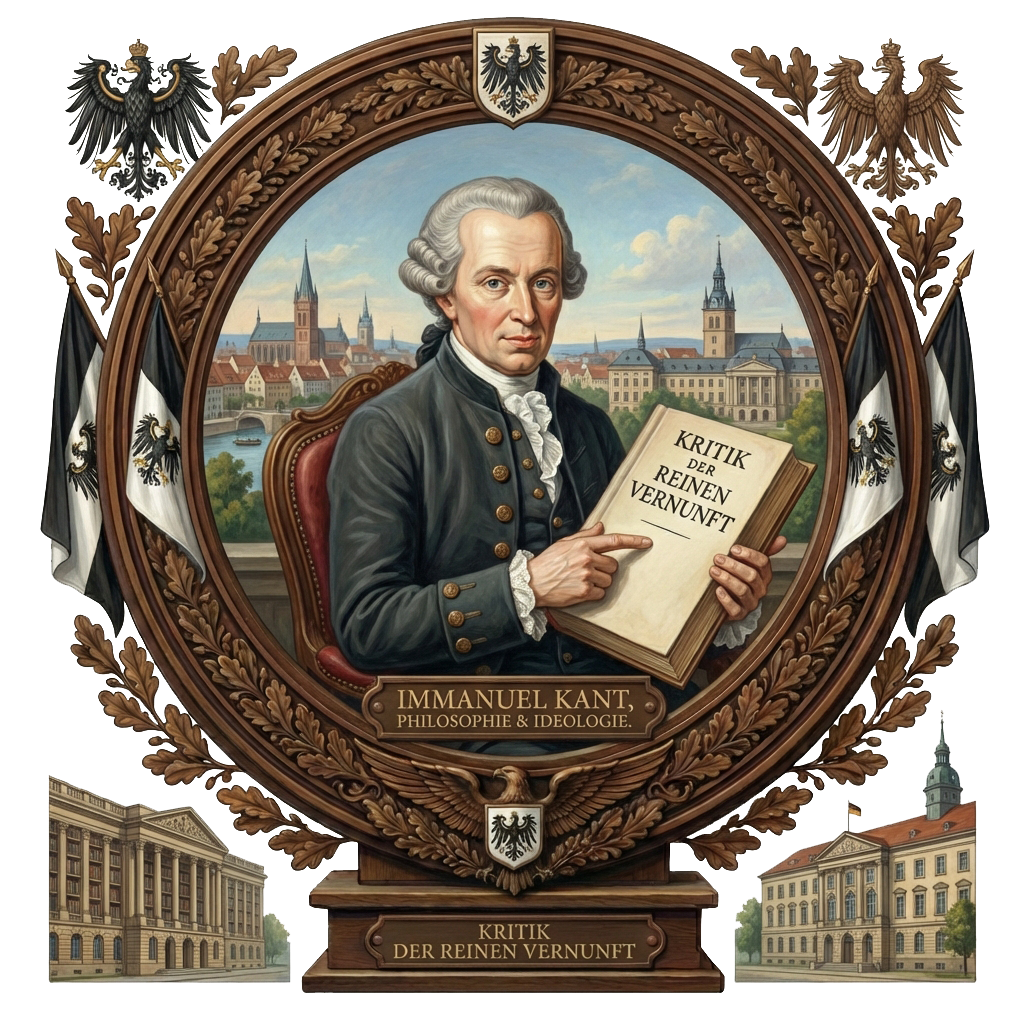
Immanuel Kant was born in 1724 in Königsberg, the capital of Prussia (now Kaliningrad, Russia), where he spent his entire life. Raised in a strict Pietist household, he developed a deep appreciation for rigorous intellectual discipline. He entered the University of Königsberg at age 16, studying philosophy, mathematics, and physics, eventually becoming a professor there and dedicating his life to academic inquiry.
Kant's philosophical breakthrough came during his 'critical period,' culminating in the publication of the 'Critique of Pure Reason' in 1781. In this monumental work, he sought to resolve the disputes between empirical and rationalist thinkers. He proposed that while all our knowledge begins with experience, it does not all arise out of experience, arguing that the human mind actively structures reality through innate categories such as space and time.
Beyond epistemology, Kant made profound contributions to moral philosophy, most notably through his formulation of the categorical imperative. He argued that morality is derived from rationality and that one should act only according to maxims that could be universally applied. His ideas laid the groundwork for deontological ethics, fundamentally shifting how subsequent generations approached duty, human rights, and moral law.
Kant's influence extends across almost every philosophical discipline, including aesthetics, teleology, and political theory. His vision of a 'league of nations' in his essay 'Perpetual Peace' anticipated modern international organizations. Dying in 1804, Kant left behind a legacy that permanently altered the trajectory of Western thought, making him one of the most indispensable philosophers of the Enlightenment.
Portrayal characteristics
Saved editorial descriptions used for the reconstruction; these are not authenticated statements by the depicted person.
- Disciplined
- Analytical
- Rigorous
- Methodical
- Systematic
- Rational
Images & artwork 4


Connections
David Hume
Intellectual Provocateur
Hume's skeptical philosophy famously 'interrupted' Kant's 'dogmatic slumber,' leading him to develop his transcendental idealism.
Kant credited Hume's critique of causality with forcing him to rethink the foundations of metaphysics. This intellectual challenge directly resulted in the publication of the 'Critique of Pure Reason,' which sought to bridge the gap between Hume's empiricism and rationalism.
Friedrich Nietzsche
Philosophical Antagonists
Nietzsche's philosophy served as a radical critique of Kant's moral and metaphysical systems.
Nietzsche rejected Kant's 'categorical imperative' and the concept of the 'thing-in-itself,' viewing them as veiled attempts to preserve Christian morality through reason. He sought to dismantle the 'back-worlds' of Kantian metaphysics in favor of life-affirmation.
Gottfried Wilhelm Leibniz
Philosophical Influence
Kant was trained in the Leibnizian-Wolffian tradition, and his 'Critique of Pure Reason' was an attempt to reconcile Leibniz's rationalism with Hume's empiricism.
Leibniz's metaphysics of monads and necessary truths provided the 'dogmatic' framework that Kant sought to transcend. Kant's distinction between analytic and synthetic judgments was a direct evolution of Leibniz's distinction between truths of reason and truths of fact.
David Hume
Philosophical Influence
Kant famously credited Hume with interrupting his "dogmatic slumber" and prompting his critical philosophy.
Hume's skepticism regarding causality and induction forced Kant to rethink the foundations of metaphysics, leading to the 'Critique of Pure Reason' where he attempted to bridge empiricism and rationalism.
Jean-Jacques Rousseau
Philosophical Influence
Kant was deeply influenced by Rousseau's views on human freedom, dignity, and moral autonomy.
Kant kept a portrait of Rousseau in his study and acknowledged that Rousseau's 'Emile' and 'The Social Contract' helped him recognize the inherent worth of every human being, shaping his categorical imperative.
Isaac Newton
Scientific Influence
Kant's early work and his mature epistemology were heavily focused on providing a philosophical foundation for Newtonian physics.
Kant viewed Newton's laws as the definitive model of scientific knowledge and sought to explain how synthetic a priori judgments made such universal laws of nature possible.
Gottfried Wilhelm Leibniz
Philosophical Predecessor
Kant was educated in the Leibnizian-Wolffian tradition and spent much of his career critiquing its metaphysical claims.
While Kant moved away from Leibniz's rationalist metaphysics, he retained many Leibnizian concepts, such as the distinction between phenomena and noumena, while rejecting the theory of monads.
John Locke
Philosophical Rival
Kant's transcendental idealism was a direct response to the empiricism championed by Locke.
Kant critiqued Locke's 'Essay Concerning Human Understanding' for failing to account for the active role the mind plays in structuring experience through categories and forms of intuition.
Johann Wolfgang von Goethe
Philosophical Influence
Goethe was significantly influenced by Kant's 'Critique of Judgment,' which helped him reconcile his scientific and poetic views of nature.
Goethe studied Kant's work extensively, finding in Kant's teleological view of nature a philosophical framework that supported his own morphological studies and his belief in the organic unity of the world.
John Locke
Philosophical Influence
Kant's 'Critique of Pure Reason' was a monumental attempt to synthesize Locke's empiricism with continental rationalism.
Kant credited the empiricist tradition (Locke and Hume) with waking him from his 'dogmatic slumber,' leading him to investigate how the mind structures experience beyond mere sensory input.
Jean-Jacques Rousseau
Influenced By
Kant was deeply influenced by Rousseau's writings on ethics and the dignity of the individual.
Kant famously claimed that reading Rousseau 'set him right' and taught him to honor human beings. He kept a portrait of Rousseau in his study and credited Rousseau's 'Emile' with shaping his own moral philosophy.
Karl Marx
Philosophical Precursor
Marx's dialectical method was rooted in the German Idealist tradition founded by Kant.
Marx's early education was steeped in Kantian philosophy, and his eventual critique of Hegel was a development of the critical tradition that Kant initiated regarding the limits of reason and the nature of reality.
Ludwig van Beethoven
Philosophical Influence
Beethoven was deeply influenced by Kant's Enlightenment philosophy, particularly regarding morality and the sublime.
Beethoven's personal notebooks contain quotes from Kant, and he was known to discuss Kantian ethics with his friends. The composer's belief in the 'moral law within us' is often cited as a driving force behind the heroic and ethical themes in his music.
Known for
- Critique of Pure Reason
- Categorical Imperative
- Transcendental Idealism
- Deontological Ethics
- Perpetual Peace theory
- Kant-Laplace nebular hypothesis
Episodes featuring or mentioning this figure
No eligible published episode featuring this figure is currently in the library.