



Jean-Jacques Rousseau
Genevan philosopher and writer whose political philosophy influenced the Enlightenment and the French Revolution.
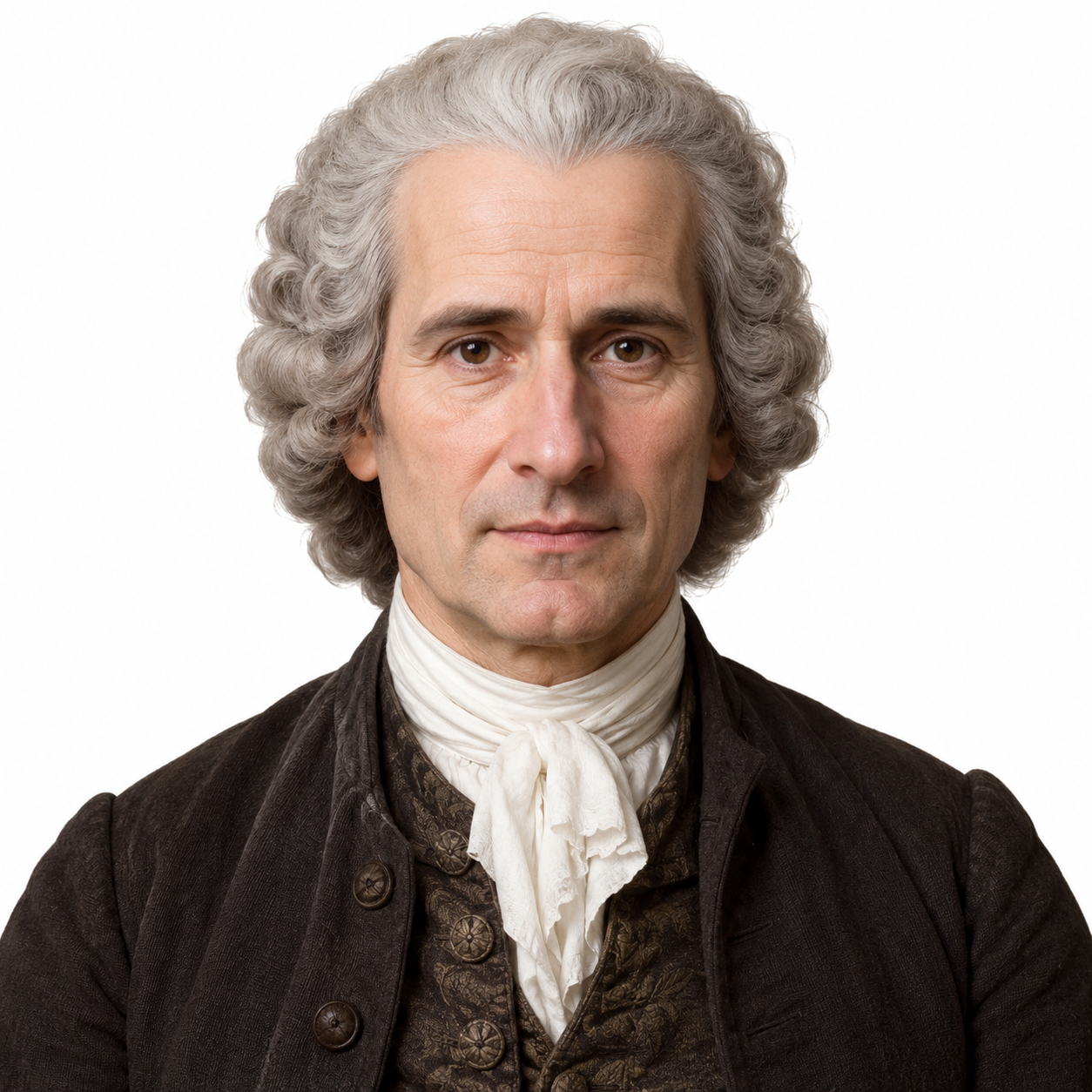
At a glance
- Born
- 1712 CE
- Died
- 1778 CE
- Era classification
- 66
- Homeland
- Republic of Geneva / France
- Period
- 18th Century
- Field
- Philosophy & Ideology
- Language
- French
- Religion
- Calvinist / Deist
- Gender
- male
Biography
Jean-Jacques Rousseau was born in Geneva in 1712. He lost his mother shortly after birth and was raised by his father, a watchmaker. At age 16, he fled Geneva and wandered through Savoy and France, eventually meeting Françoise-Louise de Warens, who became a pivotal figure in his education and early adulthood. During this period, he cultivated his deep love for nature and music, which would profoundly shape his later philosophical outlook.
Rousseau rose to intellectual prominence in 1750 when he won an essay contest from the Academy of Dijon for his 'Discourse on the Arts and Sciences.' In it, he controversially argued that human progress and civilization had corrupted inherent human virtue and morality. This marked his entry into the intellectual circles of the French Enlightenment, though he frequently clashed with contemporaries like Voltaire and Diderot due to his contrarian views on society and his increasingly reclusive nature.
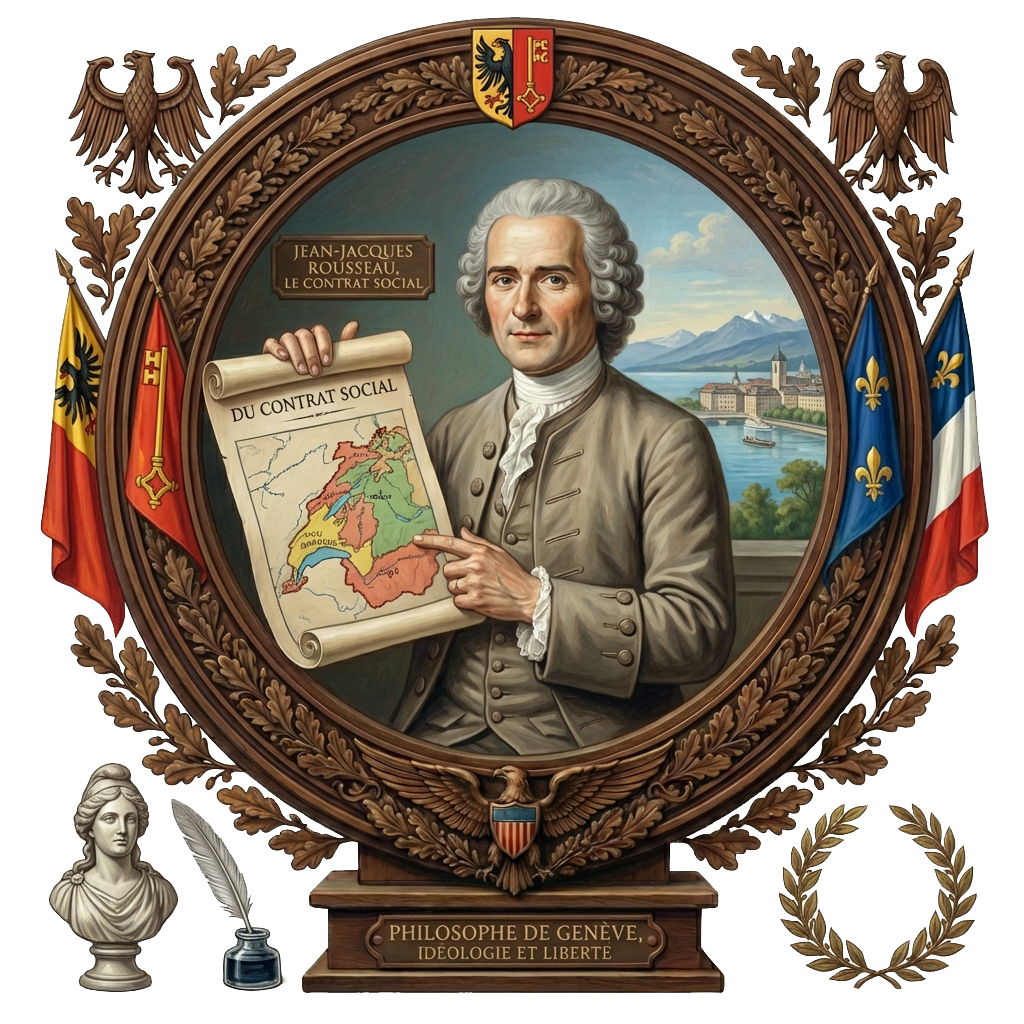
The year 1762 saw the publication of his two most significant works: 'The Social Contract' and 'Emile, or On Education.' 'The Social Contract' famously declared that 'man is born free, and everywhere he is in chains,' advocating for a system of direct democracy based on the 'general will' of the people. Meanwhile, 'Emile' revolutionized educational theory by emphasizing natural development and experiential learning over strict, dogmatic discipline.
His controversial writings led to his works being banned and burned in Paris and Geneva, forcing him into years of restless exile. He spent his final years writing introspective and autobiographical works, most notably 'Confessions,' which pioneered the modern autobiography by exploring his personal flaws and emotions with unprecedented candor. Rousseau died in 1778, leaving a profound legacy that shaped Romanticism, modern political thought, and the ideological foundations of the French Revolution.
Portrayal characteristics
Saved editorial descriptions used for the reconstruction; these are not authenticated statements by the depicted person.
- Passionate
- Contrarian
- Introspective
- Idealistic
- Rebellious
- Sensitive
Images & artwork 4


Connections
David Hume
Contemporary Friends & Rivals
Hume hosted Jean-Jacques Rousseau in England to protect him from persecution, though their relationship ended in a bitter public feud.
In 1766, Hume brought Rousseau to Britain to escape legal troubles in France and Switzerland. However, Rousseau's increasing paranoia led him to believe Hume was part of a conspiracy against him, resulting in a series of public letters that captivated the European intellectual community.
Immanuel Kant
Philosophical Influence
Kant was deeply influenced by Rousseau's views on human freedom, dignity, and moral autonomy.
Kant kept a portrait of Rousseau in his study and acknowledged that Rousseau's 'Emile' and 'The Social Contract' helped him recognize the inherent worth of every human being, shaping his categorical imperative.
Voltaire
Philosophical Rivals
The two most famous figures of the French Enlightenment, they held fundamentally opposing views on progress, religion, and society.
Voltaire championed reason and the benefits of civilization, while Rousseau argued that society and the arts corrupted human nature. Their mutual animosity was legendary, involving public insults and bitter correspondence throughout their lives.
Immanuel Kant
Influenced By
Kant was deeply influenced by Rousseau's writings on ethics and the dignity of the individual.
Kant famously claimed that reading Rousseau 'set him right' and taught him to honor human beings. He kept a portrait of Rousseau in his study and credited Rousseau's 'Emile' with shaping his own moral philosophy.
David Hume
Acquaintances & Rivals
Hume provided refuge for Rousseau in England during his exile from France, though the relationship ended in a bitter feud.
Rousseau's increasing paranoia led him to believe Hume was part of a conspiracy against him. The resulting public quarrel between the two philosophers became a major intellectual scandal across Europe.
Thomas Jefferson
Philosophical Influence
Rousseau's concepts of the 'social contract' and 'popular sovereignty' influenced Jefferson's political thought.
While Jefferson was more directly influenced by Locke, Rousseau's ideas on the inherent rights of man and the collective will of the people resonated within the democratic ideals Jefferson championed in the United States.
John Locke
Philosophical Successor
Rousseau built upon and critiqued Locke's earlier theories regarding the social contract and education.
In 'The Social Contract', Rousseau expanded on Locke's ideas of civil society but argued for a more radical form of direct democracy and the 'general will' as opposed to Locke's emphasis on individual property rights.
Napoleon Bonaparte
Philosophical Influence
In his youth, Napoleon was a fervent admirer of Rousseau's social and political theories.
Napoleon heavily annotated Rousseau's 'The Social Contract' and 'Emile' during his early military years. While his later autocratic rule diverged from Rousseau's ideals of the 'general will,' the philosopher's concepts of equality and meritocracy remained foundational to the Napoleonic Code.
Voltaire
Philosophical Rivals
Voltaire and Rousseau were the two most influential figures of the French Enlightenment but held deeply opposing views on society and human nature.
While both critiqued the status quo, Voltaire championed reason and civilization, whereas Rousseau emphasized emotion and the 'noble savage.' Their relationship was marked by public disagreements and personal animosity, particularly regarding Rousseau's 'Discourse on Inequality'.
Alexis de Tocqueville
Major Intellectual Influence
Rousseau was one of the most profound intellectual influences on Tocqueville, shaping his understanding of equality, society, and the human condition.
Alexis de Tocqueville famously wrote to a friend that there were three authors he lived with every day: Pascal, Montesquieu, and Jean-Jacques Rousseau. Rousseau's exploration of inequality and the state of nature provided the philosophical bedrock for Tocqueville's own sociological inquiries. However, their relationship was also one of profound tension. While Rousseau championed the 'General Will' as the ultimate expression of democratic sovereignty, Tocqueville saw in this very concept the seeds of the 'tyranny of the majority.' Tocqueville's analysis of American democracy was, in many ways, an attempt to see if Rousseau's democratic ideals could be realized without descending into the authoritarianism that characterized the French Revolution, which had been heavily inspired by Rousseau's writings.
Charles de Gaulle
Ideological Influence
De Gaulle's political methodology, particularly his use of national referendums to bypass parliament, was deeply rooted in Jean-Jacques Rousseau's concept of the 'general will.'
The political philosophy of Jean-Jacques Rousseau, particularly his articulation of the 'general will' in 'The Social Contract', profoundly influenced Charles de Gaulle's approach to governance. De Gaulle harbored a deep distrust of political parties, which he believed represented divisive, sectarian interests that fractured the nation. Instead, he sought a direct, unmediated relationship with the French people. This Rousseauian ideal was institutionalized in the Constitution of the Fifth Republic, which de Gaulle designed to elevate the President above partisan politics as the embodiment of the nation. De Gaulle's frequent use of referendums to legitimize his policies and constitutional changes was a direct application of Rousseau's belief that sovereignty resides in the people as a whole. When de Gaulle resigned in 1969 after losing a referendum, it was the ultimate expression of this philosophy: having lost the mandate of the general will, he believed he no longer had the right to rule.
Known for
- The Social Contract
- Emile, or On Education
- Concept of the General Will
- Discourse on Inequality
- Confessions (Autobiography)
Episodes featuring or mentioning this figure
No eligible published episode featuring this figure is currently in the library.