



Alexis de Tocqueville
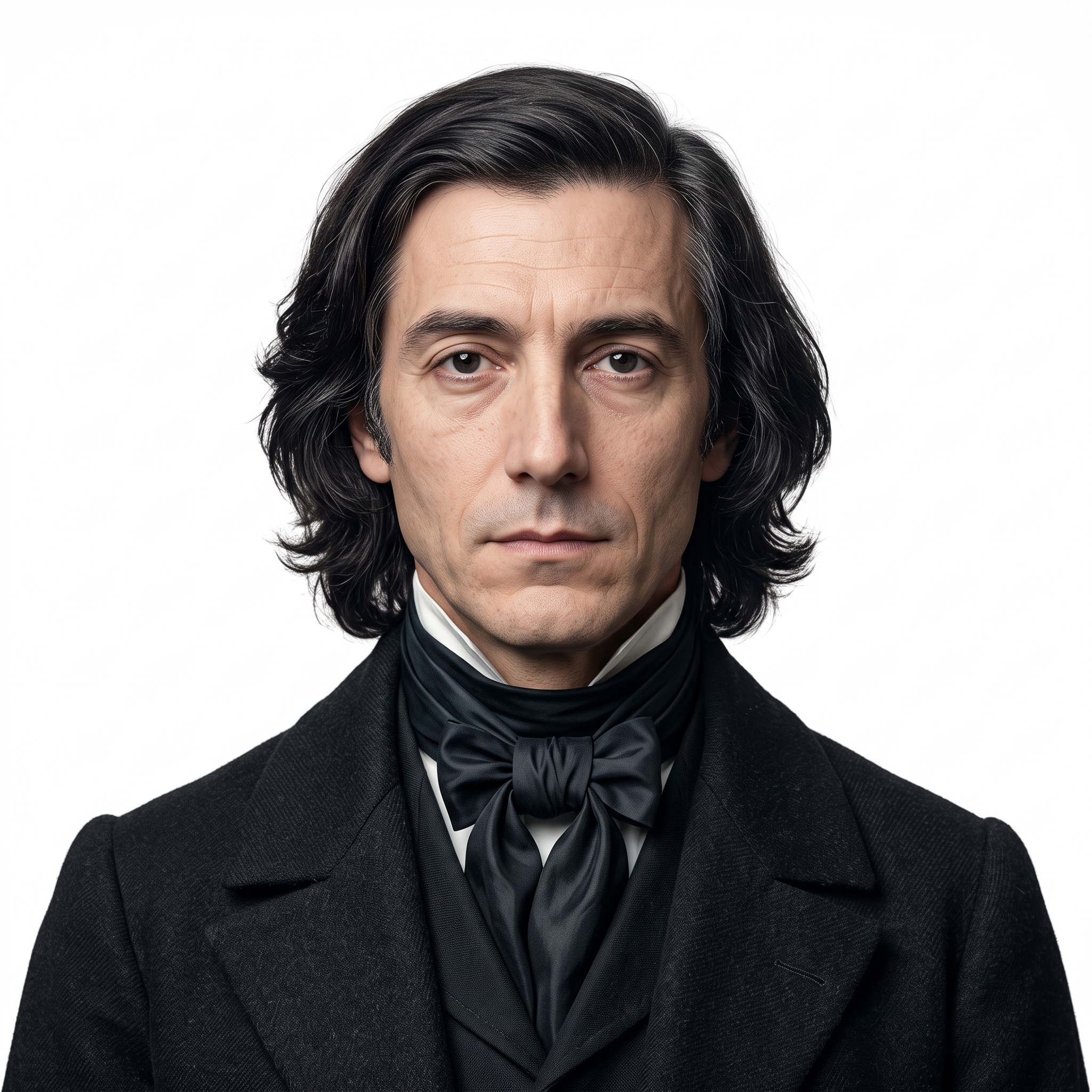
A French aristocrat and political scientist best known for his insightful analysis of American democracy and society.
At a glance
- Born
- 1805 CE
- Died
- 1859 CE
- Era classification
- Modern
- Occupation
- Political Scientist
- Homeland
- France
- Period
- 19th Century
- Field
- Philosophy & Ideology
- Language
- French
- Religion
- Catholic
- Gender
- male
Biography
Alexis de Tocqueville was a French aristocrat, diplomat, and political scientist who is most famous for his work "Democracy in America." Born into a noble family that had narrowly escaped the French Revolution's guillotine, he grew up in a France transitioning between monarchy and republicanism. This background gave him a unique perspective on the inevitable rise of equality and the decline of aristocratic privilege.
In 1831, Tocqueville and his friend Gustave de Beaumont were sent by the French government to study the American prison system. However, Tocqueville used the opportunity to conduct a much broader study of American society, politics, and culture. He was fascinated by how the United States managed to balance liberty and equality, two forces he believed were often in tension. His observations resulted in his masterpiece, published in two volumes in 1835 and 1840.
Beyond his writings on America, Tocqueville was an active participant in French politics. He served as a member of the Chamber of Deputies and briefly as Minister of Foreign Affairs in 1849. He was a staunch advocate for civil liberties and parliamentary government, often finding himself at odds with both the radical left and the authoritarian right. His later work, "The Old Regime and the Revolution," explored the origins of the French Revolution, arguing that it was a continuation of the centralization of power begun under the monarchy.
Tocqueville's legacy lies in his prophetic warnings about the "tyranny of the majority" and the potential for democratic societies to succumb to a soft form of despotism through social conformity and administrative centralization. He emphasized the importance of "intermediary institutions" like associations and local government in preserving freedom. Today, he remains one of the most cited political thinkers for understanding the dynamics of modern democracy.
Portrayal characteristics
Saved editorial descriptions used for the reconstruction; these are not authenticated statements by the depicted person.
- Analytical
- Observant
- Aristocratic
- Prophetic
- Classical Liberal
- Intellectually curious
Images & artwork 4


Connections
Jean-Jacques Rousseau
Major Intellectual Influence
Rousseau was one of the most profound intellectual influences on Tocqueville, shaping his understanding of equality, society, and the human condition.
Alexis de Tocqueville famously wrote to a friend that there were three authors he lived with every day: Pascal, Montesquieu, and Jean-Jacques Rousseau. Rousseau's exploration of inequality and the state of nature provided the philosophical bedrock for Tocqueville's own sociological inquiries. However, their relationship was also one of profound tension. While Rousseau championed the 'General Will' as the ultimate expression of democratic sovereignty, Tocqueville saw in this very concept the seeds of the 'tyranny of the majority.' Tocqueville's analysis of American democracy was, in many ways, an attempt to see if Rousseau's democratic ideals could be realized without descending into the authoritarianism that characterized the French Revolution, which had been heavily inspired by Rousseau's writings.
Karl Marx
Ideological Opponents & Contemporaries
As contemporaries who both analyzed the 1848 revolutions, Tocqueville and Marx represent the two great, opposing ideological poles of the 19th century: classical liberalism and communism.
Tocqueville and Karl Marx were both in Paris during the turbulent Revolution of 1848, and both wrote seminal accounts of the events (Tocqueville in his 'Recollections' and Marx in 'The Eighteenth Brumaire of Louis Bonaparte'). They observed the exact same historical phenomena but drew diametrically opposed conclusions. Marx viewed the uprising as a necessary step in the class struggle toward a communist utopia, despising the bourgeoisie. Tocqueville, an aristocratic liberal serving in the French government, viewed the socialist uprising as a terrifying threat to liberty and property, actively supporting its suppression to save the republic. While Marx believed the ultimate historical conflict was between classes (capital and labor), Tocqueville believed the defining struggle of modernity was the tension between equality and liberty.
Alexander Hamilton
Intellectual Influence
Tocqueville relied heavily on the writings of Alexander Hamilton, particularly 'The Federalist Papers,' to understand and explain the American constitutional system.
When writing 'Democracy in America,' Tocqueville needed to explain the complex mechanics of American federalism to a French audience accustomed to centralized power. He turned extensively to 'The Federalist Papers,' heavily citing Alexander Hamilton. Tocqueville deeply admired Hamilton's constitutional architecture, particularly his arguments for a strong, independent judiciary as a bulwark against the passions of the democratic mob. Hamilton's vision of a balanced republic that could check the 'tyranny of the majority' perfectly aligned with Tocqueville's own political anxieties. Through Tocqueville's masterpiece, Hamilton's pragmatic institutional designs were introduced to European political philosophy as the premier solution to the dangers of unchecked democratic equality.
Thomas Jefferson
Subject of Study & Philosophical Resonance
Tocqueville viewed Jefferson as the greatest apostle of American democracy, frequently citing him to validate his own warnings about the dangers of legislative tyranny.
In 'Democracy in America,' Tocqueville frequently quotes Thomas Jefferson, whom he considered the most powerful advocate for democratic equality. Interestingly, Tocqueville used Jefferson's own words to support his famous warning about the 'tyranny of the majority.' He cited Jefferson's letters pointing out that the tyranny of the legislature was the most immediate danger to the American republic. Furthermore, Jefferson's deep belief in the 'ward system'—the idea that local, decentralized administration is the best school for republican virtue—heavily influenced Tocqueville's famous praise of the New England township. Both men believed that without robust local self-government, a centralized democratic state would inevitably slide into despotism.
Napoleon Bonaparte
Subject of Historical Critique
Napoleon Bonaparte's centralized administrative state was the primary target of Tocqueville's historical critique in his later work, 'The Old Regime and the Revolution.'
Tocqueville's family suffered immensely during the French Revolution, and he viewed the subsequent rise of Napoleon Bonaparte as a tragedy for French liberty. In his masterpiece 'The Old Regime and the Revolution,' Tocqueville argued that Napoleon did not invent the highly centralized, bureaucratic French state; rather, he merely perfected the centralization that the Bourbon monarchs had begun. Tocqueville despised Napoleon's administrative apparatus because it stripped citizens of their local civic duties, replacing organic intermediary institutions with a sterile, top-down bureaucracy. For Tocqueville, Napoleon represented the ultimate manifestation of 'democratic despotism'—a system where citizens are equal in their powerlessness beneath a single, all-powerful ruler.
René Descartes
Philosophical Subject
Tocqueville famously analyzed American culture through the lens of René Descartes, arguing that Americans were the world's best practitioners of Cartesian philosophy.
In one of the most brilliant and counterintuitive chapters of 'Democracy in America,' Tocqueville opens Volume II by declaring that America is the one country in the world where the precepts of René Descartes are least studied but best applied. He observed that Americans, living in a democratic society free from entrenched aristocratic traditions, naturally employed Cartesian doubt. They rejected inherited authority, class-based dogma, and ancient traditions, choosing instead to rely on their own individual reason and practical experience to navigate the world. By linking the abstract epistemology of the French philosopher to the pragmatic, everyday habits of American pioneers, Tocqueville demonstrated how democratic social conditions fundamentally alter human psychology and intellectual methods.
Abraham Lincoln
Prophetic Observer & Historical Actor
Tocqueville accurately prophesied the American Civil War over the issue of slavery, a crisis that Abraham Lincoln would later be forced to navigate.
Though they never met, Tocqueville and Abraham Lincoln are inextricably linked by the crisis of the American soul: slavery. In the 1830s, Tocqueville wrote a chillingly prophetic chapter in 'Democracy in America' stating that the presence of Black slaves was the greatest threat to the United States. He predicted that the abolition of slavery would not erase racial prejudice, but rather shift it into a fierce social and political struggle, ultimately predicting a massive, bloody conflict between the North and South. Three decades later, Abraham Lincoln became the historical actor who had to navigate the exact apocalyptic scenario Tocqueville had foreseen. Both men ultimately concluded that the American democratic experiment could not survive half-slave and half-free.
Voltaire
Philosophical Critique
Tocqueville heavily criticized Voltaire and the French Enlightenment 'philosophes' for their abstract, utopian theories, which he blamed for the radicalism of the French Revolution.
In 'The Old Regime and the Revolution,' Tocqueville offered a scathing sociological critique of Voltaire and his fellow Enlightenment intellectuals. Tocqueville argued that because the French monarchy had excluded the aristocracy and intellectuals from actual political power, writers like Voltaire were left to theorize about politics in a vacuum. Lacking practical experience in government, they developed abstract, utopian, and highly rationalist theories that disdained tradition and religion. When the French Revolution broke out, the populace adopted Voltaire's literary, anti-clerical politics as a blueprint for society. Tocqueville argued that this attempt to rebuild society from scratch based on abstract philosophy, rather than practical statecraft, directly led to the Reign of Terror.
George Washington
Historical Exemplar
Tocqueville viewed George Washington as the ultimate exemplar of republican virtue, contrasting his leadership with the disastrous leaders of the French Revolution.
Throughout his writings, Tocqueville held up George Washington as a paragon of democratic leadership. He was particularly struck by Washington's willingness to voluntarily relinquish power, a stark contrast to the military dictators and radical demagogues who hijacked the French Revolution. Tocqueville frequently referenced Washington's Farewell Address, praising his warnings against excessive partisanship and foreign entanglements. For Tocqueville, Washington proved that a democratic republic could survive if it was guided by leaders who possessed aristocratic virtues—honor, restraint, and a deep sense of civic duty—acting as a stabilizing force against the volatile passions of the democratic majority.
Aristotle
Philosophical Lineage
Tocqueville is widely regarded by political scientists as the 'modern Aristotle' due to his empirical, comparative approach to studying political regimes and civil society.
While separated by millennia, Tocqueville and Aristotle share a profound methodological and philosophical lineage. Both thinkers rejected purely utopian or abstract political theorizing, opting instead for empirical observation and comparative analysis. Just as Aristotle collected the constitutions of Greek city-states to analyze the practical mechanics of different regimes, Tocqueville traveled to America to empirically study the 'anatomy' of democracy. Both concluded that the health of a political regime depends entirely on the 'mores' (habits of the heart) of its citizens and the presence of a robust middle class. Tocqueville's focus on intermediary institutions and civic associations as the lifeblood of liberty is a direct modern continuation of Aristotle's vision of the political community.
Charles de Gaulle
Philosophical Counterpart
De Gaulle's constitutional architecture for the Fifth Republic was designed to cure the chronic political instability that Tocqueville had famously diagnosed in French democratic culture a century earlier.
Alexis de Tocqueville's profound analyses of French political sociology—particularly the tension between equality and liberty, and the French tendency toward administrative centralization coupled with revolutionary volatility—served as a backdrop to de Gaulle's statecraft. Tocqueville lamented the weakness of French civic institutions and the perpetual cycle of revolution and authoritarianism. A century later, de Gaulle faced the collapse of the Fourth Republic, which suffered from the exact parliamentary paralysis and factionalism Tocqueville had warned about. By founding the Fifth Republic, de Gaulle sought to synthesize the French desire for strong, centralized leadership with democratic legitimacy. While Tocqueville admired decentralized American democracy, de Gaulle concluded that France's unique historical temperament required a powerful executive to maintain national unity and prevent the systemic collapse that Tocqueville had so astutely chronicled.
Known for
- Author of Democracy in America
- Coined the term Tyranny of the Majority
- Author of The Old Regime and the Revolution
- Analysis of civil society and associations
- Served as French Minister of Foreign Affairs
- Pioneer of comparative political science
Episodes featuring or mentioning this figure

Does Technology Make Us More Free? Alan Turing vs Hannah Arendt
Does technological progress expand the horizon of human freedom, or does it merely perfect the machinery of administrative control?