



George Washington
The first President of the United States and the commanding general of the victorious American army.
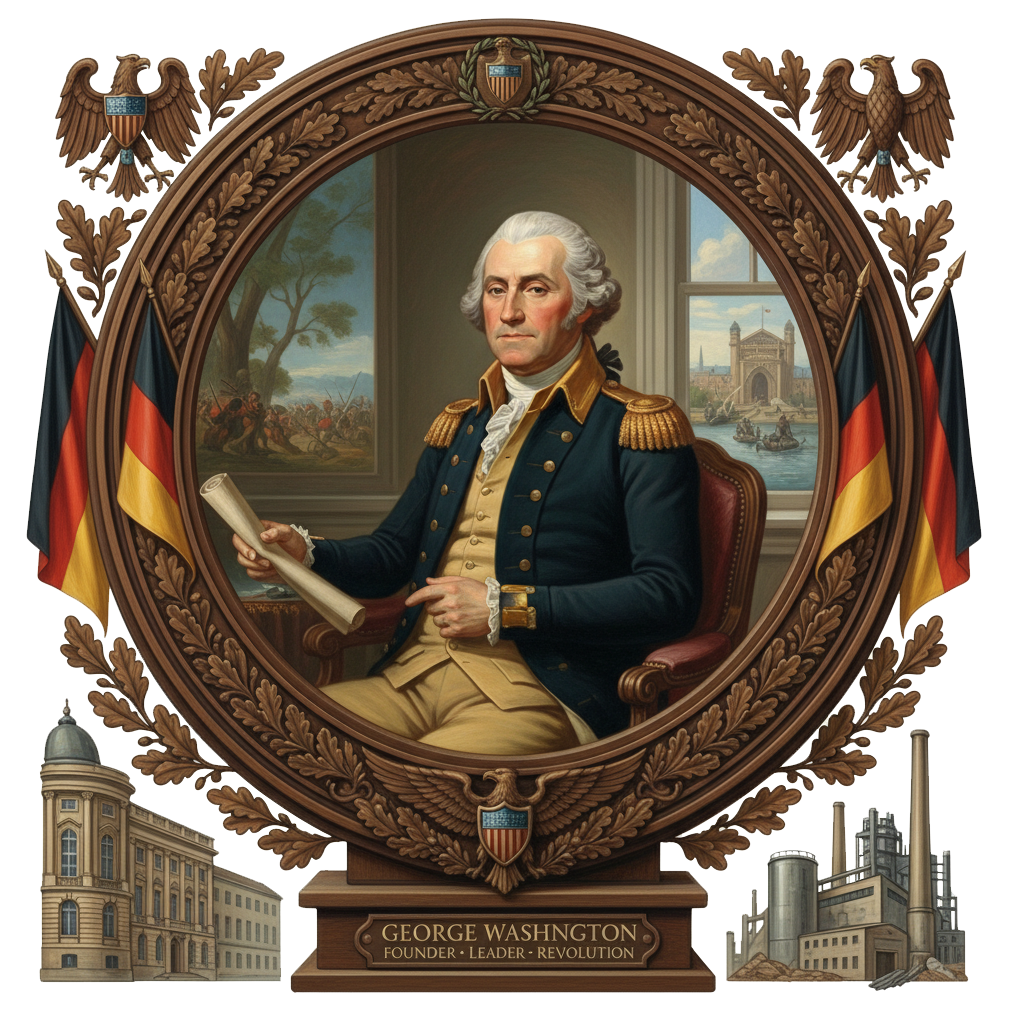
At a glance
- Born
- 1732 CE
- Died
- 1799 CE
- Era classification
- Modern
- Homeland
- United States
- Period
- 18th Century
- Field
- Politics, Leadership & War
- Language
- English
- Religion
- Christianity (Episcopalian)
- Gender
- male
Biography
George Washington was born into a prosperous Virginia planter family in 1732. He gained early military experience and recognition during the French and Indian War, serving as an officer in the colonial militia. His leadership qualities and standing among the colonies made him a natural choice for a larger role in the growing resistance against British rule.
During the American Revolutionary War, Washington was appointed commander of the Continental Army. Despite facing immense challenges, including poorly supplied troops and a formidable enemy, his strategic patience and ability to keep the army intact ultimately led to the decisive victory at Yorktown in 1781, securing American independence.
After the war, Washington voluntarily resigned his commission, establishing a crucial precedent for civilian control of the military. He later presided over the Constitutional Convention in 1787 and was unanimously elected as the first President of the United States. His two terms in office established many enduring political traditions, and his Farewell Address remains a foundational text in American political thought.
Portrayal characteristics
Saved editorial descriptions used for the reconstruction; these are not authenticated statements by the depicted person.
- Courageous
- Stoic
- Visionary
- Resolute
- Pragmatic
Images & artwork 3


Connections
Alexander Hamilton
Political Ally & Aide
Hamilton served as Washington's indispensable aide-de-camp during the Revolution and his first Treasury Secretary.
Washington relied heavily on Hamilton's administrative genius and writing skills during the war. As President, Washington consistently backed Hamilton's controversial financial plans, which established the credit of the United States and the first National Bank.
Benjamin Franklin
Contemporary Allies
Franklin and Washington were key collaborators in the founding of the United States.
Franklin provided the essential diplomatic support in France that secured the funding and military aid Washington needed to win the Revolutionary War. They later worked together at the Constitutional Convention of 1787 to stabilize the new nation's government.
Alexander Hamilton
Political Allies
Hamilton served as Washington's indispensable aide during the Revolutionary War and later as his primary economic advisor and first Secretary of the Treasury.
Washington relied heavily on Hamilton's administrative brilliance to manage the Continental Army and later to establish the financial foundations of the United States. Their partnership was the driving force behind the Federalist policies of the 1790s.
Thomas Jefferson
Political Rivals
While Jefferson served in Washington's cabinet, their differing visions for the United States led to the birth of the first American political party system.
As Secretary of State, Jefferson frequently clashed with Hamilton, forcing Washington to act as a mediator. Although Washington tried to remain above factionalism, Jefferson's opposition to federal power eventually led him to resign and form the Democratic-Republican Party.
Benjamin Franklin
Contemporary Allies
Washington and Franklin were the two most prominent figures of the American Revolution, collaborating at the Constitutional Convention.
Franklin's diplomatic success in France provided the military support Washington needed to win the war. Later, at the 1787 Constitutional Convention, Franklin's prestige and moderating influence helped secure the compromises necessary to create the office of the Presidency for Washington.
Abraham Lincoln
Historical Successor
As the first President, Washington set the precedents of the office that Lincoln later relied upon to preserve the Union during the Civil War.
Lincoln frequently invoked Washington's legacy and his Farewell Address to argue against secession. Lincoln saw himself as the protector of the 'more perfect union' that Washington had helped establish and lead.
Thomas Jefferson
Political Allies & Rivals
Jefferson served as the first U.S. Secretary of State under Washington's presidency.
While they initially worked together to establish the new nation, they eventually became estranged due to Jefferson's fierce opposition to the Federalist policies favored by Washington's administration.
Alexis de Tocqueville
Historical Exemplar
Tocqueville viewed George Washington as the ultimate exemplar of republican virtue, contrasting his leadership with the disastrous leaders of the French Revolution.
Throughout his writings, Tocqueville held up George Washington as a paragon of democratic leadership. He was particularly struck by Washington's willingness to voluntarily relinquish power, a stark contrast to the military dictators and radical demagogues who hijacked the French Revolution. Tocqueville frequently referenced Washington's Farewell Address, praising his warnings against excessive partisanship and foreign entanglements. For Tocqueville, Washington proved that a democratic republic could survive if it was guided by leaders who possessed aristocratic virtues—honor, restraint, and a deep sense of civic duty—acting as a stabilizing force against the volatile passions of the democratic majority.
Charles de Gaulle
Parallel Historical Figures
De Gaulle was frequently compared to George Washington, as both were towering military leaders who led their nations through existential crises before establishing new constitutional republics.
The historical parallels between Charles de Gaulle and George Washington are frequently drawn by historians and political scientists. Both men emerged as indispensable military leaders during their nations' darkest hours—Washington during the American Revolution, and de Gaulle during the Nazi occupation of France. After achieving military victory, both men temporarily retired from public life, only to be called back to resolve severe political crises. Just as Washington presided over the creation of the US Constitution to replace the weak Articles of Confederation, de Gaulle orchestrated the drafting of the Constitution of the Fifth Republic to replace the dysfunctional Fourth Republic. Both leaders established powerful, independent executive branches and set the precedents for the modern presidencies of their respective nations. De Gaulle himself was highly conscious of this parallel, viewing Washington as the ultimate archetype of the soldier-statesman who embodies the nation.
Known for
- First US President
- Commander of the Continental Army
- Presiding over the Constitutional Convention
Episodes featuring or mentioning this figure
No eligible published episode featuring this figure is currently in the library.