



İsmet İnönü
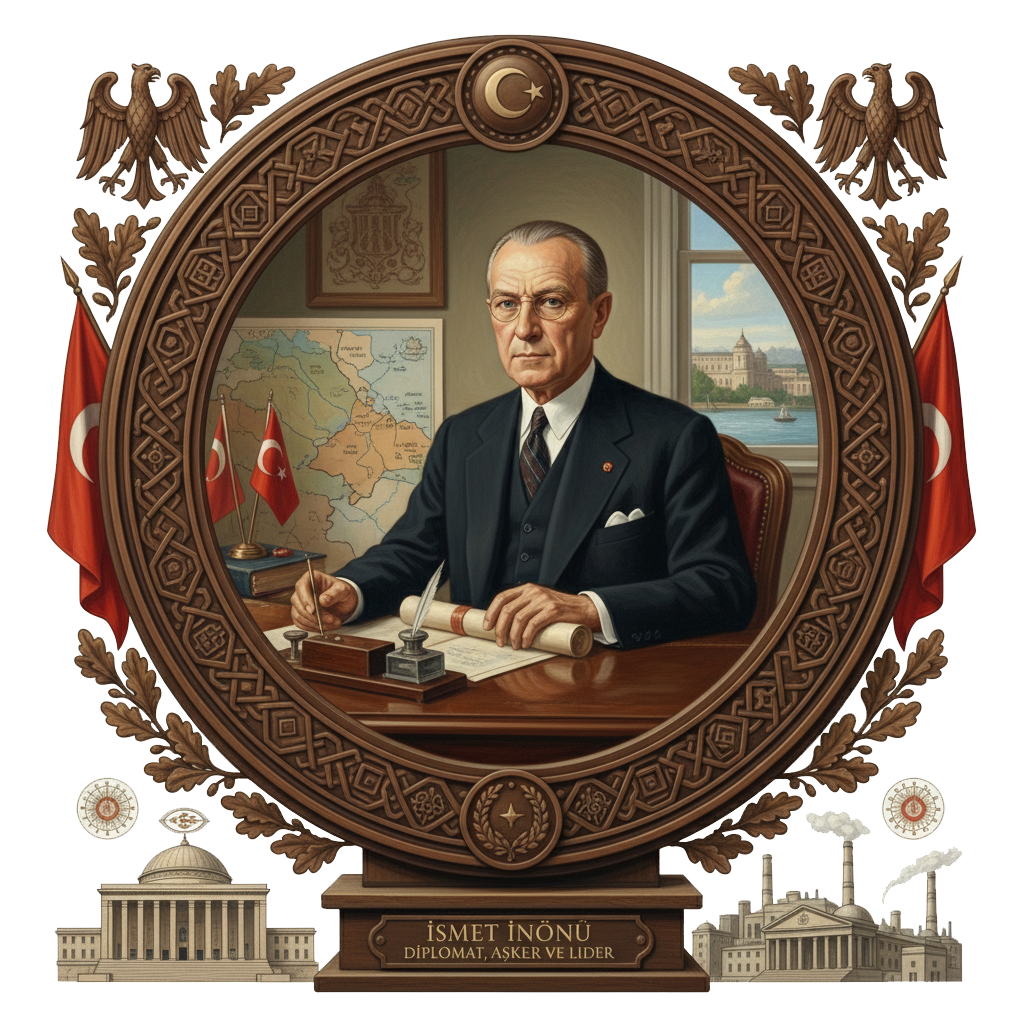
A prominent Turkish general and statesman who served as the second President of Turkey and modernized the nation.
At a glance
- Born
- 1884 CE
- Died
- 1973 CE
- Era classification
- Modern
- Homeland
- Turkey
- Period
- 20th Century
- Field
- Politics, Leadership & War
- Language
- Turkish
- Religion
- Islam
- Gender
- male
Biography
İsmet İnönü was a foundational figure in the creation and development of the modern Republic of Turkey. A distinguished military officer, he served as Mustafa Kemal Atatürk's chief of staff during the Turkish War of Independence. He commanded the nationalist forces to crucial victories at the First and Second Battles of İnönü, from which he later took his surname.
Following the establishment of the Republic, İnönü served multiple terms as Prime Minister, working closely with Atatürk to implement sweeping secular and modernizing reforms. As a skilled diplomat, he successfully negotiated the Treaty of Lausanne, which secured international recognition for the new Turkish state's borders and sovereignty.
Upon Atatürk's death in 1938, İnönü was elected as the second President of Turkey. He skillfully kept Turkey out of World War II through a policy of active neutrality. Later, he oversaw the country's transition to a multi-party democracy, peacefully handing over power after losing the 1950 elections. His legacy is defined by his unwavering commitment to the republic, diplomacy, and democratic transition.
Portrayal characteristics
Saved editorial descriptions used for the reconstruction; these are not authenticated statements by the depicted person.
- Pragmatic
- Diplomatic
- Steadfast
- Disciplined
- Patriotic
Images & artwork 3

Connections
Halide Edib Adıvar
Political Allies
She worked alongside İsmet İnönü during the Turkish National Movement and the early years of the Republic.
As a journalist and intellectual, she collaborated with İnönü and other leaders of the Turkish resistance in Ankara. Their relationship was defined by their shared commitment to Turkish independence, despite the political tensions that later emerged within the new Republic.
Mustafa Kemal Atatürk
Political Allies & Successor
İnönü was Mustafa Kemal Atatürk's closest military and political collaborator and his successor as President of Turkey.
He served as the first Prime Minister of the Republic and was the chief negotiator at the Treaty of Lausanne, later succeeding Atatürk as the 'National Chief' (Milli Şef) in 1938.
Halide Edib Adıvar
Contemporary Allies
İnönü and Adıvar were prominent figures in the Turkish National Movement during the War of Independence.
While they both served the nationalist cause against Allied occupation, Adıvar later became a critic of the one-party rule maintained by İnönü and the CHP after Atatürk's death.
Mustafa Kemal Atatürk
Political & Military Ally
İnönü was Atatürk's right-hand man, chief of staff during the War of Independence, and his successor as President.
İnönü played a crucial role in the military victories at the Battles of İnönü and represented the new Turkish Republic at the Treaty of Lausanne. He was instrumental in implementing Atatürk's secularist and modernist reforms across the nation.
Mohammad Reza Pahlavi
Regional Allies & Contemporaries
İsmet İnönü, as a leading statesman and President/Prime Minister of Turkey, interacted with the Shah as both nations navigated the Cold War. They were key partners in pro-Western regional alliances like the Baghdad Pact and CENTO.
Mohammad Reza Pahlavi and İsmet İnönü were contemporary leaders of the two most powerful non-Arab states in the Middle East during the early-to-mid Cold War. Following the legacy of Atatürk and Reza Shah, both leaders were committed to secular modernization and maintaining strong ties with the West to counter Soviet expansionism. During İnönü's tenures as President and later Prime Minister of Turkey, he and the Shah collaborated closely on regional security. This partnership was formalized through their mutual membership in the Baghdad Pact (later the Central Treaty Organization, or CENTO), a US-backed military alliance designed to contain Soviet influence in the Middle East. While their personal relationship was formal and diplomatic, their geopolitical alignment was crucial in shaping the strategic architecture of the region, with both leaders relying on American military and economic support to maintain their respective domestic and international positions.
Known for
- Serving as the second President of Turkey
- Negotiating the Treaty of Lausanne
- Commanding forces in the Turkish War of Independence
- Transitioning Turkey to a multi-party democracy
Episodes featuring or mentioning this figure
No eligible published episode featuring this figure is currently in the library.