



Khosrow I (Anushirvan the Just)
Sasanian king whose administrative reforms, military triumphs, and intellectual patronage defined a golden age.
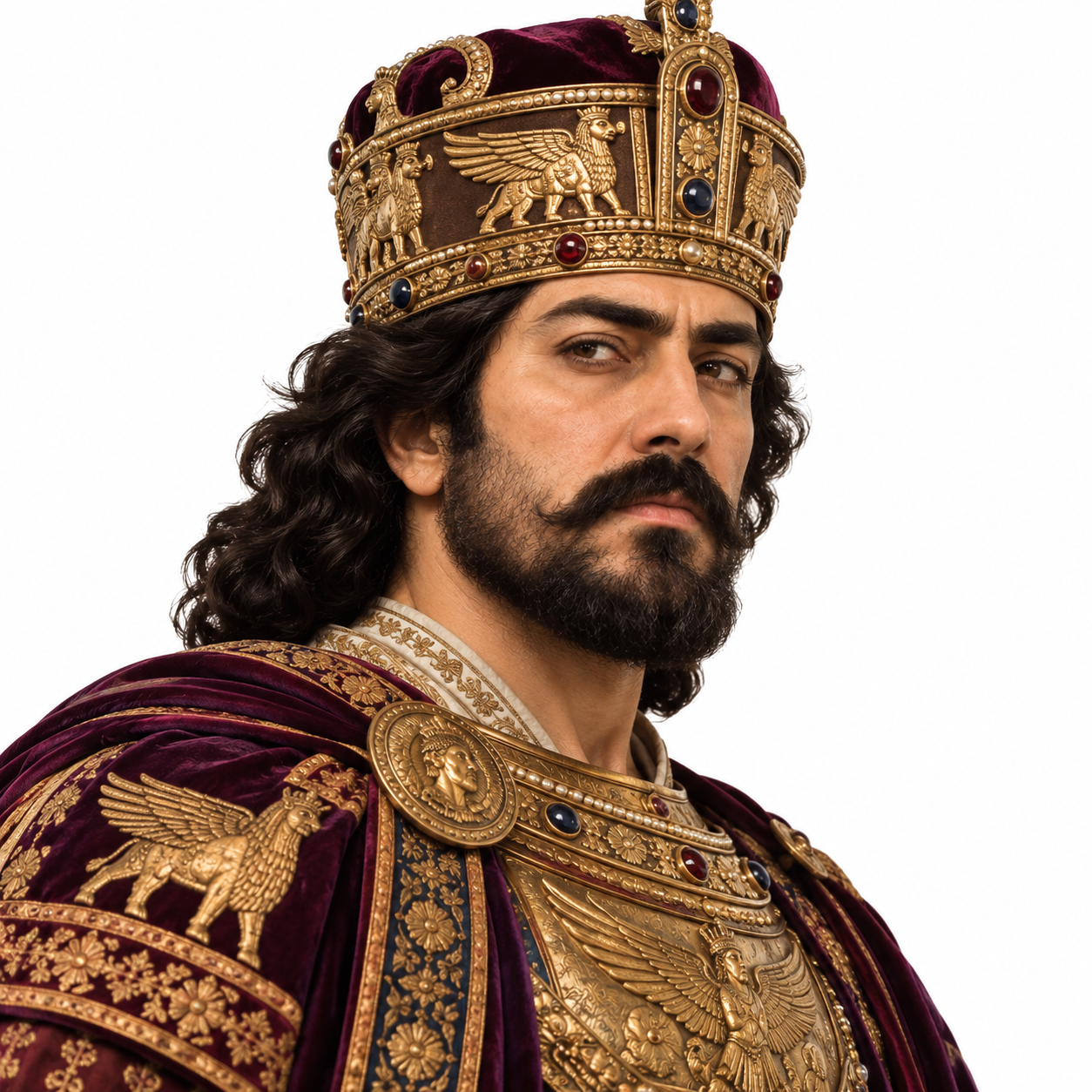
At a glance
- Born
- c. 501 CE
- Died
- 579 CE
- Era classification
- Ancient
- Occupation
- King / Queen / Emperor
- Homeland
- Sasanian Empire
- Period
- 6th century CE
- Field
- Politics, Leadership & War
- Language
- Middle Persian
- Religion
- Zoroastrianism
- Gender
- male
Biography
Khosrow I, known by the epithet Anushirvan ('of the immortal soul') and remembered in Persian tradition as 'the Just' (Dadgar), ascended the Sasanian throne in 531 CE following the death of his father, Kawad I. His rise occurred during an era of internal upheaval caused by the radical social and religious movement of the Mazdakites. Khosrow acted decisively to restore aristocratic order, executing Mazdak and suppressing the movement while integrating some of Kawad's progressive administrative initiatives to strengthen centralized royal authority over the feudal nobility.
His reign was defined by sweeping institutional transformations. Khosrow implemented a standardized cadastral survey and transformed the empire's fiscal structure by replacing irregular tribute with fixed property and poll taxes, which provided predictable revenues for the royal treasury. He reorganized the imperial military, ending reliance on regional magnates by creating a standing army of lower-ranking nobles (dehqans) equipped by the state, and divided the empire's defenses into four territorial military commands, each governed by a marshal (spahbed).
On the international stage, Khosrow waged protracted wars against the Eastern Roman (Byzantine) Empire under Justinian I and his successors, sacking Antioch in 540 CE and contesting strategic territories in Lazica and Mesopotamia. To the northeast, he formed an alliance with the Western Göktürks to crush the Hephthalite Empire, securing the Sasanian eastern frontier, and later extended Persian influence south into Yemen, establishing control over Red Sea trade routes.
Beyond military conquest, Khosrow fostered an intellectual renaissance in the Sasanian realm. He welcomed Neoplatonist philosophers exiled from the closed Academy of Athens, patronized the intellectual and medical center at Gondeshapur, and ordered the translation of scientific, philosophical, and literary texts from Greek, Sanskrit, and Syriac into Middle Persian. His legacy endured through Islamic historiography as the quintessential model of royal justice and statecraft.
Portrayal characteristics
Saved editorial descriptions used for the reconstruction; these are not authenticated statements by the depicted person.
- Reforming
- Pragmatic
- Intellectually curious
- Authoritarian
- Strategic
Images & artwork 2

Known for
- Restructuring the Sasanian tax and land registry system
- Reorganizing the military into four regional commands under spahbeds
- Capturing and sacking Roman Antioch in 540 CE
- Defeating the Hephthalites in alliance with the Göktürks
- Patronizing scholarship and translations at the Academy of Gondeshapur
Episodes featuring or mentioning this figure
No eligible published episode featuring this figure is currently in the library.