



Julius Caesar
Roman general and statesman who transformed the Roman Republic into the Roman Empire.
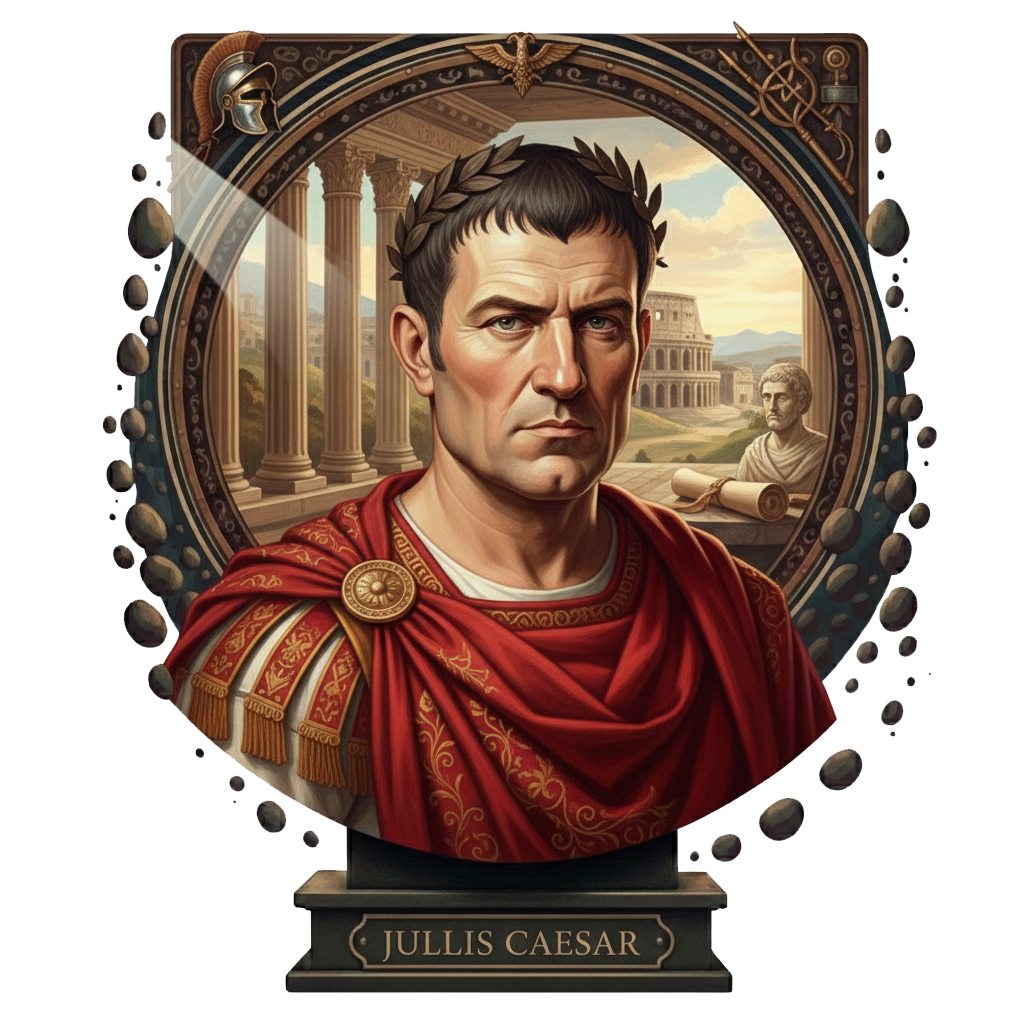
At a glance
- Born
- 100 BCE
- Died
- 44 BCE
- Era classification
- 55
- Homeland
- Roman Republic
- Period
- 100–44 BCE
- Field
- Politics, Leadership & War
- Language
- Latin
- Religion
- Roman Polytheism
- Gender
- male
Biography
Gaius Julius Caesar was born into a patrician family, the gens Julia, which claimed descent from the legendary Trojan prince Aeneas. Despite his noble lineage, his early life was fraught with danger as he navigated the volatile political landscape of the late Roman Republic. Through a combination of political acumen, immense charisma, and strategic marriages, Caesar steadily climbed the cursus honorum, eventually forming the First Triumvirate with Pompey the Great and Marcus Licinius Crassus to dominate Roman politics.
Caesar's military genius was fully realized during the Gallic Wars (58–50 BCE), where he conquered the entirety of Gaul (modern-day France) and expanded Rome's territory to the English Channel and the Rhine. He even launched the first Roman invasions of Britain. These extraordinary military successes amassed him immense wealth, a fiercely loyal veteran army, and unparalleled popularity among the Roman plebeians, deeply threatening the conservative factions within the Senate.
Ordered by the Senate to disband his army and return to Rome as a private citizen, Caesar famously crossed the Rubicon river in 49 BCE, uttering the phrase 'alea iacta est' (the die is cast) and igniting a devastating civil war. He swiftly defeated Pompey and his senatorial opponents across the Mediterranean. Upon securing total victory, Caesar centralized the Republic's bureaucracy and declared himself 'dictator perpetuo' (dictator in perpetuity), initiating sweeping social, political, and calendar reforms.
His unprecedented concentration of power and monarchical ambitions alarmed the Roman elite. On the Ides of March (March 15) in 44 BCE, Caesar was assassinated by a group of rebellious senators led by Brutus and Cassius. Rather than restoring the Republic, his murder triggered a final series of civil wars that ultimately resulted in the rise of his adopted heir, Octavian (Augustus), and the permanent establishment of the Roman Empire.
Portrayal characteristics
Saved editorial descriptions used for the reconstruction; these are not authenticated statements by the depicted person.
- Ambitious
- Charismatic
- Strategic
- Decisive
- Ruthless
- Visionary
Images & artwork 4
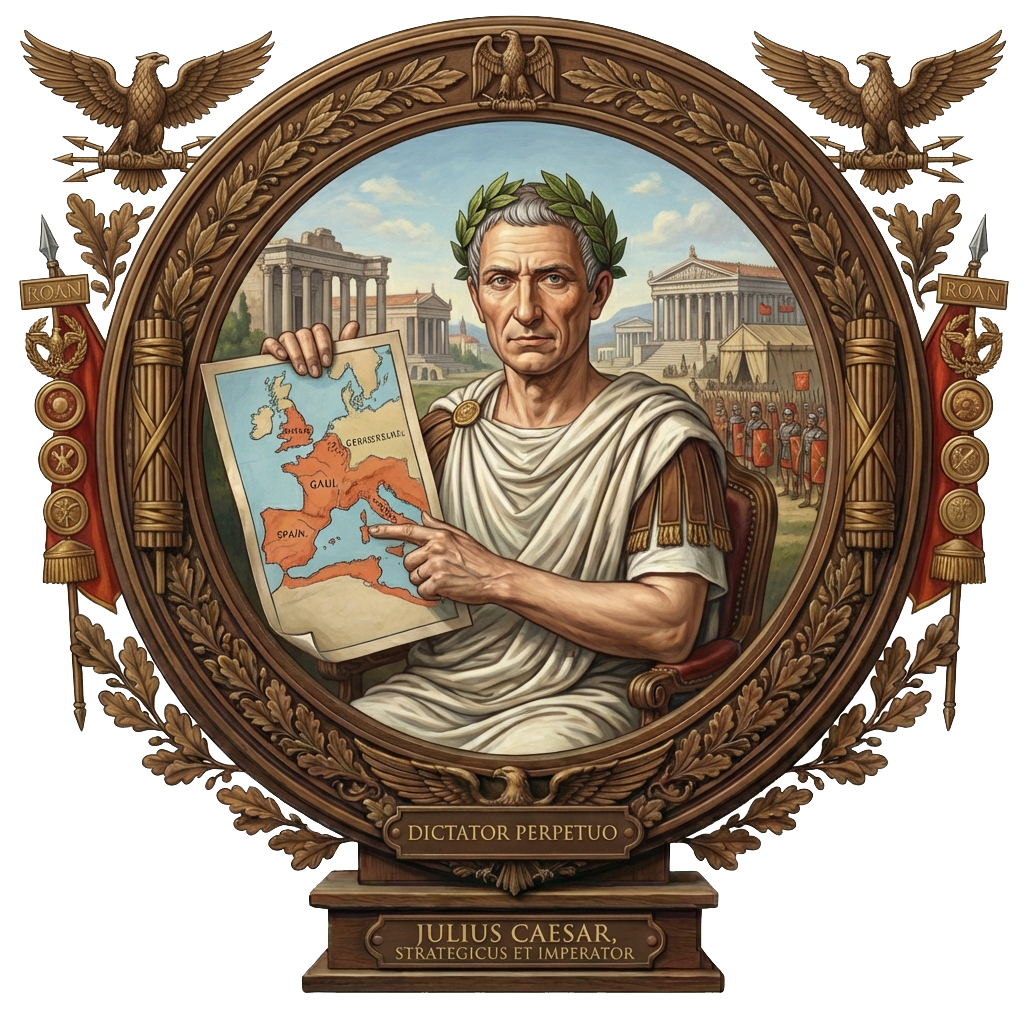
Connections
Alexander the Great
Inspiration & Rival
Caesar viewed Alexander as the ultimate standard of military achievement and political glory.
According to Plutarch, Caesar wept while reading a biography of Alexander, lamenting that at an age when Alexander had conquered the world, he himself had achieved nothing of note.
Cleopatra
Political & Romantic Allies
Cleopatra formed a strategic and romantic partnership with Caesar, which restored her to the Egyptian throne.
After Caesar arrived in Alexandria, Cleopatra famously smuggled herself into his quarters to win his support against her brother. Their alliance was crucial for both: Caesar gained access to Egypt's vast grain and wealth, while Cleopatra secured her position as Pharaoh under Roman protection.
Cleopatra
Political & Romantic Allies
Caesar formed a critical political and romantic alliance with Cleopatra, restoring her to the Egyptian throne.
During the Alexandrian War, Caesar supported Cleopatra against her brother Ptolemy XIII. Their relationship produced a son, Caesarion, and solidified Roman influence over Egypt's wealth and grain supply.
Alexander the Great
Influenced By
Caesar viewed Alexander the Great as his primary historical role model and rival for glory.
Ancient biographers like Plutarch record that Caesar wept at a statue of Alexander, lamenting that he had achieved so little by the age at which Alexander had already conquered the known world.
Napoleon Bonaparte
Inspired By
Napoleon modeled his political rise and imperial imagery after Julius Caesar.
Napoleon transitioned from a revolutionary general to a First Consul and then Emperor, mirroring Caesar's path from general to dictator. He adopted Roman symbols like the eagle and the laurel wreath to legitimize his authority through the lens of Roman history.
Niccolò Machiavelli
Historical Subject
Machiavelli used Julius Caesar as a primary case study for his theories on power and leadership.
In 'The Prince' and 'Discourses on Livy,' Machiavelli analyzed Caesar's transition from a republican general to a dictator, using him to illustrate the necessity of 'virtù' and the dangers of political corruption.
Charles de Gaulle
Historical & Literary Influence
De Gaulle, a prolific writer and military theorist, frequently drew upon Julius Caesar's campaigns in Gaul to articulate his vision of French identity, military strategy, and leadership.
Charles de Gaulle possessed a profound sense of history, tracing the origins of the French nation back to antiquity. In his writings, particularly 'France and Her Army' (1938), de Gaulle extensively analyzed Julius Caesar's conquest of Gaul. He viewed Vercingetorix's resistance against Caesar as the first manifestation of French national patriotism. However, de Gaulle also deeply admired Caesar's military genius, his decisive leadership, and his ability to impose order and civilization. The term 'Gaullism' itself, while derived from his name, carries an undeniable phonetic and historical resonance with 'Gaul,' a connection de Gaulle subtly cultivated. Furthermore, de Gaulle's political style during the Fifth Republic—relying on personal charisma, direct appeals to the populace, and the concentration of executive power—led many political scientists to describe his governance as a modern form of 'Caesarism,' echoing the Roman dictator's transformation of the Republic.
Known for
- Conquest of Gaul
- Crossing the Rubicon
- Creation of the Julian Calendar
- First Triumvirate
- Dictator in perpetuity
Episodes featuring or mentioning this figure
No eligible published episode featuring this figure is currently in the library.