



Napoleon Bonaparte
French military commander and emperor who conquered much of Europe and established the enduring Napoleonic Code.
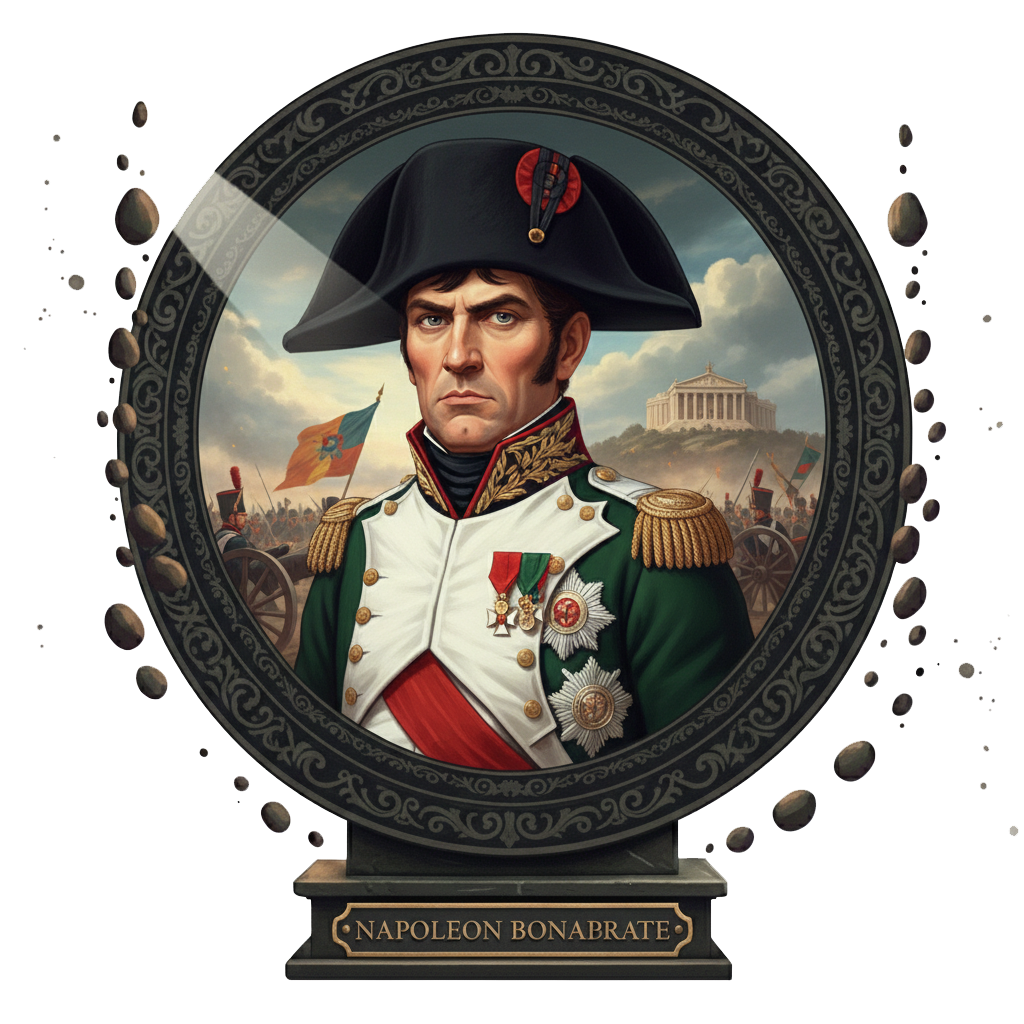
At a glance
- Born
- 15 August 1769 CE
- Died
- 5 May 1821 CE
- Era classification
- 51
- Homeland
- France (Corsica)
- Period
- 1769–1821
- Field
- Politics, Leadership & War
- Language
- French
- Religion
- Catholic (Deist)
- Gender
- male
Biography
Born in Corsica in 1769, shortly after its annexation by France, Napoleon Bonaparte attended military school in mainland France. He rose rapidly through the ranks of the French army during the French Revolution, demonstrating exceptional tactical brilliance. His successful campaigns in Italy and Egypt made him a national hero, setting the stage for his political ascent.
In 1799, Napoleon orchestrated a coup d'état, establishing himself as First Consul of the Republic. By 1804, he had consolidated his power and crowned himself Emperor of the French. Over the next decade, he led the Grande Armée to a series of historic victories at Austerlitz, Jena, and Friedland, effectively dominating continental Europe and dismantling the Holy Roman Empire.
Beyond his military conquests, Napoleon implemented sweeping administrative reforms, most notably the Napoleonic Code, which laid the administrative and judicial foundations for much of Western Europe. However, his disastrous invasion of Russia in 1812 decimated his forces. A coalition of European powers eventually defeated him, leading to his first exile to Elba in 1814.
He briefly returned to power in 1815 during the 'Hundred Days' campaign but suffered a final, crushing defeat at the Battle of Waterloo. Exiled to the remote island of Saint Helena, he spent his final years dictating his memoirs before dying in 1821. His legacy remains deeply complex, remembered simultaneously as a brilliant reformer, a military genius, and a ruthless conqueror.
Portrayal characteristics
Saved editorial descriptions used for the reconstruction; these are not authenticated statements by the depicted person.
- Ambitious
- Strategic
- Charismatic
- Authoritarian
- Visionary
- Relentless
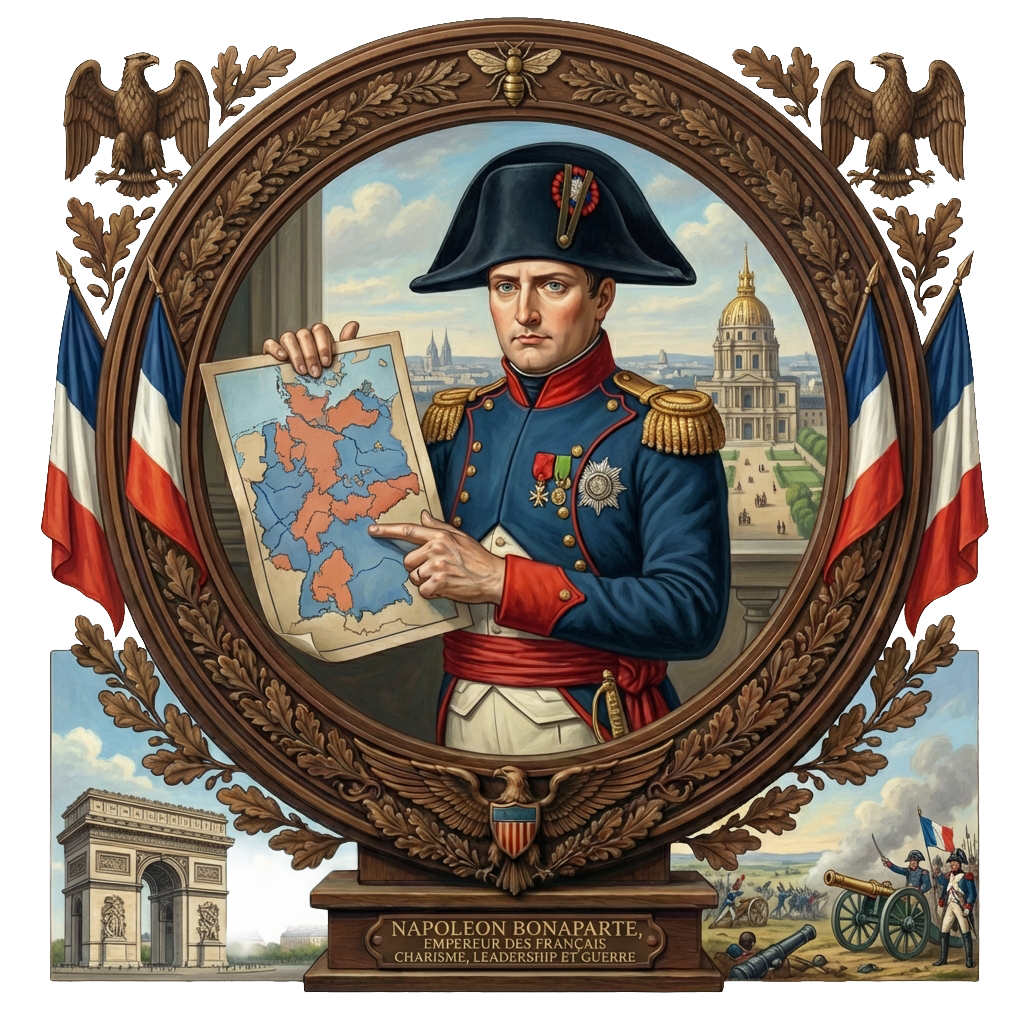
Images & artwork 4
Connections
Alexander Pushkin
Historical Subject
Pushkin wrote several poems about Napoleon, reflecting on his impact on Europe and Russia.
Pushkin's work often grappled with the 'Napoleonic' archetype of the great man of destiny, a theme that would later influence the development of the Russian novel.
Carl Friedrich Gauss
Political Opponents
Napoleon's military campaigns significantly disrupted Gauss's life and work in Göttingen.
The French occupation of Germany led to the death of Gauss's patron, the Duke of Brunswick, and forced Gauss to pay a massive war tax. Despite the conflict, French mathematicians under Napoleon's rule, such as Laplace, intervened to ensure Gauss's safety and financial stability due to his scientific genius.
Charlemagne
Historical Inspiration
Napoleon deeply admired Charlemagne and sought to recreate his pan-European empire.
Napoleon styled himself as a modern Charlemagne, even traveling to Aachen to pay respects at his tomb before his own imperial coronation. He viewed the Carolingian Empire as the blueprint for his own efforts to unify the European continent under a single legal and political system.
Johann Wolfgang von Goethe
Historical Meeting
Napoleon Bonaparte met Goethe in 1808 during the Congress of Erfurt and expressed his great admiration for Goethe's work.
Napoleon, an avid reader of 'The Sorrows of Young Werther,' famously remarked 'Vous êtes un homme' (You are a man) upon meeting the poet, and the two discussed literature and politics.
Jean-Baptiste Lamarck
Subject & Sovereign
Lamarck served as a professor at the Muséum National d'Histoire Naturelle during Napoleon's reign.
Napoleon famously dismissed Lamarck's work; when Lamarck attempted to present the Emperor with a copy of his 'Philosophie Zoologique', Napoleon publicly rebuked him, reflecting the era's skepticism toward early evolutionary ideas.
Ludwig van Beethoven
Disillusioned Admirer
Beethoven initially admired Napoleon as a champion of revolutionary ideals but famously revoked his dedication of the 'Eroica' Symphony.
When Napoleon declared himself Emperor in 1804, Beethoven was so enraged by the betrayal of republican values that he scratched out the dedication to Bonaparte on his Third Symphony. This act symbolized Beethoven's complex relationship with the political upheavals of his time.
Miguel Hidalgo y Costilla
Indirectly Triggered By
Napoleon's invasion of Spain and the deposition of the Spanish king provided the political opening for Hidalgo's revolt.
In 1808, Napoleon Bonaparte installed his brother Joseph on the Spanish throne, causing a crisis of legitimacy in the colonies. This instability encouraged Miguel Hidalgo to launch the Mexican War of Independence with the Grito de Dolores in 1810.
Otto von Bismarck
Geopolitical Rivalry (Legacy)
Bismarck's unification of Germany was a direct response to the power vacuum and French dominance established by Napoleon I.
Bismarck utilized the memory of the Napoleonic Wars to stoke German nationalism, eventually defeating Napoleon III in the Franco-Prussian War to finalize German unification.
Alexander the Great
Inspired By
Napoleon deeply admired Alexander the Great and studied his military campaigns as a model for his own conquests.
During his Egyptian campaign, Napoleon frequently compared himself to Alexander, seeking to emulate the ancient Macedonian's feat of bridging Western and Eastern empires. He carried a history of Alexander with him and viewed his own career as a modern continuation of the Great Conqueror's legacy.
Julius Caesar
Inspired By
Napoleon modeled his political rise and imperial imagery after Julius Caesar.
Napoleon transitioned from a revolutionary general to a First Consul and then Emperor, mirroring Caesar's path from general to dictator. He adopted Roman symbols like the eagle and the laurel wreath to legitimize his authority through the lens of Roman history.
Charlemagne
Political Successor
Napoleon saw himself as the restorer of the Frankish Empire and a modern-day Charlemagne.
Before his coronation in 1804, Napoleon visited Charlemagne's tomb in Aachen and used 'the crown of Charlemagne' during the ceremony. He aimed to unify Europe under a single legal and administrative system, much like the Carolingian Empire.
Jean-Jacques Rousseau
Philosophical Influence
In his youth, Napoleon was a fervent admirer of Rousseau's social and political theories.
Napoleon heavily annotated Rousseau's 'The Social Contract' and 'Emile' during his early military years. While his later autocratic rule diverged from Rousseau's ideals of the 'general will,' the philosopher's concepts of equality and meritocracy remained foundational to the Napoleonic Code.
Voltaire
Philosophical Influence
Napoleon was influenced by Voltaire's Enlightenment critiques of religion and feudalism.
Napoleon shared Voltaire's skepticism of organized religion's political power, which informed his negotiation of the Concordat of 1801. He viewed Voltaire as a pioneer of the intellectual revolution that made his own rise to power possible.
Jean-Baptiste Lamarck
Contemporary Critic
Napoleon was a prominent critic of Lamarck's early theories of evolution.
When Lamarck presented his work 'Philosophie Zoologique' to Napoleon in 1809, the Emperor publicly ridiculed him, dismissing his ideas as 'absurd.' This royal disapproval significantly hindered the early acceptance of Lamarckian evolutionary theory in France.
Johann Wolfgang von Goethe
Mutual Admirers
Napoleon and Goethe met in 1808, expressing mutual respect for each other's genius.
During the Congress of Erfurt, Napoleon famously told Goethe, 'Vous êtes un homme' (You are a man). Napoleon had read Goethe's 'The Sorrows of Young Werther' seven times and discussed literature extensively with the German poet.
Ludwig van Beethoven
Former Dedicatee
Beethoven originally dedicated his Third Symphony to Napoleon before rescinding it in anger.
Beethoven admired Napoleon as a champion of revolutionary ideals, but when Napoleon declared himself Emperor in 1804, Beethoven famously scratched out the dedication on the score of the 'Eroica' symphony, declaring that Napoleon would become a tyrant.
Thomas Jefferson
Political Peers
Napoleon and Jefferson negotiated the landmark Louisiana Purchase in 1803.
Facing a slave revolt in Haiti and impending war with Britain, Napoleon sold the Louisiana Territory to the United States under Jefferson's presidency. This transaction doubled the size of the U.S. and provided Napoleon with funds for his European wars.
Thomas Jefferson
Diplomatic Partners
Jefferson negotiated the Louisiana Purchase with Napoleon's government in 1803.
The deal, which doubled the size of the United States, was made possible because Napoleon needed funds for his wars in Europe and had abandoned his colonial ambitions in North America.
Winston Churchill
Historical Subject & Critic
As a historian and biographer, Churchill frequently analyzed Napoleon’s military campaigns and political legacy.
Churchill often drew parallels between the threat posed by Napoleon and the threat of Hitler, using the historical resistance of Britain against Napoleon as a rhetorical tool to inspire the British public during WWII.
Alexis de Tocqueville
Subject of Historical Critique
Napoleon Bonaparte's centralized administrative state was the primary target of Tocqueville's historical critique in his later work, 'The Old Regime and the Revolution.'
Tocqueville's family suffered immensely during the French Revolution, and he viewed the subsequent rise of Napoleon Bonaparte as a tragedy for French liberty. In his masterpiece 'The Old Regime and the Revolution,' Tocqueville argued that Napoleon did not invent the highly centralized, bureaucratic French state; rather, he merely perfected the centralization that the Bourbon monarchs had begun. Tocqueville despised Napoleon's administrative apparatus because it stripped citizens of their local civic duties, replacing organic intermediary institutions with a sterile, top-down bureaucracy. For Tocqueville, Napoleon represented the ultimate manifestation of 'democratic despotism'—a system where citizens are equal in their powerlessness beneath a single, all-powerful ruler.
Charles de Gaulle
Historical Predecessor & Strategic Influence
As a military thinker and statesman, de Gaulle was profoundly influenced by Napoleon's legacy of centralized authority and French grandeur. While admiring Napoleon's genius, de Gaulle also viewed his ultimate defeat as a cautionary tale of hubris.
De Gaulle's entire political and military philosophy was steeped in French history, with Napoleon Bonaparte casting the longest shadow. In his interwar writings, particularly 'The Edge of the Sword', de Gaulle analyzed Napoleonic leadership, praising the Emperor's grasp of mobile warfare, decisive action, and the projection of national glory. When de Gaulle established the Fifth Republic in 1958, he created a powerful, quasi-monarchical presidency that many political scientists compared to Bonapartism—bypassing parliament to appeal directly to the people via plebiscites. However, de Gaulle was highly critical of Napoleon's lack of moderation, noting that his endless wars ultimately left France smaller and weaker. De Gaulle sought to emulate Napoleon's restoration of French pride and state capacity without repeating his catastrophic overreach.
Known for
- Napoleonic Code
- Battle of Austerlitz
- Emperor of the French
- Conquest of Continental Europe
- Sale of the Louisiana Territory
Episodes featuring or mentioning this figure
No eligible published episode featuring this figure is currently in the library.