



Alexander Pushkin
Russian poet, playwright, and novelist, considered the founder of modern Russian literature.
At a glance
- Born
- 1799 CE
- Died
- 1837 CE
- Era classification
- Modern
- Homeland
- Russia
- Period
- 19th Century
- Field
- Poetry, Art & Ethics
- Language
- Russian
- Religion
- Russian Orthodox
- Gender
- male
Biography
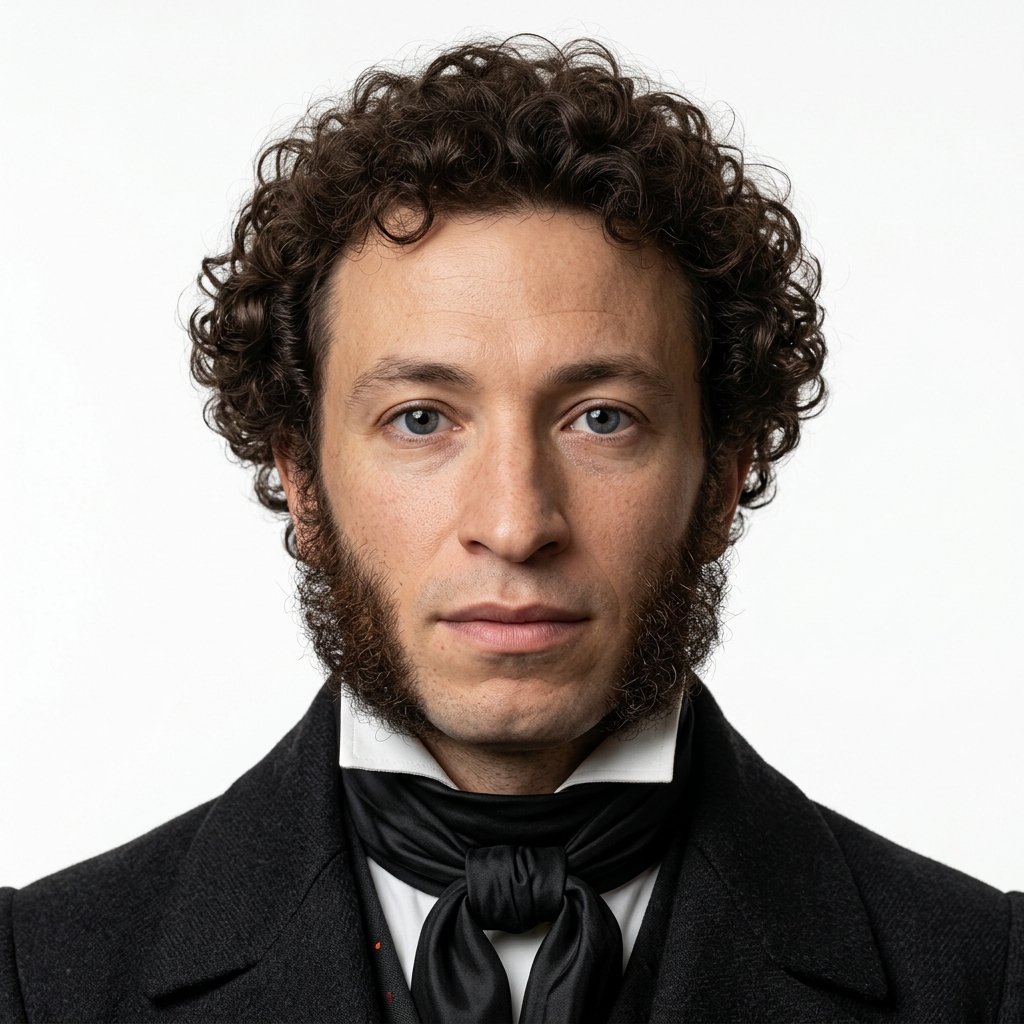
Alexander Sergeyevich Pushkin was a Russian poet, playwright, and novelist of the Romantic era. He is widely considered by many to be the greatest Russian poet and the founder of modern Russian literature. Pushkin pioneered the use of vernacular speech in his poems and plays, creating a style of storytelling—mixing drama, romance, and satire—that has been associated with Russian literature ever since.
Born into the Russian nobility in Moscow, Pushkin published his first poem at the age of 15 and was widely recognized by the literary establishment by the time of his graduation. His radical political views and satirical writings led to his exile by Tsar Alexander I. Despite strict censorship and government surveillance, he produced masterpieces such as the verse novel 'Eugene Onegin', the play 'Boris Godunov', and the poem 'The Bronze Horseman'.
Pushkin's life ended tragically at the age of 37 in a duel with Georges-Charles de Heeckeren d'Anthès, a French officer who had attempted to seduce Pushkin's wife. His death was a profound loss to Russian culture, but his literary legacy laid the foundation for the golden age of Russian literature, influencing generations of writers including Gogol, Dostoevsky, and Tolstoy.
Portrayal characteristics
Saved editorial descriptions used for the reconstruction; these are not authenticated statements by the depicted person.
- Romantic
- Innovative
- Passionate
- Satirical
- Defiant
Images & artwork 5
Connections
Peter the Great
Literary Subject & Historical Inspiration
Pushkin was fascinated by Peter the Great, writing 'The Bronze Horseman' and an unfinished novel about his own African great-grandfather, who was Peter's protégé.
Pushkin explored the complex legacy of Peter's modernization of Russia, often depicting the Tsar as both a heroic builder and a terrifying, impersonal force of state power.
Fyodor Dostoevsky
Literary Influence
Dostoevsky viewed Pushkin as the ultimate Russian poet and was deeply influenced by his psychological realism and national spirit.
In his famous 1880 'Pushkin Speech,' Dostoevsky argued that Pushkin embodied the 'universal responsiveness' of the Russian soul, cementing Pushkin's status as the father of Russian literature.
Leo Tolstoy
Literary Influence
Tolstoy admired Pushkin's prose for its clarity and economy, using it as a stylistic benchmark for his own writing.
Tolstoy reportedly re-read Pushkin's stories to find inspiration for the narrative structure of 'Anna Karenina' and praised Pushkin for creating the foundation of the modern Russian literary language.
Catherine the Great
Historical Subject
Pushkin's historical novel 'The Captain's Daughter' is set during the Pugachev Rebellion during Catherine's reign.
Pushkin conducted extensive archival research into Catherine's era to write 'The History of Pugachev,' balancing his role as a poet with that of a serious historian of the Russian Empire.
Napoleon Bonaparte
Historical Subject
Pushkin wrote several poems about Napoleon, reflecting on his impact on Europe and Russia.
Pushkin's work often grappled with the 'Napoleonic' archetype of the great man of destiny, a theme that would later influence the development of the Russian novel.
Catherine the Great
Literary Chronicler
Pushkin wrote extensively about the social and political climate of Catherine's reign.
Pushkin conducted deep archival research into the Pugachev Rebellion, the largest peasant revolt of Catherine's era. This research resulted in his historical study 'The History of Pugachev' and his famous novel 'The Captain's Daughter,' which features a nuanced portrayal of the Empress.
Fyodor Dostoevsky
Literary Inspiration
Dostoevsky viewed Pushkin as the ultimate embodiment of the Russian soul and literary genius.
Dostoevsky's 1880 'Pushkin Speech' is a landmark in Russian history, where he argued that Pushkin's ability to empathize with all cultures made him a 'universal man.' This speech solidified Dostoevsky's own status as a national prophet shortly before his death.
Leo Tolstoy
Influenced By
Tolstoy deeply admired Pushkin and considered his work the foundation of modern Russian literature.
Tolstoy frequently reread Pushkin's prose, particularly 'The Captain's Daughter,' which influenced his own approach to historical realism and narrative style. He famously stated that Pushkin's prose was the best school for any Russian writer.
Peter the Great
Literary Subject
Pushkin's literary works were instrumental in shaping the cultural mythos and historical memory of Peter the Great.
Pushkin wrote extensively about the Tsar, most notably in the epic poem 'The Bronze Horseman' and his unfinished historical novel 'The Moor of Peter the Great.' His work explored the tension between Peter's visionary progress and the human cost of his autocratic reforms.
Pyotr Ilyich Tchaikovsky
Literary Inspiration
Tchaikovsky utilized Pushkin's poems and stories as the primary source material for his most celebrated operas.
The composer's masterpieces 'Eugene Onegin' and 'The Queen of Spades' are direct adaptations of Pushkin's works, bridging the gap between 19th-century Russian literature and Romantic music.
Taras Shevchenko
Literary Contemporaries
Shevchenko and Pushkin were the preeminent poets of the Ukrainian and Russian languages, respectively, during the 19th century.
While Shevchenko respected Pushkin's talent, he used his poetry to critique the Russian imperial system that Pushkin was often associated with, establishing a distinct Ukrainian literary identity in opposition to imperial hegemony.
Yuri Gagarin
Influenced By
Gagarin was a lifelong admirer of Alexander Pushkin's poetry, which he cited as a source of personal inspiration and a symbol of Russian national identity.
During his training and even in space, Gagarin reportedly found inspiration in Pushkin's poetry, which he viewed as the pinnacle of Russian culture. This connection was often highlighted by Soviet biographers to portray Gagarin as a culturally well-rounded 'New Soviet Man' who embodied the best of his nation's history.
Known for
- Eugene Onegin
- Boris Godunov
- The Bronze Horseman
- Founder of modern Russian literature
Episodes featuring or mentioning this figure
No eligible published episode featuring this figure is currently in the library.