



Peter the Great
Tsar of Russia who modernized the empire and transformed it into a major European power.
At a glance
- Born
- 1672 CE
- Died
- 1725 CE
- Era classification
- Modern
- Homeland
- Russia
- Period
- Late 17th - Early 18th Century
- Field
- Politics, Leadership & War
- Language
- Russian
- Religion
- Russian Orthodox
- Gender
- male
Biography
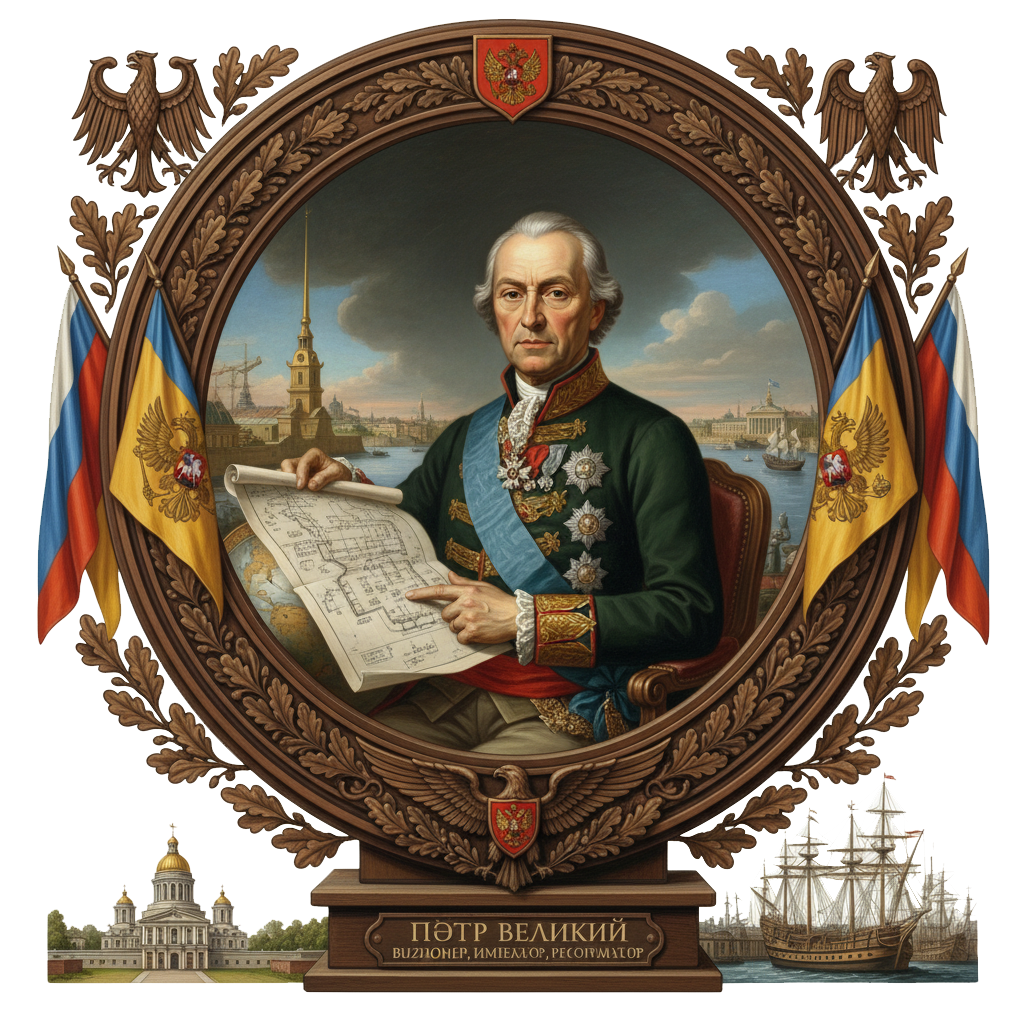
Peter the Great, born Pyotr Alekseyevich, ruled the Tsardom of Russia and later the Russian Empire from 1682 until his death. He is best known for his extensive reforms that aimed to modernize Russia and align it with Western European standards. Through a series of successful wars, he expanded the Tsardom into a much larger empire that became a major European power.
He led a cultural revolution that replaced some of the traditionalist and medieval social and political systems with ones that were modern, scientific, and Westernized. He founded the city of Saint Petersburg in 1703, which served as the Russian capital until 1918. His reforms made a lasting impact on Russia, affecting its institutions, culture, and military.
Despite his achievements, Peter was known for his ruthless methods and autocratic rule. He suppressed rebellions with extreme brutality and demanded absolute obedience from his subjects. Nevertheless, his legacy as the founder of the modern Russian state remains undisputed, and he is remembered as one of the most influential monarchs in history.
Portrayal characteristics
Saved editorial descriptions used for the reconstruction; these are not authenticated statements by the depicted person.
- Visionary
- Autocratic
- Ambitious
- Ruthless
- Energetic
Images & artwork 3
Connections
Alexander Pushkin
Literary Subject & Historical Inspiration
Pushkin was fascinated by Peter the Great, writing 'The Bronze Horseman' and an unfinished novel about his own African great-grandfather, who was Peter's protégé.
Pushkin explored the complex legacy of Peter's modernization of Russia, often depicting the Tsar as both a heroic builder and a terrifying, impersonal force of state power.
Bohdan Khmelnytsky
Historical Successor
Peter the Great utilized Khmelnytsky's earlier treaties to integrate Ukraine into the Russian Empire.
Khmelnytsky signed the Treaty of Pereyaslav in 1654, seeking a temporary military alliance with Russia. Decades later, Peter the Great used this precedent to permanently curtail the autonomy of the Cossack Hetmanate and bring Ukrainian lands under centralized Russian rule.
Catherine the Great
Political Successor
Catherine consciously modeled her reign and reforms on the legacy of Peter the Great.
She viewed herself as the true successor to Peter's westernizing mission, famously commissioning the 'Bronze Horseman' statue in his honor. Catherine continued his policies of territorial expansion and the modernization of the Russian administrative and military systems.
Nader Shah Afshar
Geopolitical Rivals
Nader Shah's rise to power involved reclaiming Persian territories that had been seized by Peter the Great's Russian Empire.
Following the collapse of the Safavids, Peter the Great occupied parts of the Caucasus and northern Iran. Nader Shah used a combination of military threats and diplomacy to force the Russian Empire to return these lands via the Treaty of Resht and the Treaty of Ganja.
Catherine the Great
Imperial Successors
Catherine the Great viewed herself as the ideological and political heir to Peter's Westernization of Russia.
Catherine consciously modeled her reign on Peter's reforms, expanding the empire and modernizing the administration. She famously commissioned the 'Bronze Horseman' statue in St. Petersburg, inscribed with 'To Peter the First from Catherine the Second' to solidify her link to his legacy.
Alexander Pushkin
Literary Subject
Pushkin's literary works were instrumental in shaping the cultural mythos and historical memory of Peter the Great.
Pushkin wrote extensively about the Tsar, most notably in the epic poem 'The Bronze Horseman' and his unfinished historical novel 'The Moor of Peter the Great.' His work explored the tension between Peter's visionary progress and the human cost of his autocratic reforms.
Gottfried Wilhelm Leibniz
Scientific Advisor
Leibniz met with Peter the Great several times to advise him on the modernization of Russian science and education.
Between 1711 and 1716, the two met to discuss the creation of the Russian Academy of Sciences. Leibniz's proposals for administrative and educational reform were highly influential in Peter's efforts to align Russia with European intellectual standards.
Known for
- Modernizing Russia
- Founding Saint Petersburg
- Establishing the Russian Empire
- Westernization reforms
Episodes featuring or mentioning this figure
No eligible published episode featuring this figure is currently in the library.