



Catherine the Great
The longest-ruling female leader of Russia, who expanded the empire and championed the Enlightenment.
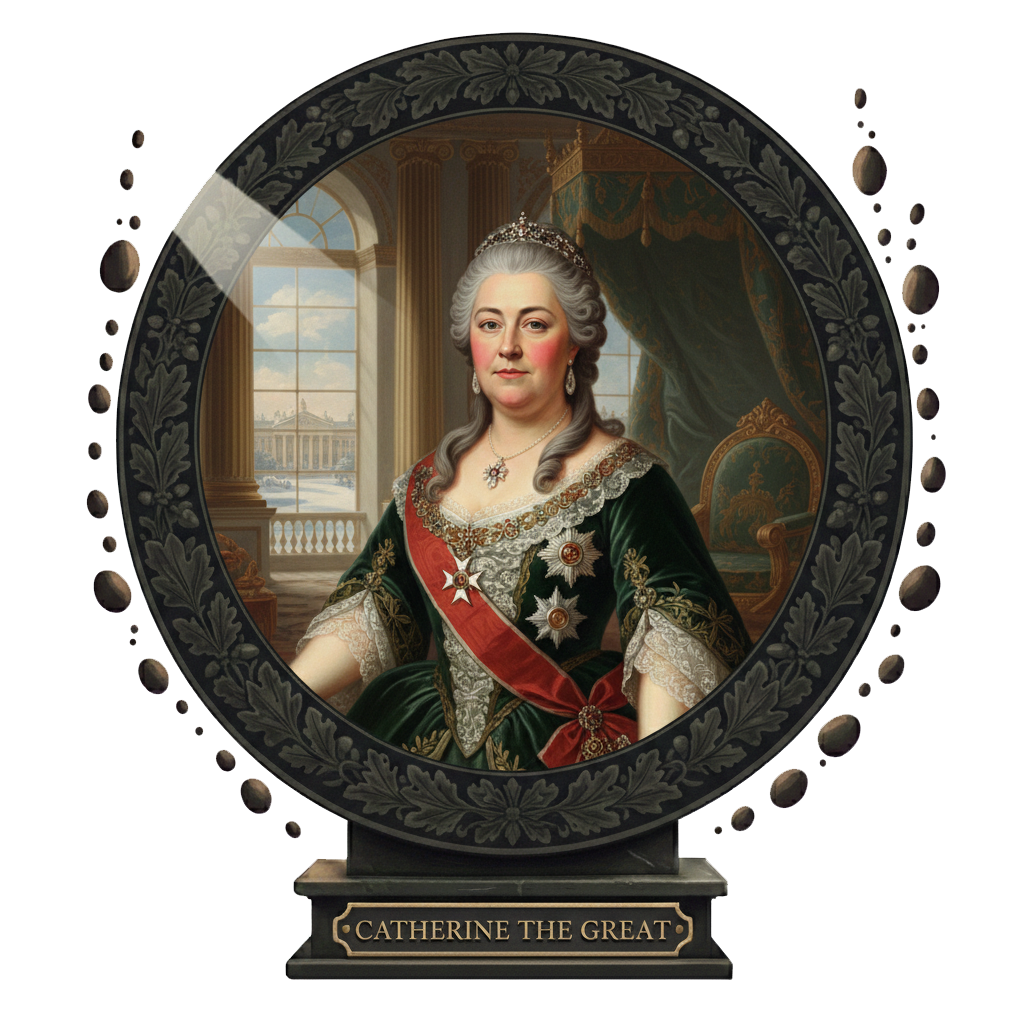
At a glance
- Born
- May 2, 1729 CE
- Died
- November 17, 1796 CE
- Era classification
- 67
- Homeland
- Prussia / Russian Empire
- Period
- 1729–1796 CE
- Field
- Politics, Leadership & War
- Language
- Russian, French, German
- Religion
- Russian Orthodox
- Gender
- female
Biography
Born Princess Sophie of Anhalt-Zerbst in Prussia, the future Catherine the Great moved to Russia in 1744 to marry the future Tsar Peter III. Highly ambitious and intellectually curious, she quickly realized her husband's unsuitability for the throne. She immersed herself in Russian culture, mastered the language, and converted to the Russian Orthodox faith, strategically positioning herself as a true Russian patriot despite her German origins.
In 1762, Catherine orchestrated a bloodless coup against her deeply unpopular husband, who was assassinated shortly thereafter. Ascending to the throne as Empress of Russia, she began a reign that would last for 34 years. This period, known as the Catherinian Era, is widely celebrated as the Golden Age of the Russian Empire, characterized by immense territorial expansion and cultural revitalization.
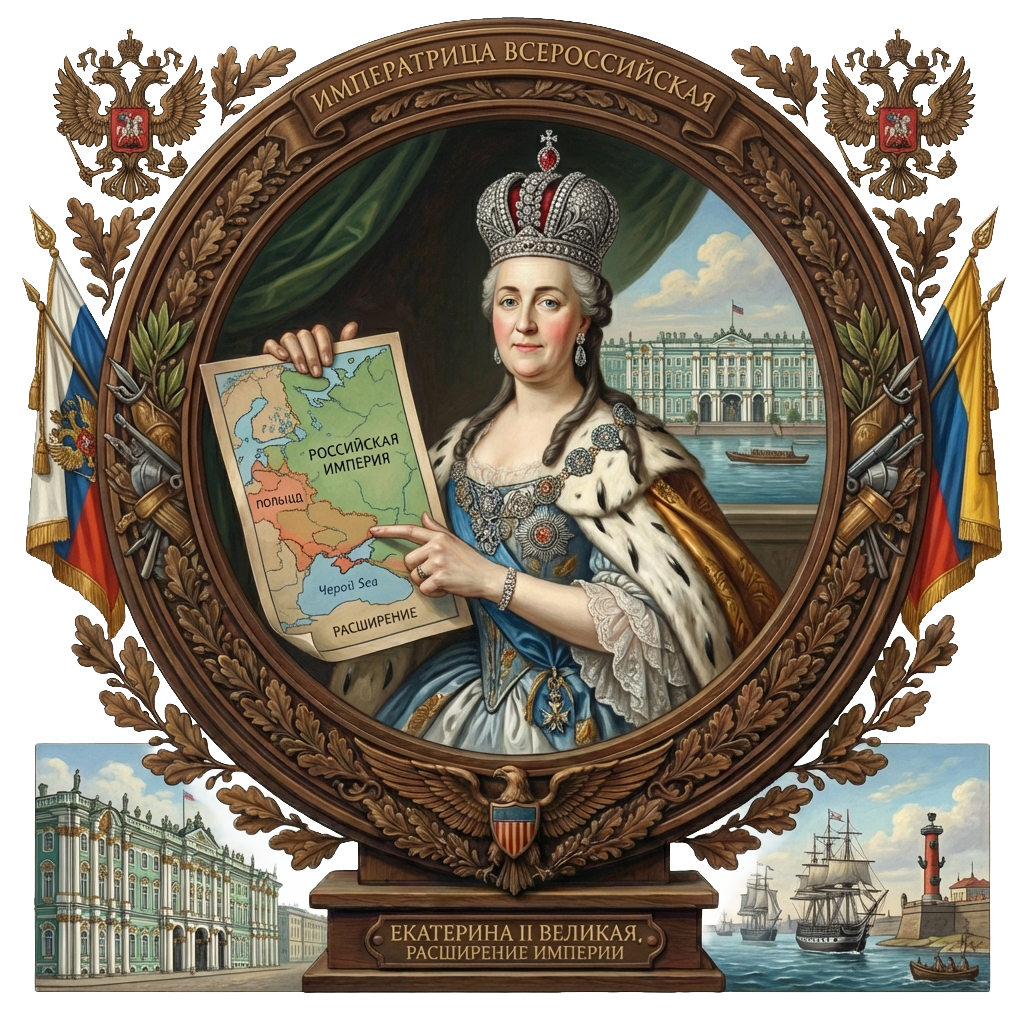
As a self-proclaimed enlightened despot, Catherine corresponded extensively with prominent Enlightenment philosophers such as Voltaire and Diderot. She sought to modernize Russian administration, reformed the legal system, and significantly expanded educational opportunities, particularly for women. Militarily, her forces achieved decisive victories against the Ottoman Empire, securing the Crimea and access to the Black Sea, while also participating in the partitions of Poland, which vastly extended Russia's western borders.
Despite her progressive ideals, Catherine's reign was marked by profound contradictions. She relied heavily on the nobility, which led to the further entrenchment of serfdom and sparked the massive Pugachev Rebellion. Nevertheless, her extraordinary patronage of the arts, the founding of the Hermitage Museum, and her success in transforming Russia into a formidable European superpower cemented her enduring legacy as 'Catherine the Great'.
Portrayal characteristics
Saved editorial descriptions used for the reconstruction; these are not authenticated statements by the depicted person.
- Ambitious
- Intellectual
- Pragmatic
- Charismatic
- Authoritative
- Cultured
Images & artwork 4
Connections
Alexander Pushkin
Historical Subject
Pushkin's historical novel 'The Captain's Daughter' is set during the Pugachev Rebellion during Catherine's reign.
Pushkin conducted extensive archival research into Catherine's era to write 'The History of Pugachev,' balancing his role as a poet with that of a serious historian of the Russian Empire.
Peter the Great
Political Successor
Catherine consciously modeled her reign and reforms on the legacy of Peter the Great.
She viewed herself as the true successor to Peter's westernizing mission, famously commissioning the 'Bronze Horseman' statue in his honor. Catherine continued his policies of territorial expansion and the modernization of the Russian administrative and military systems.
Voltaire
Contemporary Allies
Catherine and Voltaire maintained a famous 15-year intellectual correspondence.
Though they never met, Catherine used Voltaire as a sounding board for her 'Enlightened Despotism' and as a public relations tool to improve her image in Western Europe. Voltaire, in turn, praised her as the 'Star of the North' and supported her military campaigns against the Ottoman Empire.
Alexander Pushkin
Literary Chronicler
Pushkin wrote extensively about the social and political climate of Catherine's reign.
Pushkin conducted deep archival research into the Pugachev Rebellion, the largest peasant revolt of Catherine's era. This research resulted in his historical study 'The History of Pugachev' and his famous novel 'The Captain's Daughter,' which features a nuanced portrayal of the Empress.
Peter the Great
Imperial Successors
Catherine the Great viewed herself as the ideological and political heir to Peter's Westernization of Russia.
Catherine consciously modeled her reign on Peter's reforms, expanding the empire and modernizing the administration. She famously commissioned the 'Bronze Horseman' statue in St. Petersburg, inscribed with 'To Peter the First from Catherine the Second' to solidify her link to his legacy.
Voltaire
Correspondents & Intellectual Allies
Voltaire maintained a long and influential correspondence with the Russian Empress, who viewed him as a mentor of Enlightenment values.
Catherine the Great sought to present herself as an 'enlightened despot' and used her letters with Voltaire to bolster her reputation in Europe. Voltaire, in turn, praised her reforms and her efforts to modernize the Russian Empire.
Known for
- Expanding the Russian Empire
- Championing the Russian Enlightenment
- Overthrowing Tsar Peter III
- Establishing the Hermitage Museum
- Partitioning of Poland
Episodes featuring or mentioning this figure
No eligible published episode featuring this figure is currently in the library.