



Cyrus the Great
Founder of the Achaemenid Empire, renowned for his military genius, human rights legacy, and religious tolerance.
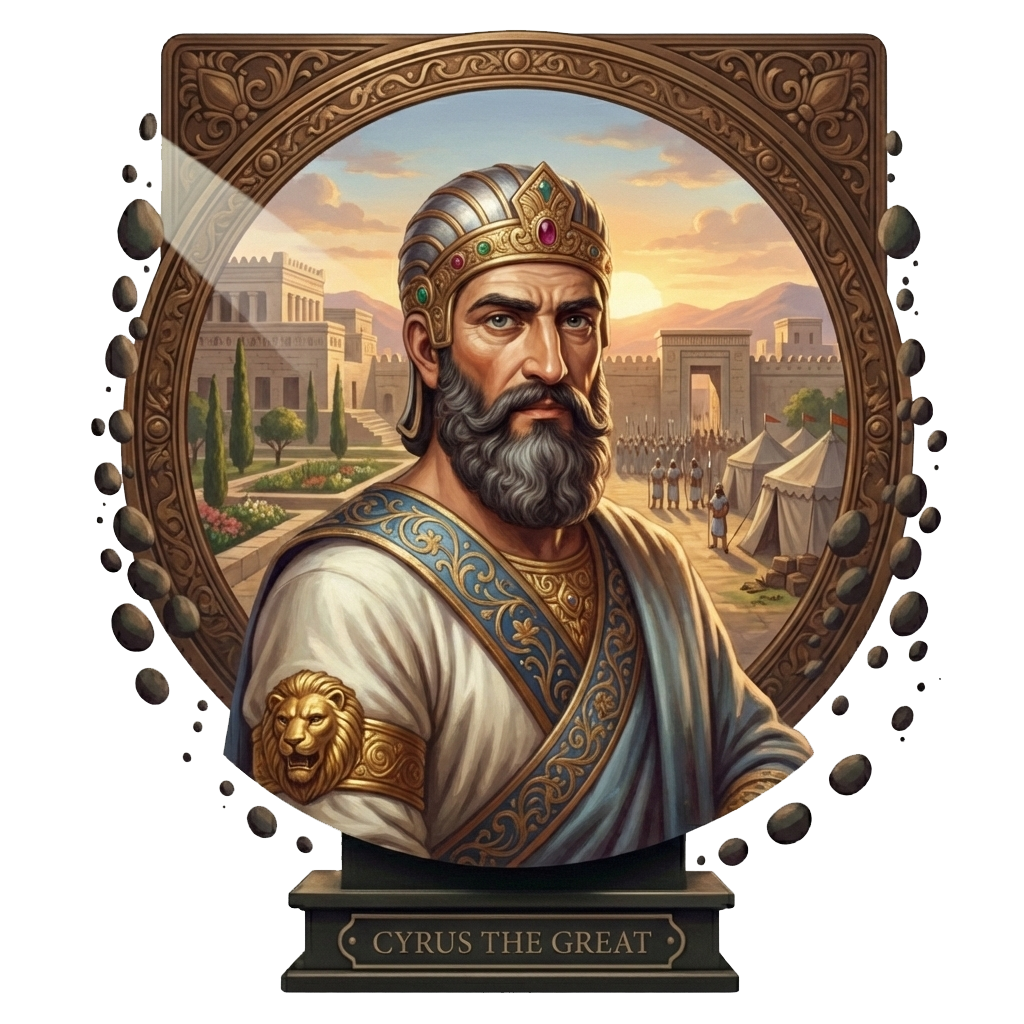
At a glance
- Born
- c. 600 BCE
- Died
- 530 BCE
- Era classification
- c. 70
- Homeland
- Persia
- Period
- c. 600–530 BCE
- Field
- Politics, Leadership & War
- Language
- Old Persian
- Religion
- Zoroastrianism
- Gender
- male
Biography
Cyrus II of Persia, commonly known as Cyrus the Great, was born around 600 BCE in Anshan, Persis. As the son of Cambyses I, he inherited the throne of a small vassal state under the Median Empire. In 553 BCE, Cyrus led a successful rebellion against his grandfather, the Median king Astyages, ultimately conquering the Median Empire and uniting the Medes and Persians under a single banner. This marked the birth of the Achaemenid Empire.
Following his victory over the Medes, Cyrus embarked on a series of unprecedented military campaigns. He conquered the Lydian Empire in Asia Minor, defeating King Croesus, and later captured the formidable Neo-Babylonian Empire after the bloodless fall of Babylon in 539 BCE. Through these conquests, Cyrus forged the largest empire the world had ever seen, stretching from the Mediterranean Sea and the Hellespont in the west to the Indus River in the east.
Beyond his military prowess, Cyrus is celebrated for his revolutionary approach to governance. Unlike previous conquerors, he respected the customs, religions, and institutions of the lands he subdued. He famously issued a decree, recorded on the Cyrus Cylinder, which allowed deported peoples—most notably the Jewish exiles in Babylon—to return to their homelands and rebuild their temples. This policy of religious tolerance and administrative autonomy became a hallmark of the Achaemenid state.
Cyrus the Great died in battle around 530 BCE, likely while campaigning against the Massagetae, a nomadic tribal confederation in Central Asia. He was buried in a modest tomb in his capital city of Pasargadae. His legacy profoundly influenced both Eastern and Western civilizations, inspiring later leaders such as Alexander the Great and serving as a model of the ideal ruler in works like Xenophon's 'Cyropaedia'.
Portrayal characteristics
Saved editorial descriptions used for the reconstruction; these are not authenticated statements by the depicted person.
- Tolerant
- Visionary
- Magnanimous
- Strategic
- Charismatic
- Just
Images & artwork 4
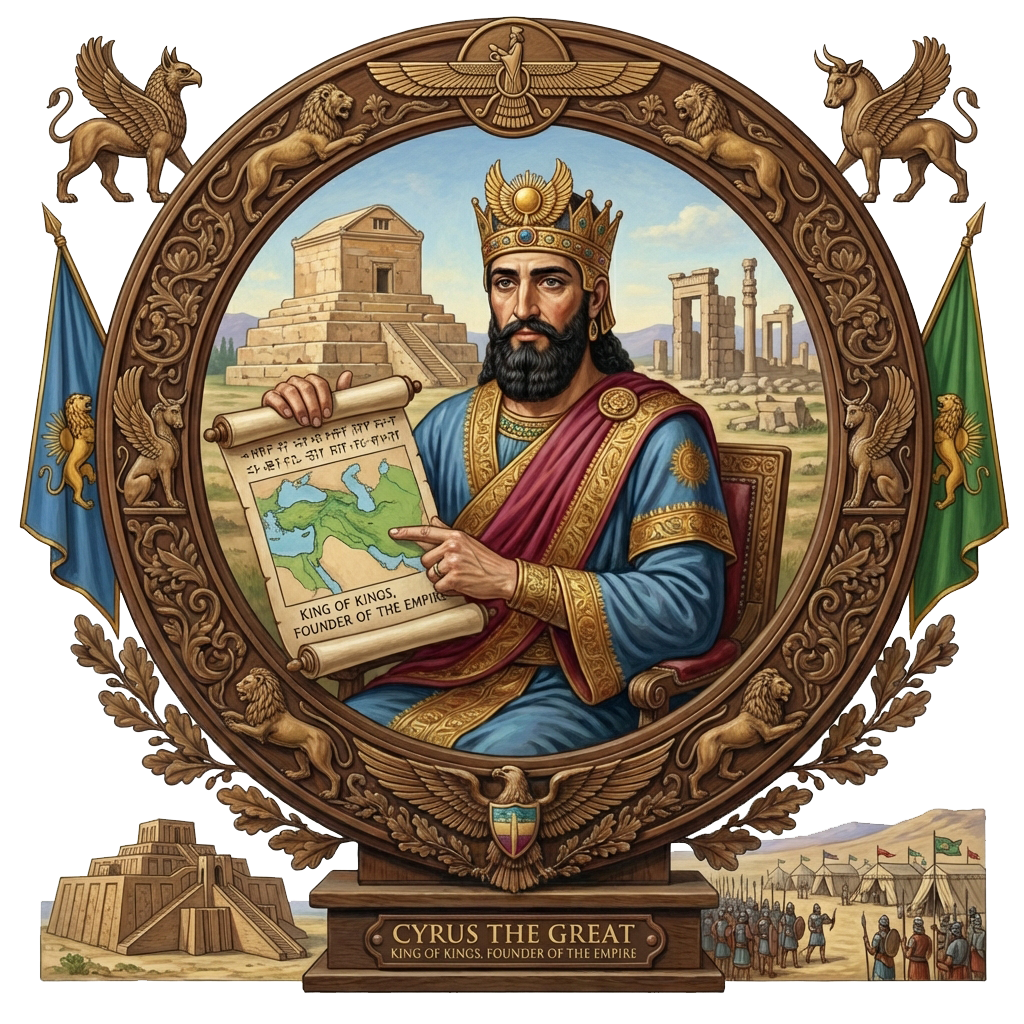
Connections
Alexander the Great
Admirer & Successor
Alexander deeply admired Cyrus the Great as a model of a just and powerful conqueror.
Upon reaching Pasargadae, Alexander ordered the restoration of Cyrus's tomb and punished those who had desecrated it, signaling his intent to rule as a legitimate successor to the Achaemenid throne.
Darius the Great
Successor & Relative
Darius the Great was a relative of Cyrus who stabilized and expanded the Achaemenid Empire after the death of Cyrus's son, Cambyses II.
Darius claimed descent from the same Achaemenid line as Cyrus and solidified the administrative foundations of the empire Cyrus founded. He famously recorded his lineage and his rise to power on the Behistun Inscription, linking his legitimacy to the legacy of Cyrus.
Xerxes (Khashayarsha)
Grandfather & Predecessor
Xerxes was the grandson of Cyrus the Great through his mother, Atossa, the daughter of Cyrus.
Xerxes's lineage from Cyrus was a crucial component of his royal legitimacy. As the third major ruler of the Achaemenid Empire, he inherited the vast territories and the imperial ideology established by his grandfather.
Alexander the Great
Admirer & Conqueror
Alexander the Great deeply admired Cyrus as a model of kingship and visited his tomb in Pasargadae after conquering Persia.
Alexander was influenced by Xenophon's 'Cyropaedia,' a fictionalized biography of Cyrus, and sought to emulate his style of benevolent rule. Upon finding Cyrus's tomb plundered, Alexander ordered its immediate restoration and punished those responsible.
Thomas Jefferson
Intellectual Influence
Thomas Jefferson studied Cyrus the Great as a model for statecraft and religious tolerance, specifically through Xenophon's 'Cyropaedia'.
Jefferson owned multiple copies of the 'Cyropaedia' and advised his family to read it as a guide for leadership. Cyrus's historical policy of allowing the Jews to return to Jerusalem and practice their faith influenced Jefferson's own advocacy for religious freedom.
Darius the Great
Predecessor & Relative
Darius I rose to power following the death of Cyrus's son and worked to preserve and expand the empire Cyrus had established.
Darius emphasized his connection to Cyrus the Great to legitimize his rule after a period of civil unrest. He continued Cyrus's policy of religious tolerance while introducing the satrapy system to manage the empire's vast territories.
Ferdowsi
Historical Inspiration
Ferdowsi's Shahnameh preserves the legends of the ancient Persian kings, including figures inspired by Cyrus.
While the Shahnameh focuses more on the mythical Kayanian dynasty, the historical memory of Cyrus the Great is woven into the epic's portrayal of the ideal, just Persian ruler. Ferdowsi's work was instrumental in keeping the spirit of Cyrus's empire alive during centuries of foreign rule.
Xerxes (Khashayarsha)
Grandfather & Grandson
Xerxes was the grandson of Cyrus the Great through his mother, Atossa.
His lineage from Cyrus was central to his legitimacy as Great King. Xerxes maintained the imperial structures and the capital of Persepolis that were founded on the legacy of Cyrus's original conquests.
Mohammad Reza Pahlavi
Historical Idol & Source of Legitimacy
Mohammad Reza Pahlavi heavily utilized the legacy of Cyrus the Great to legitimize his own rule, most notably during the extravagant 1971 Persepolis celebrations. The Shah sought to position himself as the modern successor to Cyrus's ancient empire.
In his quest to forge a secular, nationalist identity for modern Iran, Mohammad Reza Pahlavi frequently invoked the grandeur of the pre-Islamic Achaemenid Empire, with Cyrus the Great as its ultimate symbol. This ideological connection reached its zenith in 1971 during the 2,500-year celebration of the Persian Empire, a lavish event hosted at the ancient ruins of Persepolis. During the ceremonies, the Shah famously stood before the Tomb of Cyrus at Pasargadae and delivered a speech declaring, 'Rest in peace, Cyrus, for we are awake, and we will always stay awake.' By directly addressing the ancient king, the Shah attempted to draw an unbroken line of monarchical continuity from Cyrus to the Pahlavi dynasty, bypassing centuries of Islamic history. He also heavily promoted the 'Cyrus Cylinder' as the world's first charter of human rights, aligning ancient Persian history with his modern, pro-Western image. However, this intense focus on pre-Islamic antiquity alienated the conservative Shia clergy and highlighted the disconnect between the Shah's grandiose imperial vision and the socio-economic realities of the Iranian populace.
Known for
- Founding the Achaemenid Empire
- The Cyrus Cylinder
- Freeing the Jewish exiles in Babylon
- Conquering Media, Lydia, and Babylon
- Pioneering religious tolerance
Episodes featuring or mentioning this figure
No eligible published episode featuring this figure is currently in the library.