



Thomas Jefferson
The principal author of the Declaration of Independence and the third President of the United States.
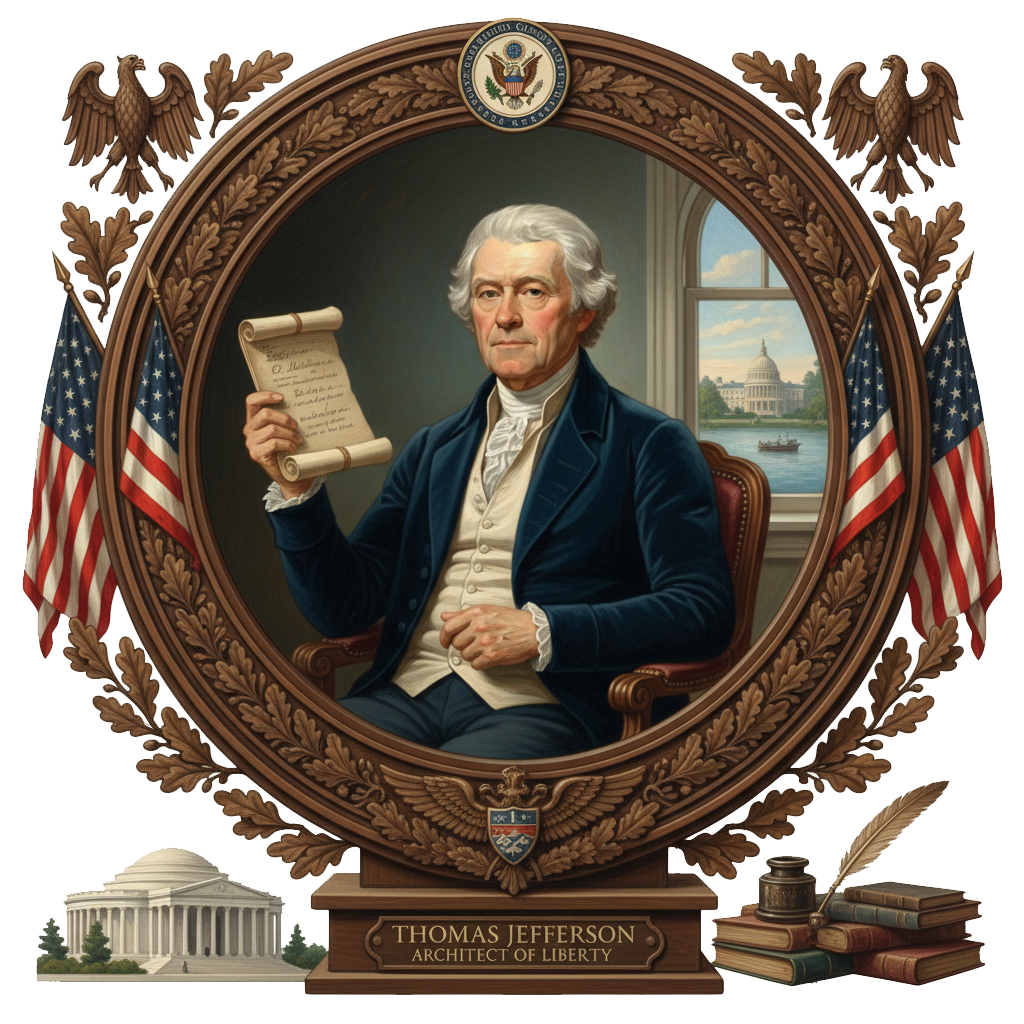
At a glance
- Born
- 1743 CE
- Died
- 1826 CE
- Era classification
- Modern
- Homeland
- United States
- Period
- 18th-19th Century
- Field
- Politics & Leadership
- Language
- English
- Religion
- Deism
- Gender
- male
Biography
Thomas Jefferson was born in Virginia in 1743 into a wealthy planter family. He received a comprehensive education, becoming a lawyer, architect, and a voracious reader. Deeply influenced by Enlightenment thinkers, Jefferson became a leading voice for colonial rights and republicanism early in his political career.
He is best remembered as the principal author of the Declaration of Independence in 1776, articulating the profound assertion that 'all men are created equal.' Despite writing these soaring ideals of liberty, Jefferson remained a lifelong enslaver, a contradiction that has heavily shaped his historical legacy.
During his presidency (1801–1809), Jefferson organized the Louisiana Purchase, doubling the size of the United States, and commissioned the Lewis and Clark Expedition to explore the new territory. In his later years, he founded the University of Virginia, designing its unique curriculum and neoclassical architecture.
Portrayal characteristics
Saved editorial descriptions used for the reconstruction; these are not authenticated statements by the depicted person.
- Intellectual
- Idealistic
- Articulate
- Contradictory
- Erudite
Images & artwork 3


Connections
Alexander Hamilton
Political Rivals
Hamilton and Jefferson represented the fundamental ideological divide in early American politics.
Their fierce disagreements over the power of the federal government, the creation of a national bank, and foreign policy led to the formation of the first political parties: the Federalists and the Democratic-Republicans. Their rivalry defined the American debate between industrialization and agrarianism.
Cyrus the Great
Intellectual Influence
Thomas Jefferson studied Cyrus the Great as a model for statecraft and religious tolerance, specifically through Xenophon's 'Cyropaedia'.
Jefferson owned multiple copies of the 'Cyropaedia' and advised his family to read it as a guide for leadership. Cyrus's historical policy of allowing the Jews to return to Jerusalem and practice their faith influenced Jefferson's own advocacy for religious freedom.
Benjamin Franklin
Contemporary Allies
They served together on the committee to draft the Declaration of Independence.
Franklin famously edited Jefferson's draft of the Declaration, changing 'sacred and undeniable' to 'self-evident.' Jefferson later succeeded Franklin as the United States Minister to France, famously remarking that he was merely Franklin's successor, as no one could truly replace him.
George Washington
Political Rivals
While Jefferson served in Washington's cabinet, their differing visions for the United States led to the birth of the first American political party system.
As Secretary of State, Jefferson frequently clashed with Hamilton, forcing Washington to act as a mediator. Although Washington tried to remain above factionalism, Jefferson's opposition to federal power eventually led him to resign and form the Democratic-Republican Party.
John Locke
Ideological Influence
Jefferson considered Locke one of the three greatest men to have ever lived and drew heavily from his work when drafting the Declaration of Independence.
Locke's concepts of natural rights—life, liberty, and property—and the idea that government derives its power from the consent of the governed are the foundational principles of the American democratic experiment.
Jean-Jacques Rousseau
Philosophical Influence
Rousseau's concepts of the 'social contract' and 'popular sovereignty' influenced Jefferson's political thought.
While Jefferson was more directly influenced by Locke, Rousseau's ideas on the inherent rights of man and the collective will of the people resonated within the democratic ideals Jefferson championed in the United States.
Napoleon Bonaparte
Political Peers
Napoleon and Jefferson negotiated the landmark Louisiana Purchase in 1803.
Facing a slave revolt in Haiti and impending war with Britain, Napoleon sold the Louisiana Territory to the United States under Jefferson's presidency. This transaction doubled the size of the U.S. and provided Napoleon with funds for his European wars.
George Washington
Political Allies & Rivals
Jefferson served as the first U.S. Secretary of State under Washington's presidency.
While they initially worked together to establish the new nation, they eventually became estranged due to Jefferson's fierce opposition to the Federalist policies favored by Washington's administration.
Alexander Hamilton
Political Rivals
Their conflicting visions for the future of the United States led to the birth of the first American political parties.
Hamilton's preference for a strong central government and industrialization clashed with Jefferson's vision of a decentralized, agrarian society. Their bitter disputes within Washington's cabinet defined early American political discourse.
Benjamin Franklin
Co-Authors of Independence
Jefferson and Franklin served together on the Committee of Five that drafted the Declaration of Independence.
Jefferson was the primary author, but Franklin provided crucial edits, including the famous change of 'sacred and undeniable' to 'self-evident.' They also served together as diplomats in France.
John Locke
Influenced By
Locke's theories on natural rights and the social contract were the primary inspiration for Jefferson's political philosophy.
Jefferson considered Locke one of the three greatest men to have ever lived. The language of the Declaration of Independence, particularly regarding 'life, liberty, and the pursuit of happiness,' is a direct adaptation of Lockean principles.
Napoleon Bonaparte
Diplomatic Partners
Jefferson negotiated the Louisiana Purchase with Napoleon's government in 1803.
The deal, which doubled the size of the United States, was made possible because Napoleon needed funds for his wars in Europe and had abandoned his colonial ambitions in North America.
Voltaire
Influenced By
Jefferson was a dedicated reader of Voltaire and was heavily influenced by his views on religious freedom and reason.
Jefferson kept a bust of Voltaire at Monticello and frequently cited the French philosopher's defense of civil liberties when drafting legislation like the Virginia Statute for Religious Freedom.
Alexis de Tocqueville
Subject of Study & Philosophical Resonance
Tocqueville viewed Jefferson as the greatest apostle of American democracy, frequently citing him to validate his own warnings about the dangers of legislative tyranny.
In 'Democracy in America,' Tocqueville frequently quotes Thomas Jefferson, whom he considered the most powerful advocate for democratic equality. Interestingly, Tocqueville used Jefferson's own words to support his famous warning about the 'tyranny of the majority.' He cited Jefferson's letters pointing out that the tyranny of the legislature was the most immediate danger to the American republic. Furthermore, Jefferson's deep belief in the 'ward system'—the idea that local, decentralized administration is the best school for republican virtue—heavily influenced Tocqueville's famous praise of the New England township. Both men believed that without robust local self-government, a centralized democratic state would inevitably slide into despotism.
Known for
- Writing the Declaration of Independence
- Louisiana Purchase
- Founding the University of Virginia
Episodes featuring or mentioning this figure
No eligible published episode featuring this figure is currently in the library.