



Voltaire
French Enlightenment philosopher and writer famous for his wit, satire, and fierce advocacy of civil liberties.
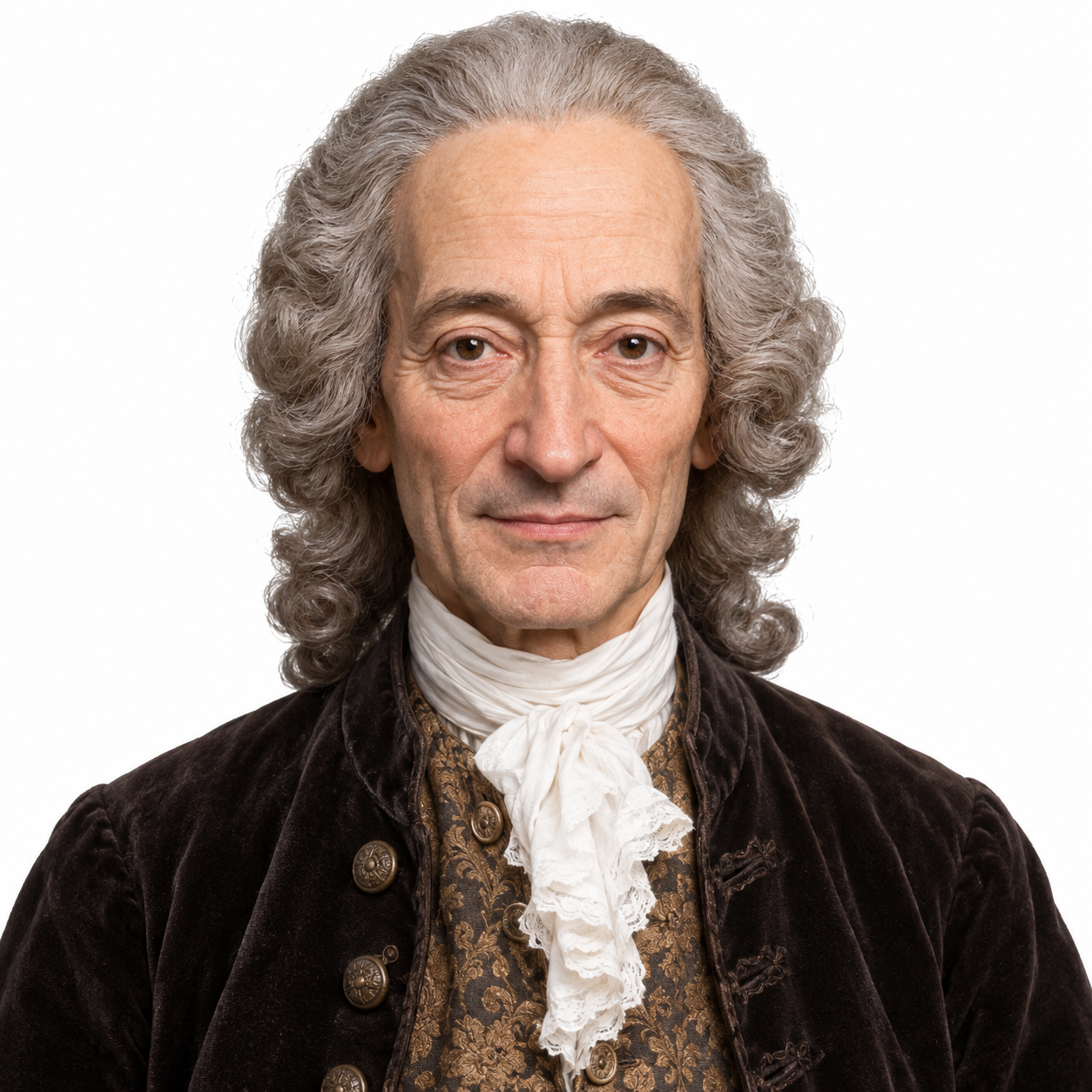
At a glance
- Born
- 1694 CE
- Died
- 1778 CE
- Era classification
- 83
- Homeland
- France
- Period
- 1694–1778 CE
- Field
- Philosophy & Ideology
- Language
- French
- Religion
- Deist
- Gender
- male
Biography
Born François-Marie Arouet in Paris, Voltaire adopted his famous pen name in 1718 following an imprisonment in the Bastille. He emerged as a leading figure of the French Enlightenment, renowned for his sharp wit, prolific writing, and relentless criticism of established institutions, particularly the Catholic Church and the absolute monarchy of France.
His satirical works frequently brought him into conflict with authorities, leading to a pivotal exile in England from 1726 to 1729. There, he was deeply influenced by British constitutional monarchy, the scientific theories of Isaac Newton, and the empiricism of John Locke. He returned to France to champion these ideas, fundamentally shaping the intellectual landscape of continental Europe and introducing Newtonian physics to the French public.
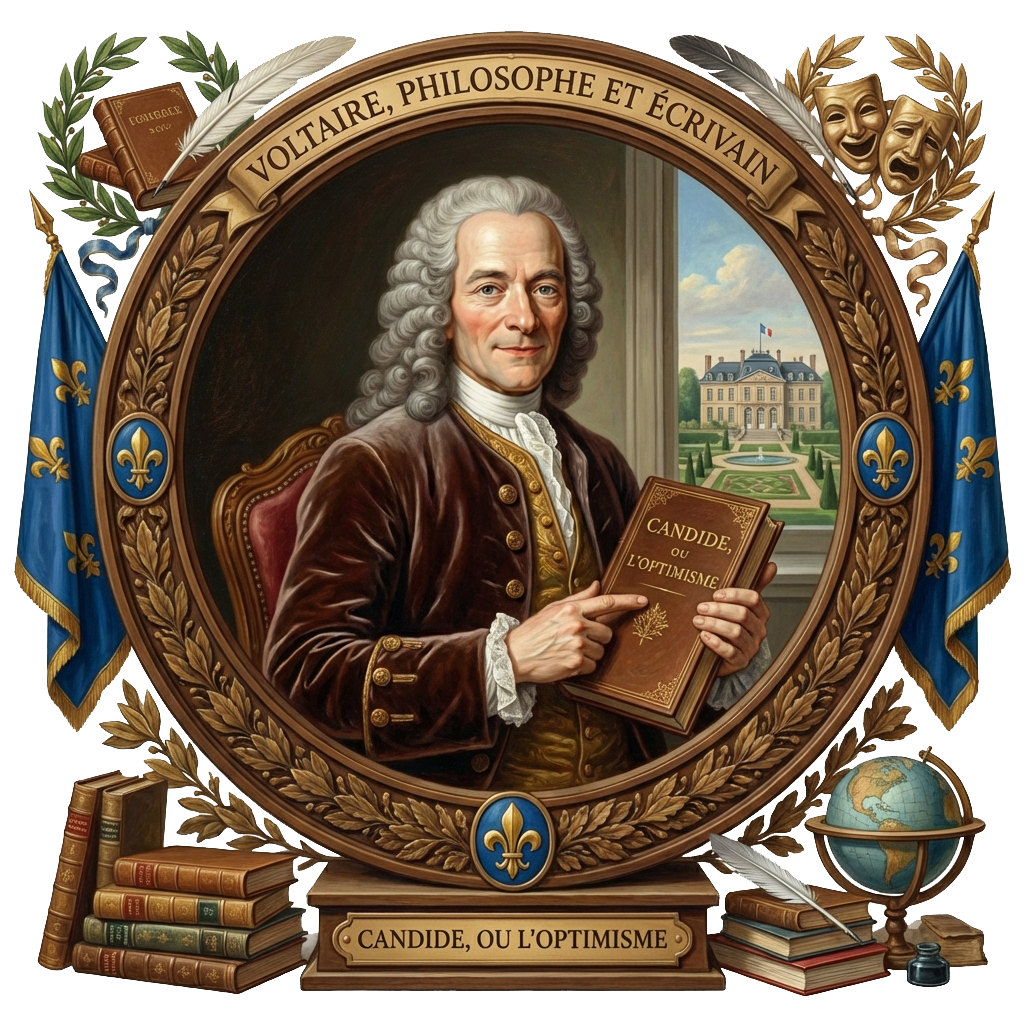
Voltaire's literary output was immense, encompassing plays, poems, novels, essays, and historical works. His most famous novella, 'Candide' (1759), brilliantly satirizes the philosophical optimism of Leibniz, exposing the absurdities of human suffering and religious dogma. As a staunch Deist, he advocated for religious tolerance, freedom of speech, and the separation of church and state, famously dedicating much of his life to fighting injustice and intolerance.
Spending his later years at his estate in Ferney, near the Swiss border, he became known as the 'Patriarch of Ferney,' actively defending victims of religious persecution. Voltaire's enduring legacy lies in his passionate defense of civil liberties and reason, making him a foundational pillar of modern democratic and secular thought.
Portrayal characteristics
Saved editorial descriptions used for the reconstruction; these are not authenticated statements by the depicted person.
- Witty
- Satirical
- Rational
- Prolific
- Anti-dogmatic
- Courageous
Images & artwork 4


Connections
Confucius
Intellectual Influence
Voltaire viewed Confucius as a paragon of rational, secular morality and used his teachings to critique European religious institutions.
During the Enlightenment, Voltaire praised Confucianism for its emphasis on ethics without the need for divine revelation. He frequently cited Confucius in his works to argue that a society could be virtuous and orderly based solely on human reason rather than theological dogma.
David Hume
Enlightenment Contemporaries
Hume and Voltaire were the leading figures of the Scottish and French Enlightenments, respectively, and met during Hume's time in Paris.
During Hume's service at the British embassy in Paris, he was celebrated by the French philosophes. Voltaire admired Hume's 'History of England' and his skeptical approach to religion, and the two maintained a mutual respect as champions of reason.
Benjamin Franklin
Enlightenment Peers
The two iconic figures of the Enlightenment met in a famous public encounter in Paris in 1778.
Their meeting at the Académie des Sciences was a major cultural event where the two were urged by the crowd to embrace. This symbolic union of American pragmatism and French philosophy was hailed as the 'embrace of Solon and Sophocles.'
Catherine the Great
Contemporary Allies
Catherine and Voltaire maintained a famous 15-year intellectual correspondence.
Though they never met, Catherine used Voltaire as a sounding board for her 'Enlightened Despotism' and as a public relations tool to improve her image in Western Europe. Voltaire, in turn, praised her as the 'Star of the North' and supported her military campaigns against the Ottoman Empire.
Johann Wolfgang von Goethe
Literary Influence
Goethe was deeply engaged with the works of Voltaire, translating some of his plays and critiquing his Enlightenment rationalism.
While Goethe admired Voltaire's wit and influence on European culture, he also sought to move beyond Voltaire's strict rationalism toward the more emotional and organic perspectives of the Sturm und Drang and Weimar Classicism movements.
John Locke
Ideological Successor
Voltaire was instrumental in introducing Locke's empiricism and political liberalism to the French Enlightenment.
In his 'Letters on the English,' Voltaire praised Locke's rejection of innate ideas and his advocacy for religious toleration, using Locke's philosophy as a weapon against French institutional absolutism.
Jean-Jacques Rousseau
Philosophical Rivals
The two most famous figures of the French Enlightenment, they held fundamentally opposing views on progress, religion, and society.
Voltaire championed reason and the benefits of civilization, while Rousseau argued that society and the arts corrupted human nature. Their mutual animosity was legendary, involving public insults and bitter correspondence throughout their lives.
Napoleon Bonaparte
Philosophical Influence
Napoleon was influenced by Voltaire's Enlightenment critiques of religion and feudalism.
Napoleon shared Voltaire's skepticism of organized religion's political power, which informed his negotiation of the Concordat of 1801. He viewed Voltaire as a pioneer of the intellectual revolution that made his own rise to power possible.
Thomas Jefferson
Influenced By
Jefferson was a dedicated reader of Voltaire and was heavily influenced by his views on religious freedom and reason.
Jefferson kept a bust of Voltaire at Monticello and frequently cited the French philosopher's defense of civil liberties when drafting legislation like the Virginia Statute for Religious Freedom.
Jean-Jacques Rousseau
Philosophical Rivals
Voltaire and Rousseau were the two most influential figures of the French Enlightenment but held deeply opposing views on society and human nature.
While both critiqued the status quo, Voltaire championed reason and civilization, whereas Rousseau emphasized emotion and the 'noble savage.' Their relationship was marked by public disagreements and personal animosity, particularly regarding Rousseau's 'Discourse on Inequality'.
Catherine the Great
Correspondents & Intellectual Allies
Voltaire maintained a long and influential correspondence with the Russian Empress, who viewed him as a mentor of Enlightenment values.
Catherine the Great sought to present herself as an 'enlightened despot' and used her letters with Voltaire to bolster her reputation in Europe. Voltaire, in turn, praised her reforms and her efforts to modernize the Russian Empire.
John Locke
Influenced By
Voltaire was a profound admirer of Locke’s empiricism and political liberalism, which he encountered during his exile in England.
Voltaire's 'Letters on the English' played a crucial role in introducing Locke's ideas on religious tolerance and constitutional government to the French public, laying the groundwork for the French Enlightenment.
Isaac Newton
Intellectual Proponent
Voltaire was instrumental in popularizing Newtonian physics in France, moving the intellectual climate away from Cartesianism.
After witnessing Newton's high social standing in England, Voltaire wrote 'Elements of the Philosophy of Newton' with Émilie du Châtelet to explain and defend Newton's theories of gravity and optics.
Benjamin Franklin
Contemporary Allies
The two Enlightenment icons met in Paris in 1778, a meeting famously described as the embrace of the Old World and the New World.
Their meeting at the French Academy of Sciences was a major symbolic event; Voltaire reportedly blessed Franklin's grandson in the name of 'God and Liberty,' signifying their shared commitment to rationalism and freedom.
Alexis de Tocqueville
Philosophical Critique
Tocqueville heavily criticized Voltaire and the French Enlightenment 'philosophes' for their abstract, utopian theories, which he blamed for the radicalism of the French Revolution.
In 'The Old Regime and the Revolution,' Tocqueville offered a scathing sociological critique of Voltaire and his fellow Enlightenment intellectuals. Tocqueville argued that because the French monarchy had excluded the aristocracy and intellectuals from actual political power, writers like Voltaire were left to theorize about politics in a vacuum. Lacking practical experience in government, they developed abstract, utopian, and highly rationalist theories that disdained tradition and religion. When the French Revolution broke out, the populace adopted Voltaire's literary, anti-clerical politics as a blueprint for society. Tocqueville argued that this attempt to rebuild society from scratch based on abstract philosophy, rather than practical statecraft, directly led to the Reign of Terror.
Charles de Gaulle
Cultural Heritage & Ideological Contrast
While de Gaulle embodied the traditional, Catholic, and authoritative aspects of French history, he governed a nation deeply shaped by Voltaire's Enlightenment ideals of secularism and anti-authoritarianism.
The intellectual legacy of Voltaire, characterized by fierce secularism, skepticism of authority, and defense of civil liberties, formed the bedrock of the French republican tradition that de Gaulle had to navigate. De Gaulle himself was a product of the opposite French tradition: conservative, Catholic, and military. Throughout his presidency, particularly during the cultural upheavals of May 1968, de Gaulle clashed with the modern inheritors of Voltaire's rebellious spirit—students and intellectuals who rejected his paternalistic authority. Yet, de Gaulle possessed a profound respect for French literary genius. When his advisors suggested arresting the existentialist philosopher Jean-Paul Sartre (a modern-day Voltaire figure) for civil disobedience, de Gaulle famously refused, stating, 'One does not arrest Voltaire.' This demonstrated de Gaulle's understanding that France's greatness was built as much on its rebellious intellectuals as on its statesmen.
Known for
- Candide
- Dictionnaire philosophique
- Advocacy of freedom of speech
- Letters on the English
- Critique of the Catholic Church
- Defense of civil liberties
Episodes featuring or mentioning this figure
No eligible published episode featuring this figure is currently in the library.