



Confucius
Ancient Chinese philosopher whose teachings on ethics and social harmony profoundly shaped East Asian culture.
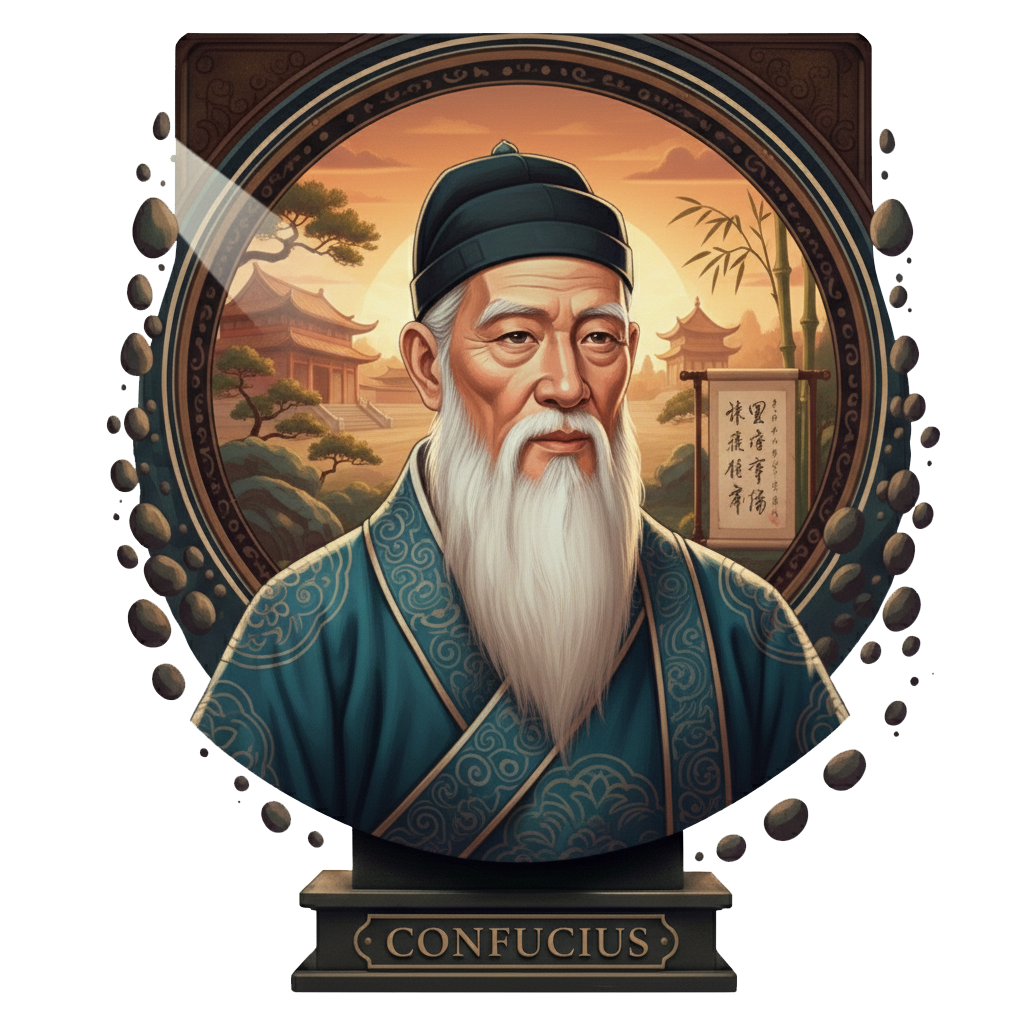
At a glance
- Born
- 551 BCE
- Died
- 479 BCE
- Era classification
- 72
- Homeland
- China
- Period
- Spring and Autumn period
- Field
- Philosophy & Ideology
- Language
- Old Chinese
- Religion
- Confucianism
- Gender
- male
Biography
Confucius was born in 551 BCE in the State of Lu (modern-day Shandong Province) during China's Spring and Autumn period. Born into the 'shi' class—a social tier between aristocrats and commoners—he was raised in poverty by his mother after the early death of his father. Despite his modest upbringing, he developed an insatiable thirst for learning, mastering the classical traditions, rituals, and music of the Zhou Dynasty, which he believed held the key to restoring order to a fractured world.
Throughout his life, Confucius sought to implement his political ideals by serving in various government roles, eventually rising to the position of Minister of Crime in his home state. However, disillusioned by the moral decay and political corruption of the ruling elite, he resigned from his post. He subsequently embarked on a long self-imposed exile, traveling with a group of devoted disciples from state to state, hoping to find a ruler who would embrace his vision of ethical governance.
At the core of his philosophy was a deeply humanistic worldview that emphasized personal and governmental morality, the correctness of social relationships, justice, and sincerity. He championed the concept of 'Ren' (benevolence or humaneness) and 'Xiao' (filial piety), arguing that a harmonious society is built upon strong family bonds and respect for elders. He is also famous for articulating an early version of the Golden Rule: 'Do not do unto others what you do not want done to yourself.'
Although Confucius died in 479 BCE believing his mission had been a failure, his legacy proved to be monumental. His teachings, compiled by his followers into the 'Analects', became the bedrock of Chinese education, statecraft, and social ethics for over two millennia. Confucianism evolved into a dominant philosophical and quasi-religious system that has indelibly shaped the cultural DNA of China, Korea, Japan, and Vietnam.
Portrayal characteristics
Saved editorial descriptions used for the reconstruction; these are not authenticated statements by the depicted person.
- Ethical
- Wise
- Principled
- Traditionalist
- Humanistic
- Pedagogical
Images & artwork 4


Connections
Voltaire
Intellectual Influence
Voltaire viewed Confucius as a paragon of rational, secular morality and used his teachings to critique European religious institutions.
During the Enlightenment, Voltaire praised Confucianism for its emphasis on ethics without the need for divine revelation. He frequently cited Confucius in his works to argue that a society could be virtuous and orderly based solely on human reason rather than theological dogma.
Leo Tolstoy
Intellectual Influence
Tolstoy was deeply influenced by Confucian ethics later in his life, incorporating its principles of moral self-improvement into his own philosophy.
Tolstoy studied the Analects and other Confucian texts extensively, seeing parallels between Chinese thought and his own interpretation of Christian ethics. He translated and published selections of Confucius's sayings for a Russian audience in his work 'The Path of Life'.
Known for
- Founding Confucianism
- The Analects
- Concept of Filial Piety (Xiao)
- The Golden Rule (Silver Rule)
- Emphasis on Benevolence (Ren)
Episodes featuring or mentioning this figure
No eligible published episode featuring this figure is currently in the library.