



David Hume
Scottish Enlightenment philosopher famous for his highly influential system of radical empiricism and skepticism.
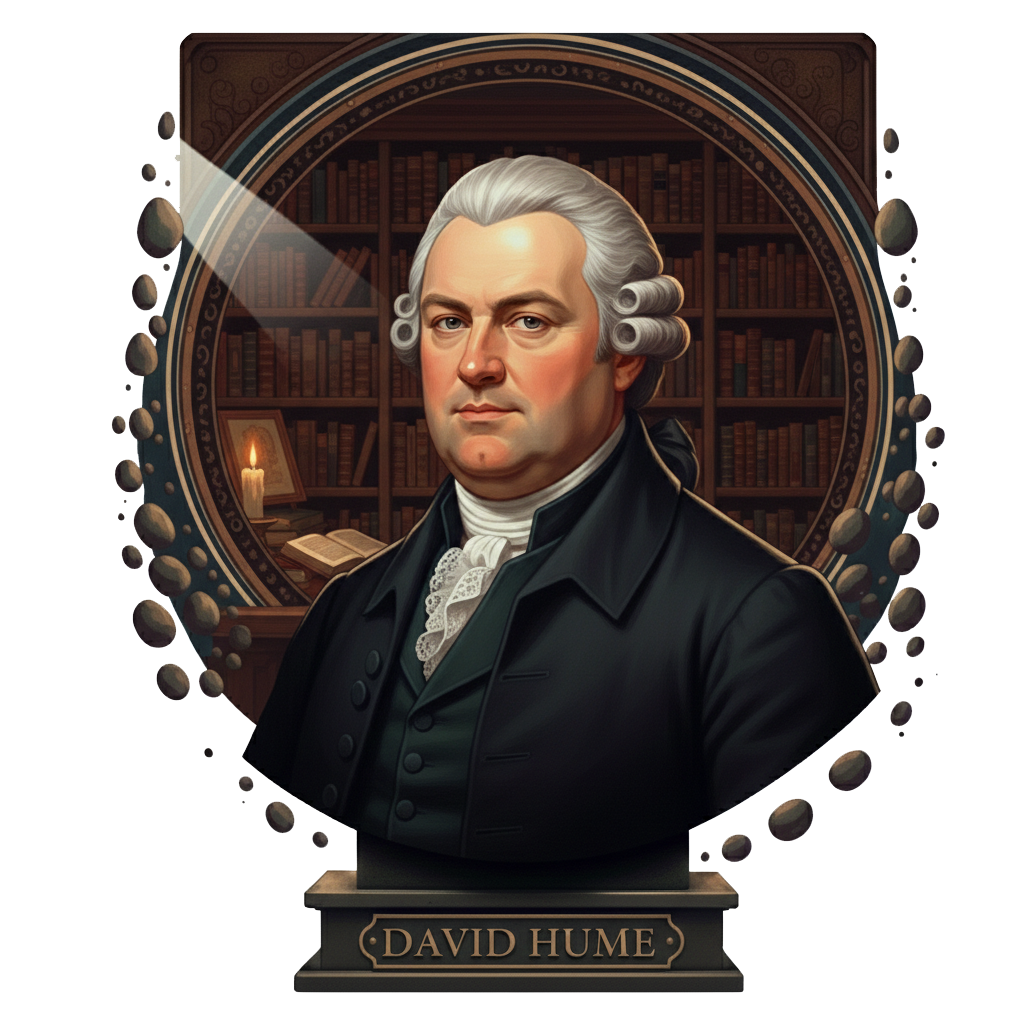
At a glance
- Born
- 7 May 1711 CE
- Died
- 25 August 1776 CE
- Era classification
- 65
- Homeland
- Scotland, Great Britain
- Period
- 1711–1776
- Field
- Philosophy & Ideology
- Language
- English
- Religion
- Agnostic / Atheist
- Gender
- male
Biography
David Hume was born in Edinburgh, Scotland, in 1711. He attended the University of Edinburgh at an unusually early age, initially pressured by his family to study law. However, he soon found an "insurmountable aversion to everything but the pursuits of Philosophy and general Learning," dedicating his life to intellectual inquiry and the study of human nature.
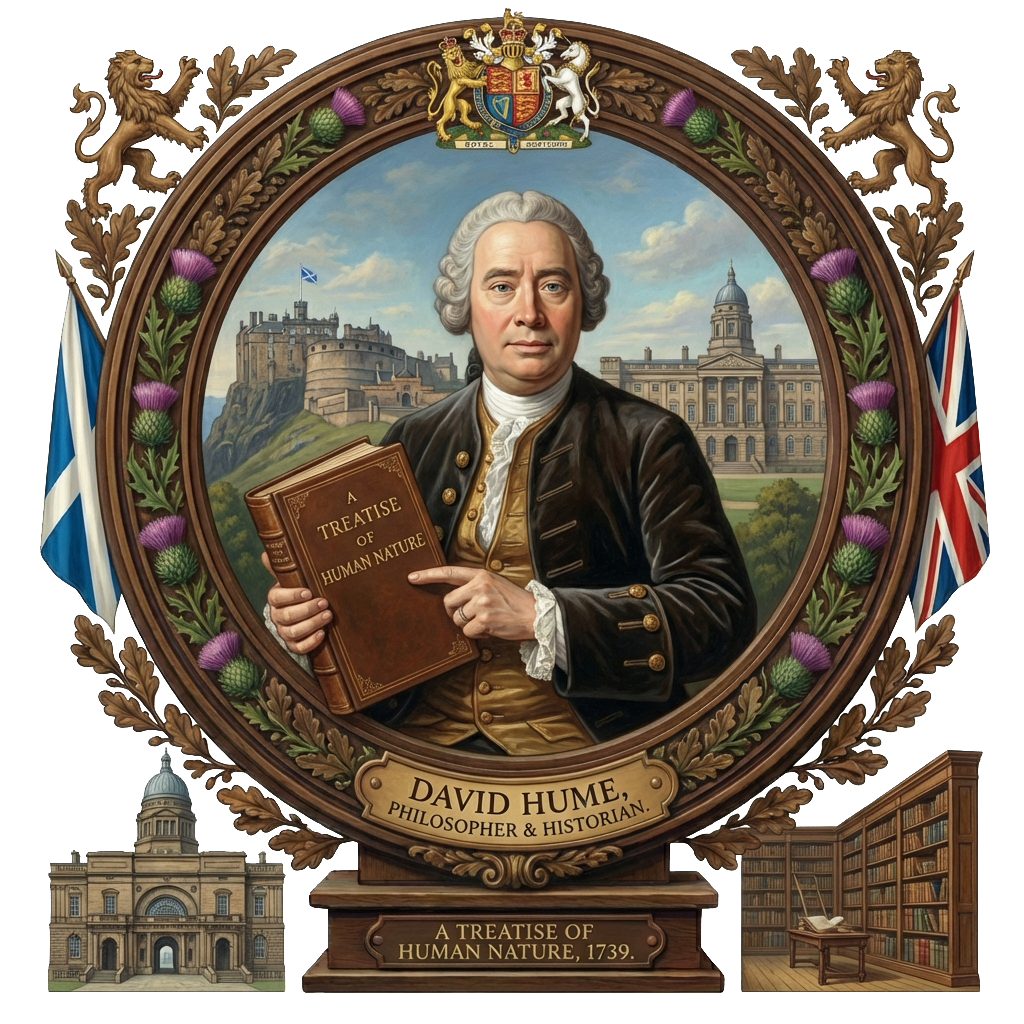
In 1739–1740, Hume published his magnum opus, 'A Treatise of Human Nature'. Although he famously noted that it "fell dead-born from the press," the work later became recognized as a cornerstone of Western philosophy. Hume argued that all human knowledge is restricted to experience, challenging the rationalist belief in innate ideas. He famously questioned the logical basis of causality and induction, asserting that our belief in cause and effect is based on custom and mental habit rather than strict rational proof.
Beyond his purely philosophical treatises, Hume achieved immense contemporary fame as an essayist and historian. His monumental six-volume 'The History of England' became a standard bestseller and the definitive history of the nation for decades. He also wrote extensively on religion, economics, and ethics, notably arguing that morality is grounded in human sentiment and sympathy rather than abstract reason, famously stating that "reason is, and ought only to be the slave of the passions."
Hume's radical skepticism awoke Immanuel Kant from his "dogmatic slumber" and deeply influenced utilitarianism, logical positivism, and modern cognitive science. He died in Edinburgh in 1776, maintaining a cheerful, secular composure to the very end. His peaceful death in the absence of religious belief astonished his contemporaries and cemented his legacy as one of the most profound and amiable thinkers of the Enlightenment.
Portrayal characteristics
Saved editorial descriptions used for the reconstruction; these are not authenticated statements by the depicted person.
- Skeptical
- Analytical
- Empirical
- Amiable
- Secular
- Pragmatic
Images & artwork 4


Connections
Immanuel Kant
Intellectual Provocateur
Hume's skeptical philosophy famously 'interrupted' Kant's 'dogmatic slumber,' leading him to develop his transcendental idealism.
Kant credited Hume's critique of causality with forcing him to rethink the foundations of metaphysics. This intellectual challenge directly resulted in the publication of the 'Critique of Pure Reason,' which sought to bridge the gap between Hume's empiricism and rationalism.
Jean-Jacques Rousseau
Contemporary Friends & Rivals
Hume hosted Jean-Jacques Rousseau in England to protect him from persecution, though their relationship ended in a bitter public feud.
In 1766, Hume brought Rousseau to Britain to escape legal troubles in France and Switzerland. However, Rousseau's increasing paranoia led him to believe Hume was part of a conspiracy against him, resulting in a series of public letters that captivated the European intellectual community.
John Locke
Philosophical Influence
Hume built upon and refined the empiricist foundations established by John Locke.
As a key figure in the British Empiricist tradition, Hume took Locke's idea that all knowledge comes from experience to its logical extreme. He critiqued Locke's concepts of substance and the self, pushing empiricism toward a more radical skepticism.
Voltaire
Enlightenment Contemporaries
Hume and Voltaire were the leading figures of the Scottish and French Enlightenments, respectively, and met during Hume's time in Paris.
During Hume's service at the British embassy in Paris, he was celebrated by the French philosophes. Voltaire admired Hume's 'History of England' and his skeptical approach to religion, and the two maintained a mutual respect as champions of reason.
Baruch Spinoza
Philosophical Influence
Hume engaged deeply with Spinoza's metaphysical system, famously critiquing it in 'A Treatise of Human Nature'.
Hume referred to Spinoza's monism as a 'hideous hypothesis' but was nonetheless influenced by Spinoza's naturalism and his critique of miracles. Hume's own work on the nature of belief and causality often serves as a counter-point to Spinoza's rationalist determinism.
Benjamin Franklin
Close Friends
Franklin and Hume were close personal friends and intellectual correspondents.
During Franklin's time in Great Britain, he stayed with Hume in Scotland and the two engaged in deep discussions on philosophy and science. Hume was a vocal admirer of Franklin's scientific discoveries and supported his early efforts to reconcile the American colonies with the British Crown.
Immanuel Kant
Philosophical Influence
Kant famously credited Hume with interrupting his "dogmatic slumber" and prompting his critical philosophy.
Hume's skepticism regarding causality and induction forced Kant to rethink the foundations of metaphysics, leading to the 'Critique of Pure Reason' where he attempted to bridge empiricism and rationalism.
John Locke
Philosophical Successor
Hume expanded upon the empiricist foundations laid by Locke, though he took them to more skeptical conclusions.
Hume's 'A Treatise of Human Nature' refined Locke's theory that all knowledge comes from experience, further analyzing the mechanics of human perception and the limits of reason.
Jean-Jacques Rousseau
Acquaintances & Rivals
Hume provided refuge for Rousseau in England during his exile from France, though the relationship ended in a bitter feud.
Rousseau's increasing paranoia led him to believe Hume was part of a conspiracy against him. The resulting public quarrel between the two philosophers became a major intellectual scandal across Europe.
Known for
- A Treatise of Human Nature
- The Problem of Induction
- The Is-Ought Problem
- Bundle theory of the self
- The History of England
- Radical Empiricism
Episodes featuring or mentioning this figure
No eligible published episode featuring this figure is currently in the library.