



John Locke
English philosopher and physician, widely regarded as the father of liberalism and a key Enlightenment thinker.
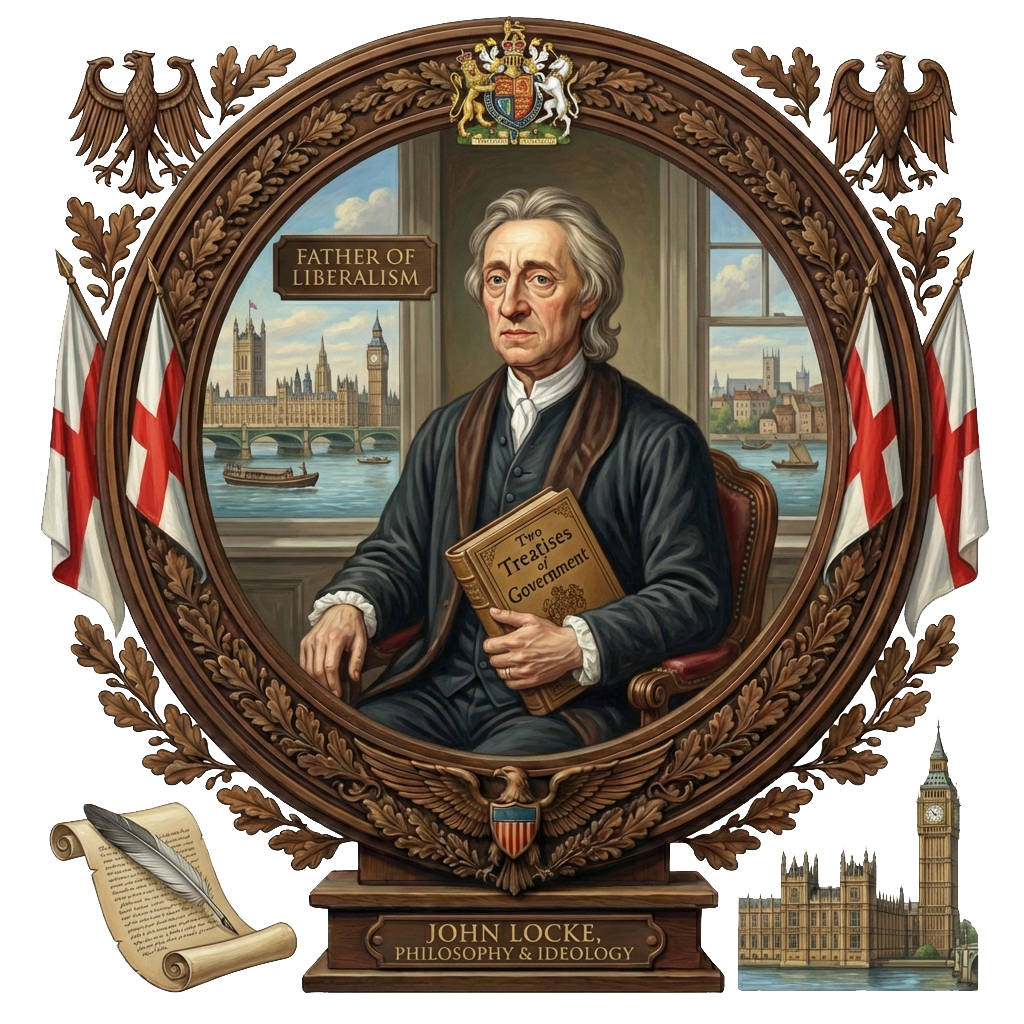
At a glance
- Born
- August 29, 1632 CE
- Died
- October 28, 1704 CE
- Era classification
- 72
- Homeland
- England
- Period
- 1632–1704 CE
- Field
- Philosophy & Ideology
- Language
- English
- Religion
- Anglican
- Gender
- male
Biography
John Locke was born in 1632 in Wrington, Somerset, England. He received an outstanding education at Westminster School and later at Christ Church, Oxford, where he studied medicine and immersed himself in the works of modern philosophers like René Descartes. His medical expertise led him to become the personal physician and close associate of Anthony Ashley Cooper, the 1st Earl of Shaftesbury, a relationship that profoundly shaped Locke's political ideas and career.
Locke's monumental contribution to epistemology is encapsulated in his 1690 work, 'An Essay Concerning Human Understanding'. In it, he famously argued against the existence of innate ideas, proposing instead that the human mind at birth is a 'tabula rasa' or blank slate. According to Locke, all human knowledge is ultimately derived from sensory experience and subsequent reflection, establishing him as the first of the three great British empiricists.
In the realm of political philosophy, Locke's 'Two Treatises of Government' (1689) remains a cornerstone of modern democratic thought. He vehemently opposed the divine right of kings, arguing instead that legitimate government relies on a social contract and the consent of the governed. Locke asserted that all individuals possess fundamental natural rights—specifically life, liberty, and property—and that the primary role of the state is to protect these rights.
Locke's intellectual legacy is vast and enduring. His advocacy for religious toleration and the separation of church and state laid the groundwork for modern secular governance. Furthermore, his articulation of natural rights and government by consent profoundly influenced the leaders of the American Revolution, echoing clearly in the Declaration of Independence. He died in 1704, leaving behind a philosophical framework that continues to underpin Western liberal democracy.
Portrayal characteristics
Saved editorial descriptions used for the reconstruction; these are not authenticated statements by the depicted person.
- Empiricist
- Rational
- Pragmatic
- Analytical
- Tolerant
- Visionary
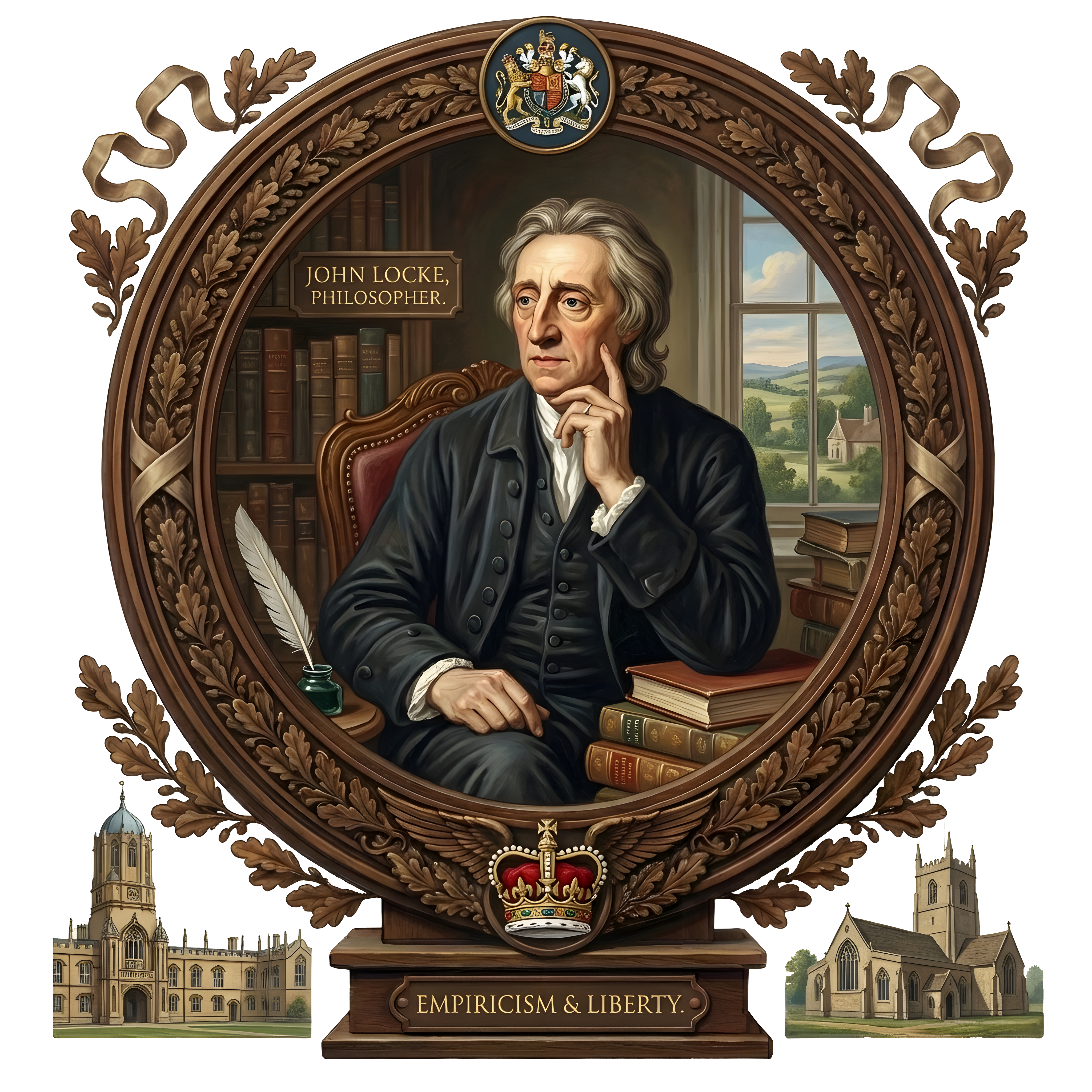
Images & artwork 5



Connections
Abraham Lincoln
Influenced By
Lincoln's political philosophy and reverence for the Declaration of Independence were deeply rooted in John Locke's theories of natural rights.
Lincoln's arguments against the expansion of slavery relied heavily on the Lockean principles of natural rights and consent of the governed, which were embedded in the American founding documents. He frequently echoed Locke's concepts of self-ownership, asserting that no man has the right to govern another without his consent. This philosophical foundation was central to Lincoln's rhetoric, including his famous debates with Stephen Douglas.
David Hume
Philosophical Influence
Hume built upon and refined the empiricist foundations established by John Locke.
As a key figure in the British Empiricist tradition, Hume took Locke's idea that all knowledge comes from experience to its logical extreme. He critiqued Locke's concepts of substance and the self, pushing empiricism toward a more radical skepticism.
Gottfried Wilhelm Leibniz
Philosophical Opponents
Leibniz's 'New Essays on Human Understanding' was a comprehensive, point-by-point critique of Locke's empiricism.
Leibniz argued against Locke's 'tabula rasa' (blank slate) theory, famously adding 'except the intellect itself' to the empiricist maxim. He maintained that the mind possesses innate structures and 'petites perceptions' that Locke's sensory-based model could not account for.
Immanuel Kant
Philosophical Rival
Kant's transcendental idealism was a direct response to the empiricism championed by Locke.
Kant critiqued Locke's 'Essay Concerning Human Understanding' for failing to account for the active role the mind plays in structuring experience through categories and forms of intuition.
Isaac Newton
Contemporary Allies
Newton and Locke were close friends who shared interests in theology, science, and the limits of human knowledge.
Locke was greatly influenced by Newton's empirical success, describing himself as an 'under-labourer' clearing the ground for 'the incomparable Mr. Newton' in his philosophical writings.
Isaac Newton
Intellectual Peers
Locke and Newton were close friends and fellow members of the Royal Society who shared interests in theology and science.
Locke was one of the few people Newton trusted with his private theological manuscripts, and Locke's 'An Essay Concerning Human Understanding' was deeply influenced by the empirical, scientific method championed by Newton.
Thomas Hobbes
Philosophical Rivals
Locke's political philosophy is often viewed as a direct liberal rebuttal to the absolutism proposed by Thomas Hobbes.
While both used the concept of a 'social contract,' Locke argued for natural rights and the right to revolution in 'Two Treatises of Government,' contrasting sharply with Hobbes's 'Leviathan,' which advocated for an absolute sovereign to prevent social chaos.
Thomas Jefferson
Ideological Influence
Jefferson considered Locke one of the three greatest men to have ever lived and drew heavily from his work when drafting the Declaration of Independence.
Locke's concepts of natural rights—life, liberty, and property—and the idea that government derives its power from the consent of the governed are the foundational principles of the American democratic experiment.
Voltaire
Ideological Successor
Voltaire was instrumental in introducing Locke's empiricism and political liberalism to the French Enlightenment.
In his 'Letters on the English,' Voltaire praised Locke's rejection of innate ideas and his advocacy for religious toleration, using Locke's philosophy as a weapon against French institutional absolutism.
David Hume
Philosophical Successor
Hume expanded upon the empiricist foundations laid by Locke, though he took them to more skeptical conclusions.
Hume's 'A Treatise of Human Nature' refined Locke's theory that all knowledge comes from experience, further analyzing the mechanics of human perception and the limits of reason.
Immanuel Kant
Philosophical Influence
Kant's 'Critique of Pure Reason' was a monumental attempt to synthesize Locke's empiricism with continental rationalism.
Kant credited the empiricist tradition (Locke and Hume) with waking him from his 'dogmatic slumber,' leading him to investigate how the mind structures experience beyond mere sensory input.
Jean-Jacques Rousseau
Philosophical Successor
Rousseau built upon and critiqued Locke's earlier theories regarding the social contract and education.
In 'The Social Contract', Rousseau expanded on Locke's ideas of civil society but argued for a more radical form of direct democracy and the 'general will' as opposed to Locke's emphasis on individual property rights.
René Descartes
Philosophical Opponents
Locke's empiricism was developed largely as a rebuttal to Descartes' theory of innate ideas.
In 'An Essay Concerning Human Understanding', Locke explicitly challenged the Cartesian notion that the mind is born with certain ideas. This debate between Cartesian rationalism and Lockean empiricism defined much of the Enlightenment's intellectual trajectory.
Thomas Hobbes
Philosophical Rivals
Hobbes and Locke are the two most influential social contract theorists, offering opposing views on human nature and governance.
While Hobbes argued in 'Leviathan' for absolute sovereignty to prevent a 'war of all against all,' Locke's later work argued for limited government and natural rights, serving as a direct intellectual counterpoint.
Thomas Jefferson
Influenced By
Locke's theories on natural rights and the social contract were the primary inspiration for Jefferson's political philosophy.
Jefferson considered Locke one of the three greatest men to have ever lived. The language of the Declaration of Independence, particularly regarding 'life, liberty, and the pursuit of happiness,' is a direct adaptation of Lockean principles.
Voltaire
Influenced By
Voltaire was a profound admirer of Locke’s empiricism and political liberalism, which he encountered during his exile in England.
Voltaire's 'Letters on the English' played a crucial role in introducing Locke's ideas on religious tolerance and constitutional government to the French public, laying the groundwork for the French Enlightenment.
Known for
- Father of Liberalism
- Tabula rasa (blank slate) concept
- Natural rights (life, liberty, property)
- Social contract theory
- British Empiricism
- Two Treatises of Government
Episodes featuring or mentioning this figure
No eligible published episode featuring this figure is currently in the library.