



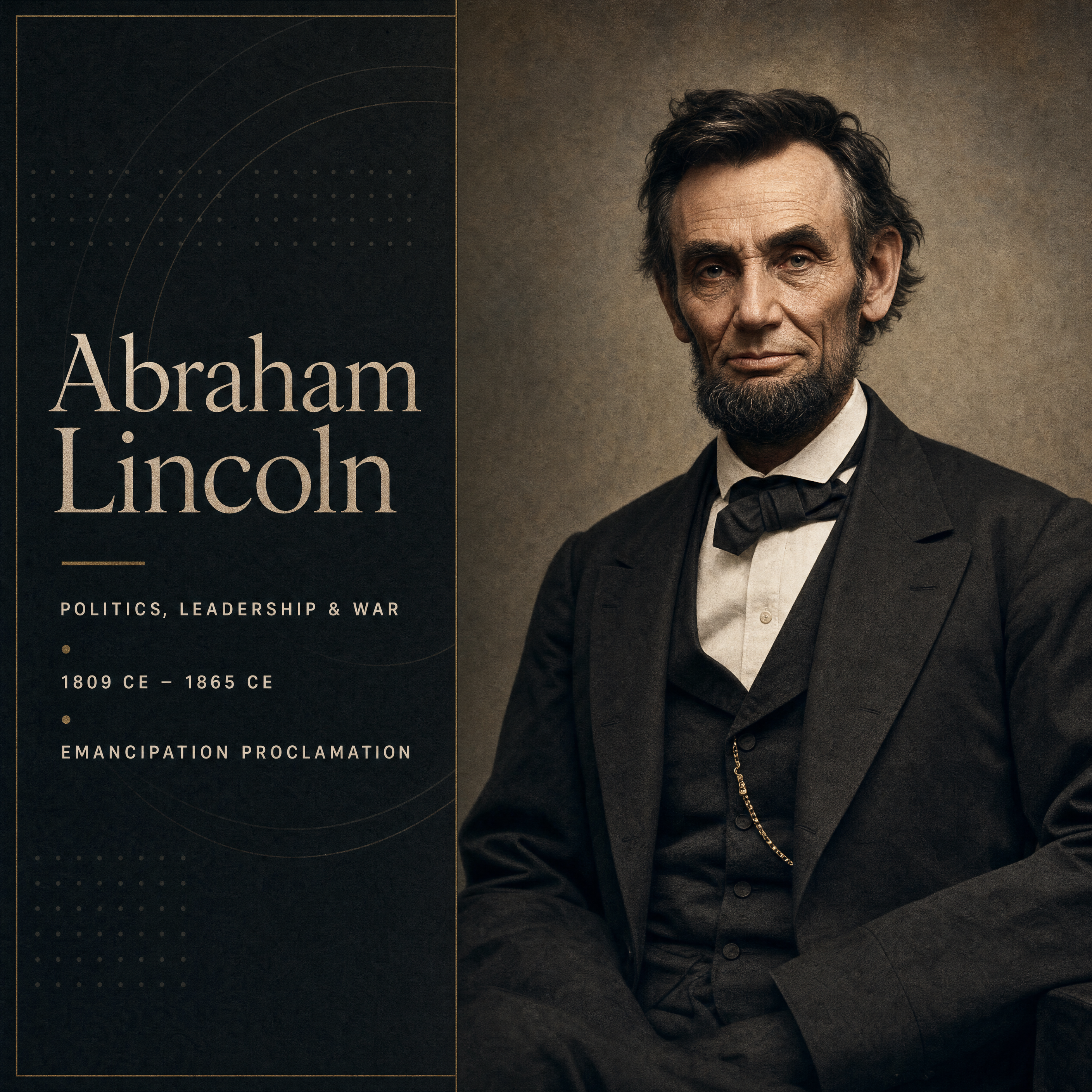
Abraham Lincoln
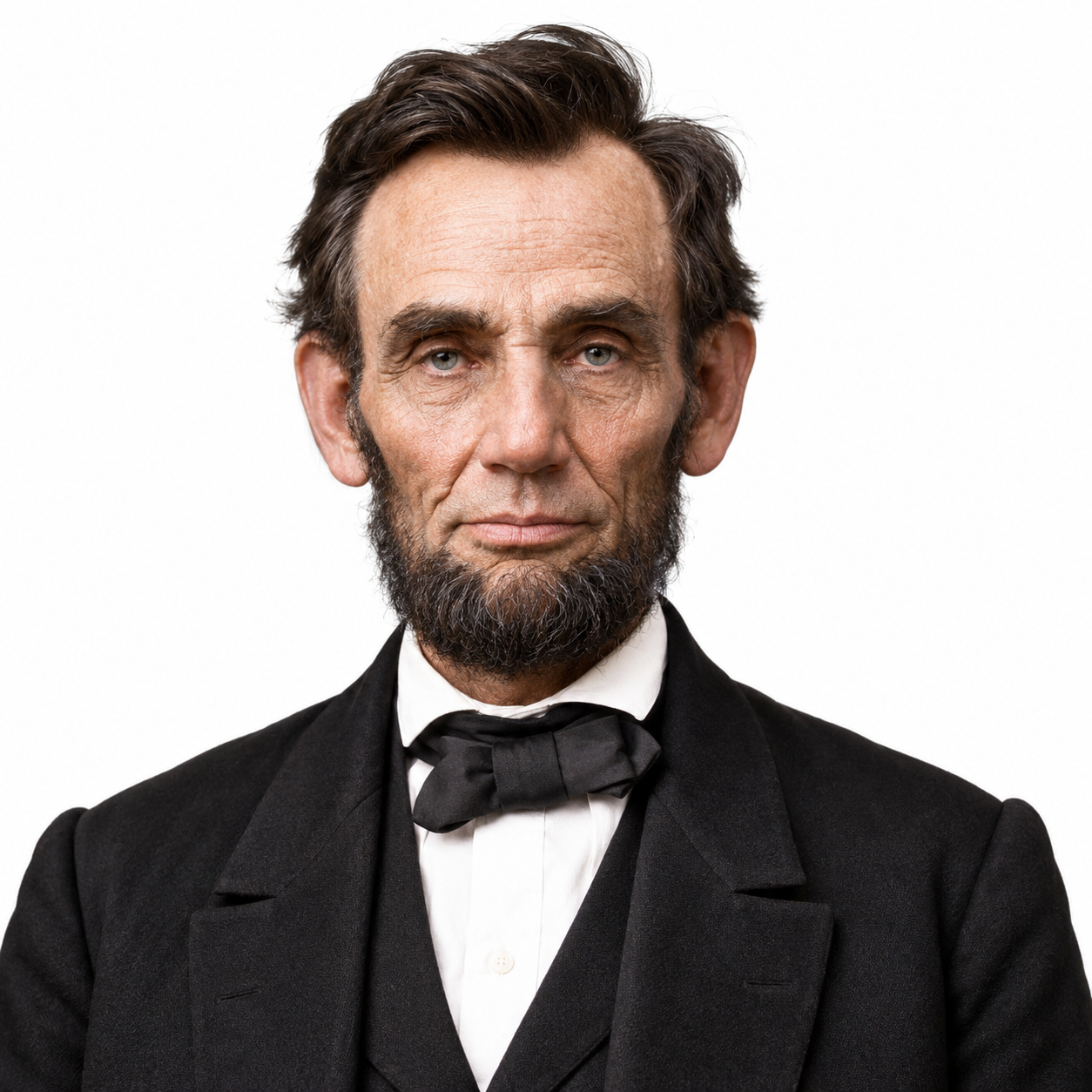
The 16th U.S. president who led the nation through the Civil War, preserved the Union, and abolished slavery.
At a glance
- Born
- 1809 CE
- Died
- 1865 CE
- Era classification
- 56
- Homeland
- USA
- Period
- 1809–1865
- Field
- Politics, Leadership & War
- Language
- English
- Religion
- Christian
- Gender
- male
Biography
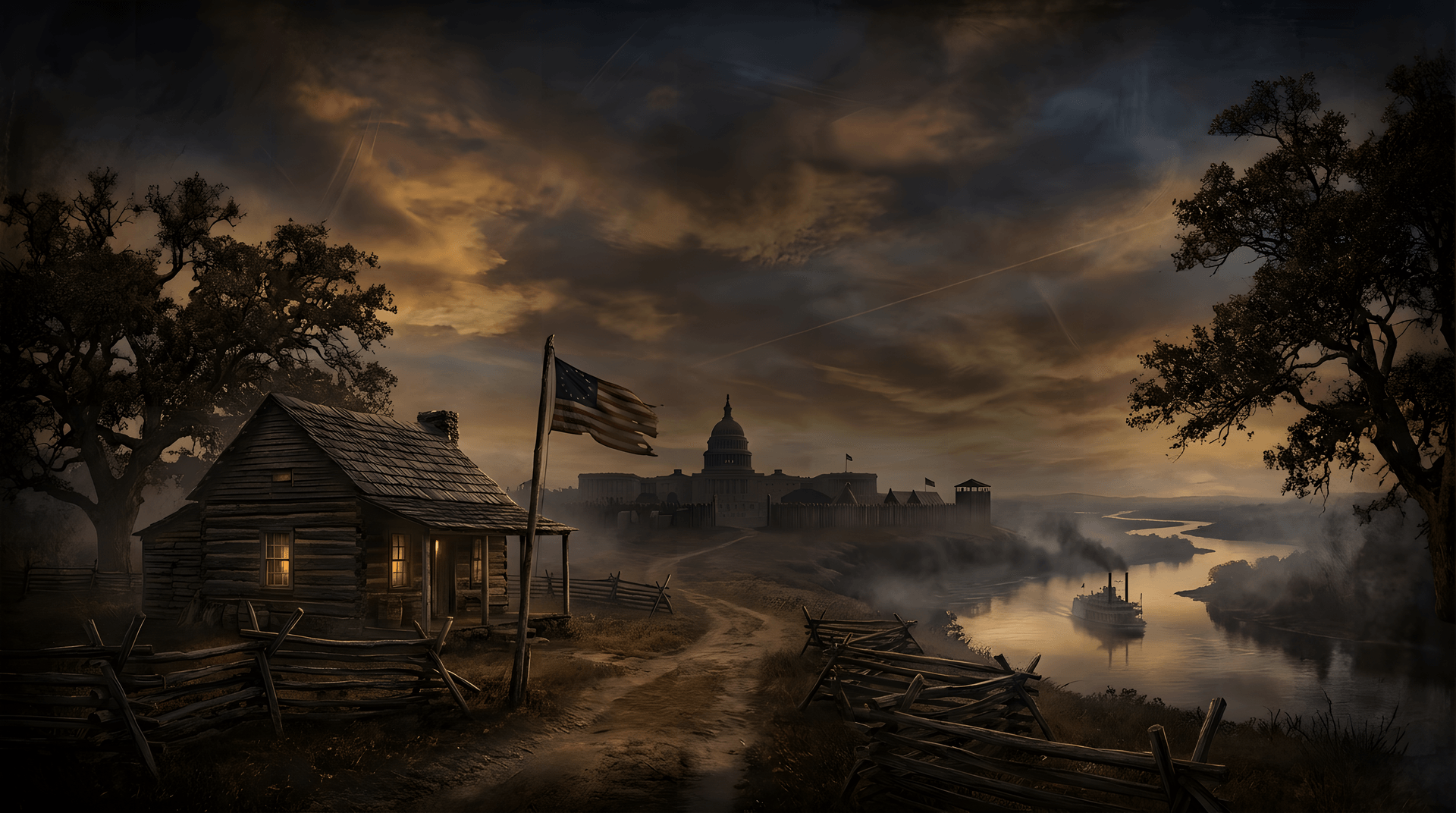
Abraham Lincoln was born into poverty in a log cabin in Kentucky and raised on the American frontier. Largely self-educated, he developed a voracious appetite for reading and eventually became a self-taught lawyer, Whig Party leader, and state legislator in Illinois. His reputation for honesty and his formidable debating skills propelled him into national politics, particularly during the highly publicized 1858 Senate campaign against Stephen A. Douglas, where Lincoln articulated a strong moral opposition to the expansion of slavery.
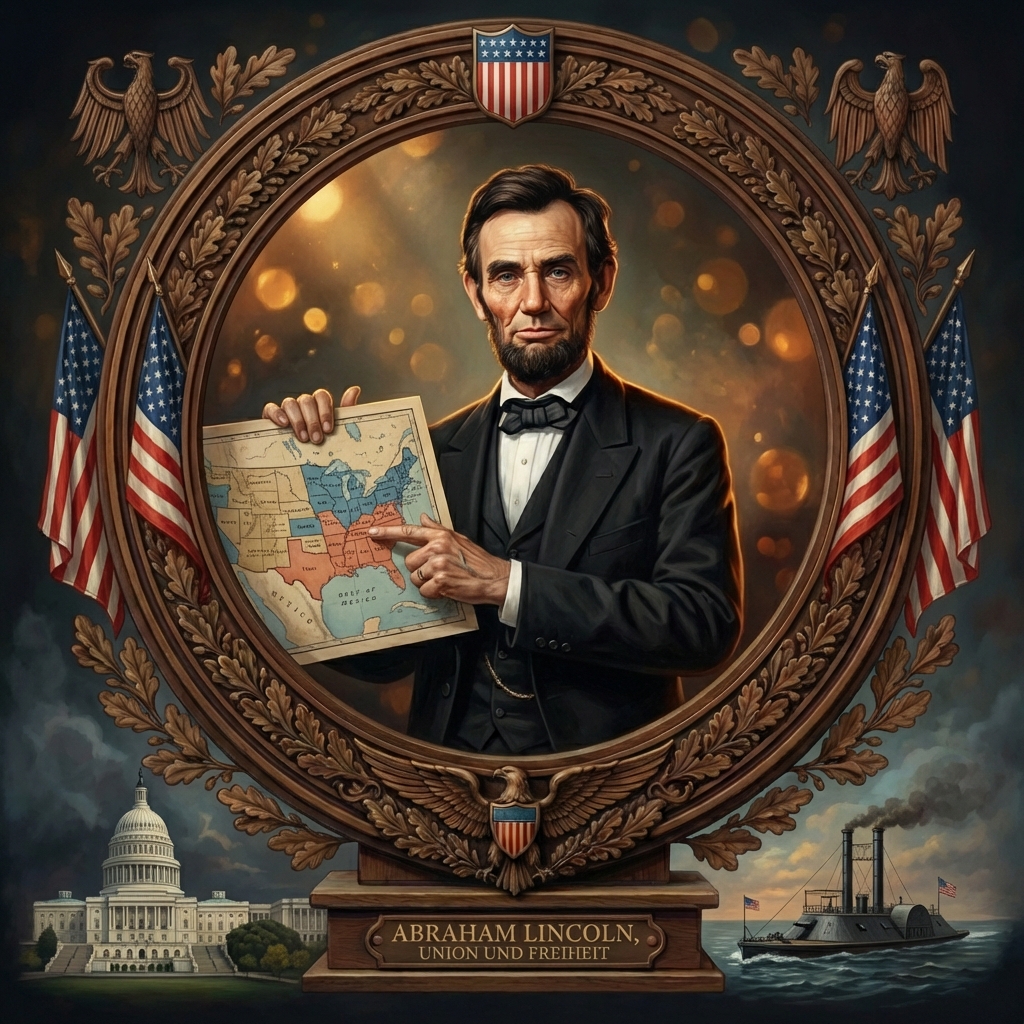
In 1860, Lincoln was elected as the 16th President of the United States. His victory, achieved entirely with Northern electoral votes, prompted seven Southern slave states to secede and form the Confederacy before he even took office. When Confederate forces attacked Fort Sumter in April 1861, Lincoln called up volunteers to suppress the rebellion, plunging the nation into the American Civil War. As a wartime leader, he proved to be a masterful political and military strategist, expertly navigating the competing factions of his cabinet and the deeply divided public.
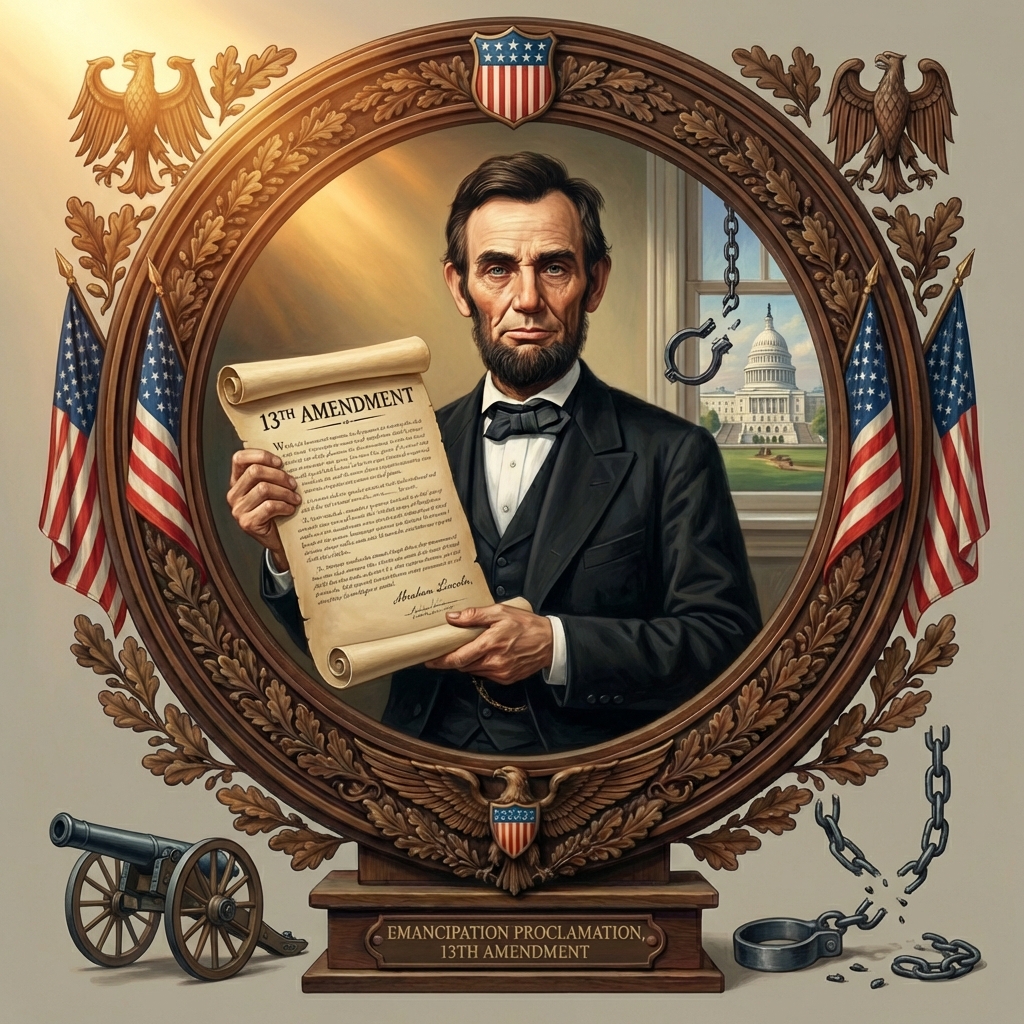
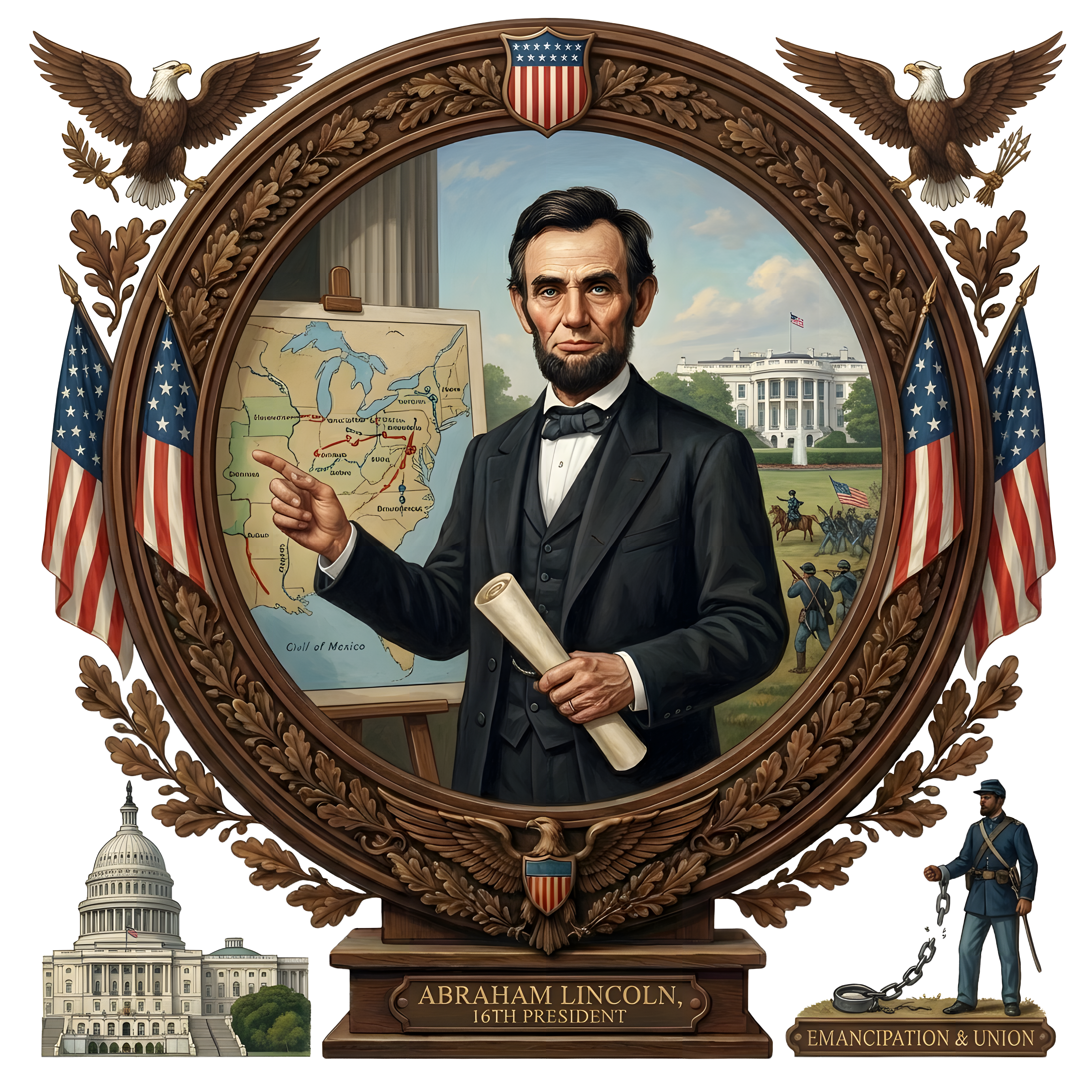
Lincoln's defining legacy was cemented on January 1, 1863, when he issued the Emancipation Proclamation, declaring forever free those slaves within the Confederacy. Later that year, he delivered the Gettysburg Address, a profound and concise dedication of a military cemetery that redefined the war's purpose as a struggle for human equality and a 'new birth of freedom.' He subsequently pushed for the 13th Amendment to the U.S. Constitution, which permanently abolished slavery nationwide.
Tragically, Lincoln did not live to see the fully reunited nation he had fought so hard to preserve. On April 14, 1865, just days after the surrender of the primary Confederate army, he was assassinated by Confederate sympathizer John Wilkes Booth at Ford's Theatre in Washington, D.C. He died the following morning, instantly becoming a national martyr. Today, Lincoln is consistently ranked by scholars and the public as one of the greatest presidents in American history.
Portrayal characteristics
Saved editorial descriptions used for the reconstruction; these are not authenticated statements by the depicted person.
- Resilient
- Eloquent
- Pragmatic
- Compassionate
- Melancholic
- Visionary
Images & artwork 9
Connections
Theodore Roosevelt
Posthumous Influence
Theodore Roosevelt deeply admired Lincoln, viewing him as the ultimate model for presidential leadership and moral courage.
As a young boy, Roosevelt witnessed Lincoln's funeral procession in New York City, an event that left a lasting impression on him. During his own presidency, Roosevelt frequently cited Lincoln as his greatest political hero and modeled his expansive view of executive power on Lincoln's wartime leadership. Roosevelt even wore a ring containing a lock of Lincoln's hair, gifted to him by Lincoln's former secretary John Hay, during his 1905 inauguration.
Martin Luther King Jr.
Posthumous Influence
Martin Luther King Jr. drew heavily upon Lincoln's legacy of emancipation, most famously delivering his 'I Have a Dream' speech at the Lincoln Memorial.
Exactly one hundred years after Lincoln issued the Emancipation Proclamation, King stood in the symbolic shadow of the 16th President during the 1963 March on Washington. King deliberately invoked Lincoln's rhetoric and legacy to highlight the unfulfilled promises of equality and civil rights in America. Lincoln's framing of the American democratic experiment served as a foundational text for King's own moral and political arguments.
Euclid of Alexandria
Influenced By
Lincoln intensely studied Euclid's mathematical proofs to hone his logical reasoning and legal argumentation.
As a self-taught lawyer and politician, Lincoln realized he needed a better grasp of formal logic to effectively argue his cases. He carried a copy of Euclid's 'Elements' with him while traveling the judicial circuit, eventually mastering the first six books. He frequently applied Euclidean logic to his political arguments against slavery, demonstrating that if all men are created equal, certain unalienable rights must logically follow.
John Locke
Influenced By
Lincoln's political philosophy and reverence for the Declaration of Independence were deeply rooted in John Locke's theories of natural rights.
Lincoln's arguments against the expansion of slavery relied heavily on the Lockean principles of natural rights and consent of the governed, which were embedded in the American founding documents. He frequently echoed Locke's concepts of self-ownership, asserting that no man has the right to govern another without his consent. This philosophical foundation was central to Lincoln's rhetoric, including his famous debates with Stephen Douglas.
Benito Juárez
Contemporary Allies
Lincoln supported Juárez's republican government during the French Intervention in Mexico.
While the United States was embroiled in its own Civil War, Lincoln maintained a policy of friendship toward Juárez and refused to recognize the French-backed regime of Maximilian I. This diplomatic stance was crucial in isolating the imperial government and allowing Juárez to eventually reclaim control of Mexico.
Charles Darwin
Contemporary Peers
Darwin and Lincoln were born on the exact same day, February 12, 1809, and both transformed the 19th-century world.
The coincidence of their births is frequently cited by historians to illustrate the parallel shifts in science and politics during the era. While Darwin revolutionized the understanding of human origins, Lincoln redefined the concepts of liberty and union in the United States.
Frederick Douglass
Political Advisors
Douglass met with Lincoln several times to advocate for the rights of Black soldiers and the abolition of slavery.
Initially a critic of Lincoln's caution, Douglass eventually became a trusted advisor and friend. He pushed the President to issue the Emancipation Proclamation and to ensure equal pay and treatment for African American troops in the Union Army.
Euclid of Alexandria
Influenced (Logic)
Lincoln famously studied Euclid's 'Elements' to master the art of logical demonstration.
As a self-taught lawyer, Lincoln carried Euclid's 'Elements' with him on the legal circuit. He claimed that he could not understand the meaning of 'demonstrate' until he had mastered Euclid's proofs, a skill he later used to construct his rigorous political arguments against slavery.
Harriet Tubman
Wartime Service
Tubman served as a scout, spy, and nurse for the Union Army during Lincoln's presidency.
While it is debated if they had a formal private meeting, Tubman's military contributions were vital to the Union effort that Lincoln led. She was the first woman to lead an armed assault during the Civil War, the Combahee River Raid, which liberated over 700 slaves.
George Washington
Historical Successor
As the first President, Washington set the precedents of the office that Lincoln later relied upon to preserve the Union during the Civil War.
Lincoln frequently invoked Washington's legacy and his Farewell Address to argue against secession. Lincoln saw himself as the protector of the 'more perfect union' that Washington had helped establish and lead.
Mark Twain
Contemporary Influence
Twain's early career and literary voice were shaped by the era of the American Civil War defined by Lincoln.
Although they never met, Twain's writing often grappled with the social and political shifts Lincoln initiated. Twain's transition from a young man in the South to a national literary icon mirrored the country's transformation during and after Lincoln's presidency.
Martin Luther King Jr.
Historical Inspiration
King frequently invoked Lincoln's legacy, most notably delivering his 'I Have a Dream' speech at the Lincoln Memorial.
King used the backdrop of the Lincoln Memorial to highlight that a century after the Emancipation Proclamation, the 'Negro still is not free,' effectively challenging America to live up to Lincoln's promise.
Otto von Bismarck
Contemporary State-Builders
Both leaders were contemporaries who led their respective nations through wars of unification in the 1860s.
Bismarck closely observed the American Civil War, and the two leaders are often compared for their roles in centralizing federal power and overseeing rapid industrialization in Germany and the United States.
Susan B. Anthony
Political Lobbyist & President
Anthony worked to pressure Lincoln toward the total abolition of slavery during the American Civil War.
She helped organize the Women's Loyal National League, which collected nearly 400,000 signatures to support the passage of the 13th Amendment, directly influencing Lincoln's legislative agenda.
Theodore Roosevelt
Political Idol
Roosevelt viewed Lincoln as his greatest political role model and often sought to emulate his leadership style.
Roosevelt famously wore a ring containing a lock of Lincoln's hair during his inauguration and frequently invoked Lincoln's legacy to justify his own 'Square Deal' and the expansion of federal power.
Alexis de Tocqueville
Prophetic Observer & Historical Actor
Tocqueville accurately prophesied the American Civil War over the issue of slavery, a crisis that Abraham Lincoln would later be forced to navigate.
Though they never met, Tocqueville and Abraham Lincoln are inextricably linked by the crisis of the American soul: slavery. In the 1830s, Tocqueville wrote a chillingly prophetic chapter in 'Democracy in America' stating that the presence of Black slaves was the greatest threat to the United States. He predicted that the abolition of slavery would not erase racial prejudice, but rather shift it into a fierce social and political struggle, ultimately predicting a massive, bloody conflict between the North and South. Three decades later, Abraham Lincoln became the historical actor who had to navigate the exact apocalyptic scenario Tocqueville had foreseen. Both men ultimately concluded that the American democratic experiment could not survive half-slave and half-free.
Known for
- Emancipation Proclamation
- Preserving the Union
- Gettysburg Address
- Abolition of slavery (13th Amendment)
- Leadership during the American Civil War
Episodes featuring or mentioning this figure
No eligible published episode featuring this figure is currently in the library.