



Martin Luther King Jr.
American Baptist minister and activist who became the most visible leader of the civil rights movement.
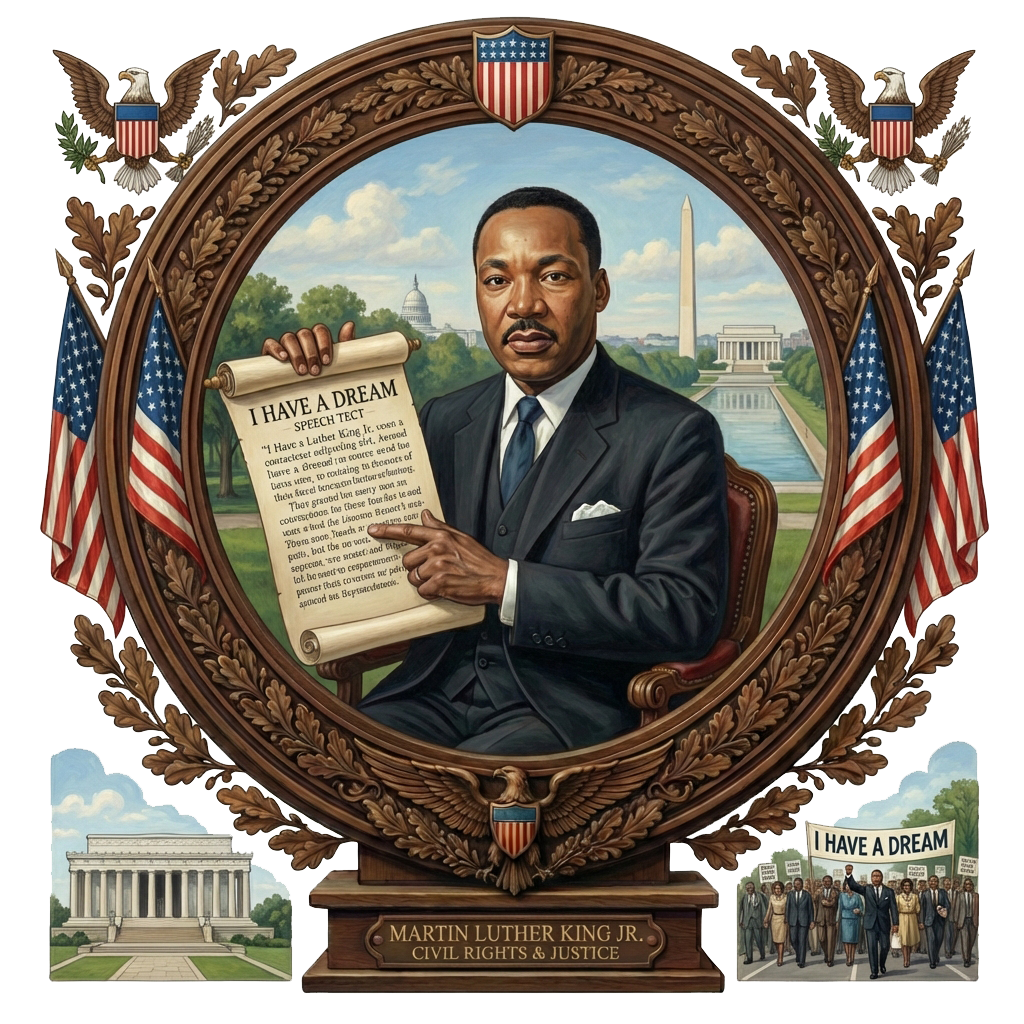
At a glance
- Born
- January 15, 1929 CE
- Died
- April 4, 1968 CE
- Era classification
- 39
- Homeland
- United States
- Period
- 1929–1968 CE
- Field
- Politics & Leadership
- Language
- English
- Religion
- Christianity (Baptist)
- Gender
- male
Biography
Born Michael King Jr. in Atlanta, Georgia, Martin Luther King Jr. grew up in a family of deeply rooted Baptist ministers. He excelled academically, attending Morehouse College, Crozer Theological Seminary, and Boston University, where he earned his Ph.D. in systematic theology. His intellectual foundation was heavily influenced by his Christian faith and the teachings of Mahatma Gandhi, which together shaped his lifelong philosophy of nonviolent civil disobedience.
King's rise to national prominence began with his leadership of the 1955 Montgomery bus boycott, a pivotal event sparked by Rosa Parks's refusal to surrender her seat. As the first president of the Southern Christian Leadership Conference (SCLC), he organized numerous peaceful protests against systemic racial segregation in the American South. His leadership during the 1963 Birmingham campaign and his iconic 'I Have a Dream' speech at the March on Washington solidified his status as a defining moral voice of the 20th century.
His tireless advocacy played an instrumental role in the passage of landmark American legislation, including the Civil Rights Act of 1964 and the Voting Rights Act of 1965. In 1964, King's efforts were globally recognized when he was awarded the Nobel Peace Prize. In his final years, he expanded his activism to oppose the Vietnam War and combat economic inequality through the Poor People's Campaign, before his tragic assassination in Memphis, Tennessee, in 1968.
Portrayal characteristics
Saved editorial descriptions used for the reconstruction; these are not authenticated statements by the depicted person.
- Charismatic
- Courageous
- Visionary
- Eloquent
- Resolute
- Compassionate
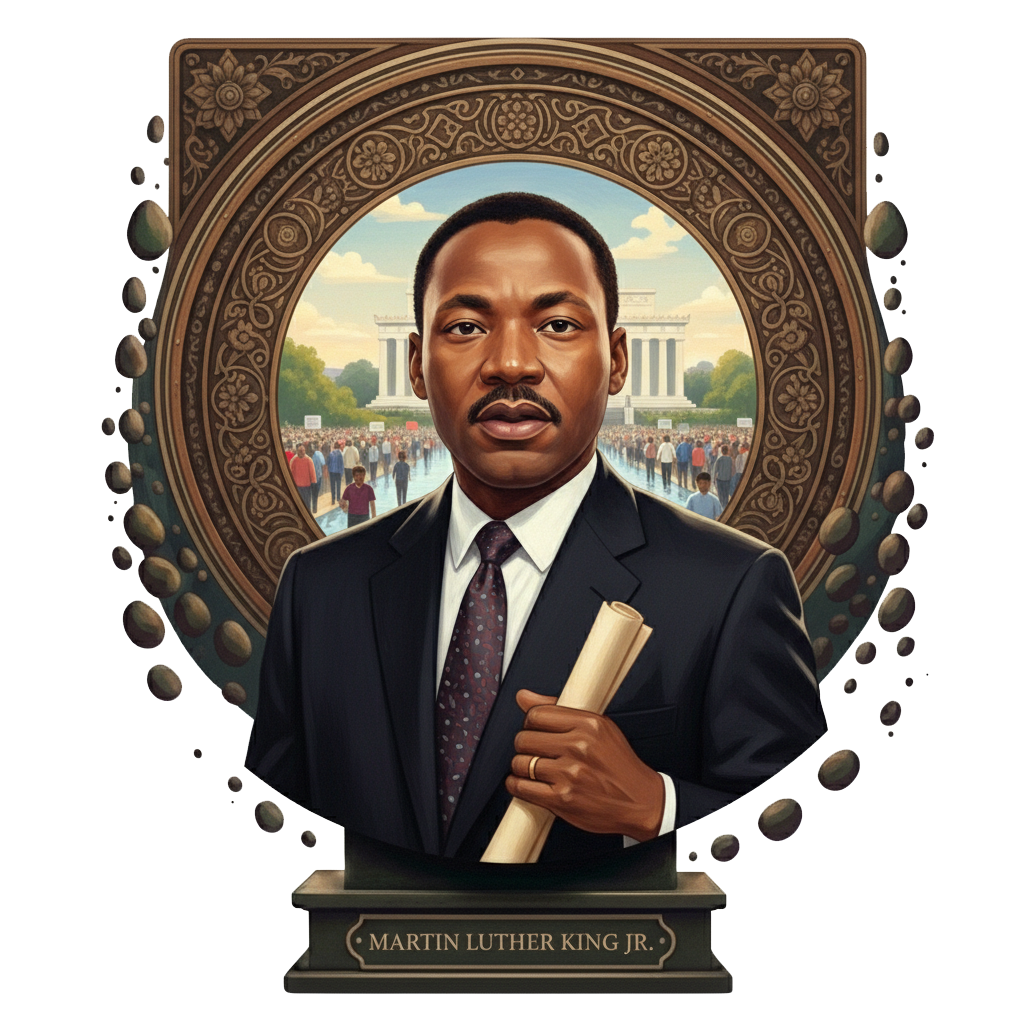
Images & artwork 5



Connections
Abraham Lincoln
Posthumous Influence
Martin Luther King Jr. drew heavily upon Lincoln's legacy of emancipation, most famously delivering his 'I Have a Dream' speech at the Lincoln Memorial.
Exactly one hundred years after Lincoln issued the Emancipation Proclamation, King stood in the symbolic shadow of the 16th President during the 1963 March on Washington. King deliberately invoked Lincoln's rhetoric and legacy to highlight the unfulfilled promises of equality and civil rights in America. Lincoln's framing of the American democratic experiment served as a foundational text for King's own moral and political arguments.
Eleanor Roosevelt
Civil Rights Allies
Eleanor was an early supporter of King and the Southern Christian Leadership Conference.
Roosevelt used her newspaper column and public platform to support the Civil Rights Movement. She met with King on several occasions and was a vocal advocate for the non-violent protests he led, often pushing the Democratic Party to take a stronger stance on racial equality.
Mahatma Gandhi
Ideological Inspiration
King adopted Gandhi's philosophy of non-violent resistance as the core strategy for the American Civil Rights Movement.
King first learned of Gandhi's teachings in seminary and later visited India in 1959 to deepen his understanding of Satyagraha. He famously stated, 'Christ gave us the goals and Mahatma Gandhi the tactics,' applying Gandhian principles to dismantle Jim Crow laws.
Malcolm X
Civil Rights Contemporaries
Malcolm X and King were the two most influential leaders of the 1960s Black freedom struggle, representing different ideological paths.
Though they met only once briefly in 1964, their legacies are inextricably linked as they debated the merits of non-violence versus self-defense. Toward the end of their lives, their positions began to converge, with Malcolm X moving toward global human rights and King becoming more radical in his critique of economic injustice.
Mahatma Gandhi
Philosophical Influence
King adopted Gandhi's principle of non-violent resistance (Satyagraha) as the core strategy for the American Civil Rights Movement.
King first learned of Gandhi's teachings while in seminary and later traveled to India in 1959. He described Gandhi as the 'guiding light' of his technique of non-violent social change.
Malcolm X
Contemporary Rivals
The two most prominent leaders of the Civil Rights Movement represented contrasting philosophies of integration versus black nationalism.
Though they only met briefly once in 1964, their public discourse and differing tactics—King's non-violence versus Malcolm's 'by any means necessary'—defined the era's struggle for racial justice.
Rosa Parks
Civil Rights Allies
Parks' refusal to give up her bus seat led to the Montgomery Bus Boycott, which King was chosen to lead.
The 1955 boycott launched King into the national spotlight as a leader. Throughout the movement, Parks and King remained symbols of the grassroots and leadership wings of the struggle.
Abraham Lincoln
Historical Inspiration
King frequently invoked Lincoln's legacy, most notably delivering his 'I Have a Dream' speech at the Lincoln Memorial.
King used the backdrop of the Lincoln Memorial to highlight that a century after the Emancipation Proclamation, the 'Negro still is not free,' effectively challenging America to live up to Lincoln's promise.
Nelson Mandela
Civil Rights Peers
Mandela and King are the two most iconic figures of the 20th-century struggle for racial equality.
Though they never met, Mandela felt a strong kinship with King's struggle in the United States. Mandela frequently referenced King's speeches and the American Civil Rights Movement as a parallel to the fight against South African apartheid.
Rosa Parks
Civil Rights Allies
Parks' arrest for refusing to give up her bus seat led to the Montgomery Bus Boycott, which King led.
The 1955 Montgomery Bus Boycott was the event that brought both Parks and King to national prominence. They worked closely within the Montgomery Improvement Association to sustain the 381-day protest that eventually ended segregation on public buses.
Known for
- Leading the American Civil Rights Movement
- Advocating nonviolent civil disobedience
- Delivering the 'I Have a Dream' speech
- Winning the 1964 Nobel Peace Prize
- Organizing the Montgomery bus boycott
- Instrumental in the Civil Rights Act of 1964
Episodes featuring or mentioning this figure
No eligible published episode featuring this figure is currently in the library.