



Mahatma Gandhi
Leader of India's nonviolent independence movement against British rule and champion of civil rights.
At a glance
- Born
- October 2, 1869 CE
- Died
- January 30, 1948 CE
- Era classification
- 78
- Homeland
- India
- Period
- 1869–1948 CE
- Field
- Politics & Leadership
- Language
- Gujarati
- Religion
- Hinduism
- Gender
- male
Biography
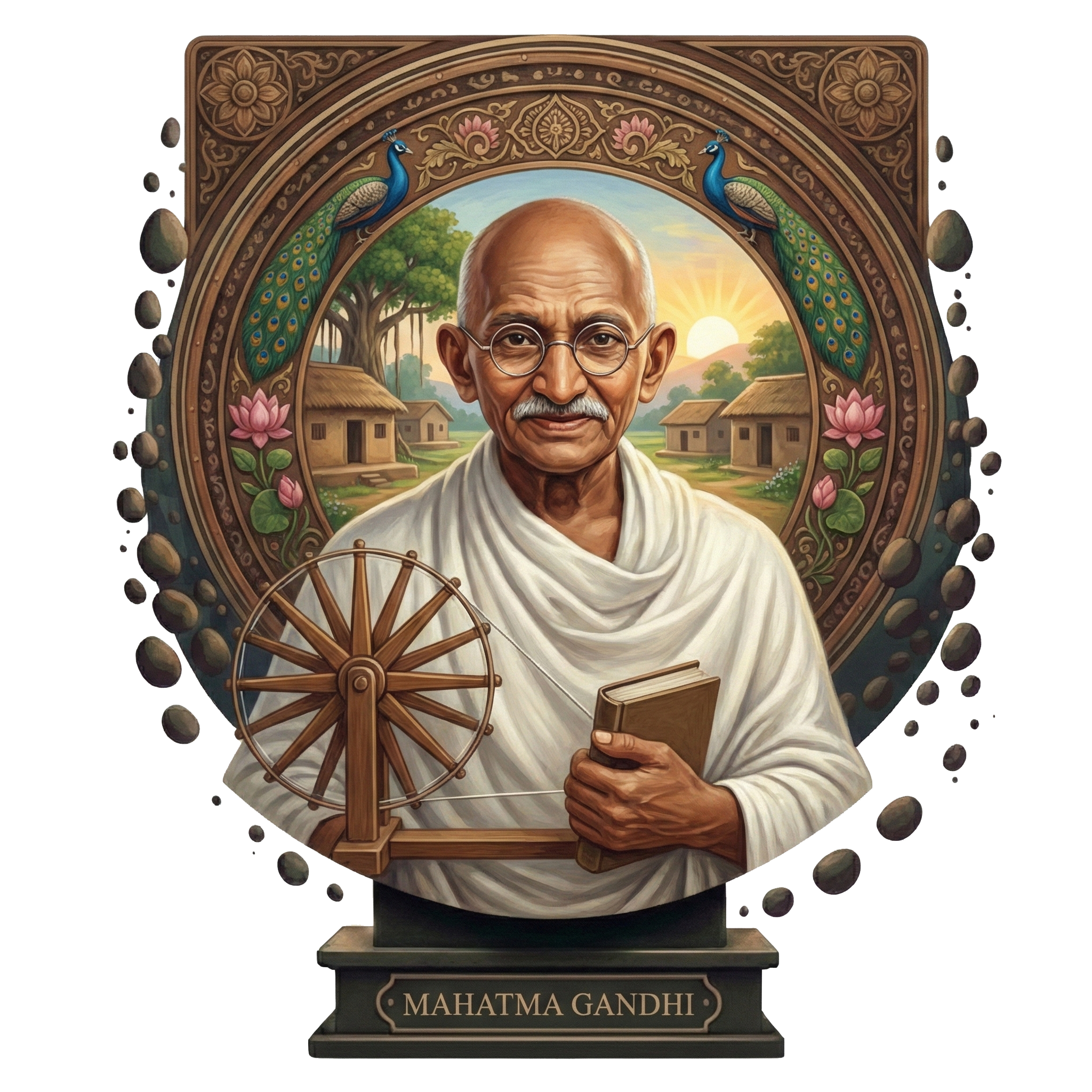
Mohandas Karamchand Gandhi, universally known as Mahatma (Great Soul), was born in 1869 in Porbandar, India. After studying law at the Inner Temple in London, he moved to South Africa in 1893 to represent an Indian merchant. It was there, facing rampant racial discrimination, that Gandhi first employed nonviolent civil disobedience as an expatriate lawyer fighting for the civil rights of the resident Indian community.
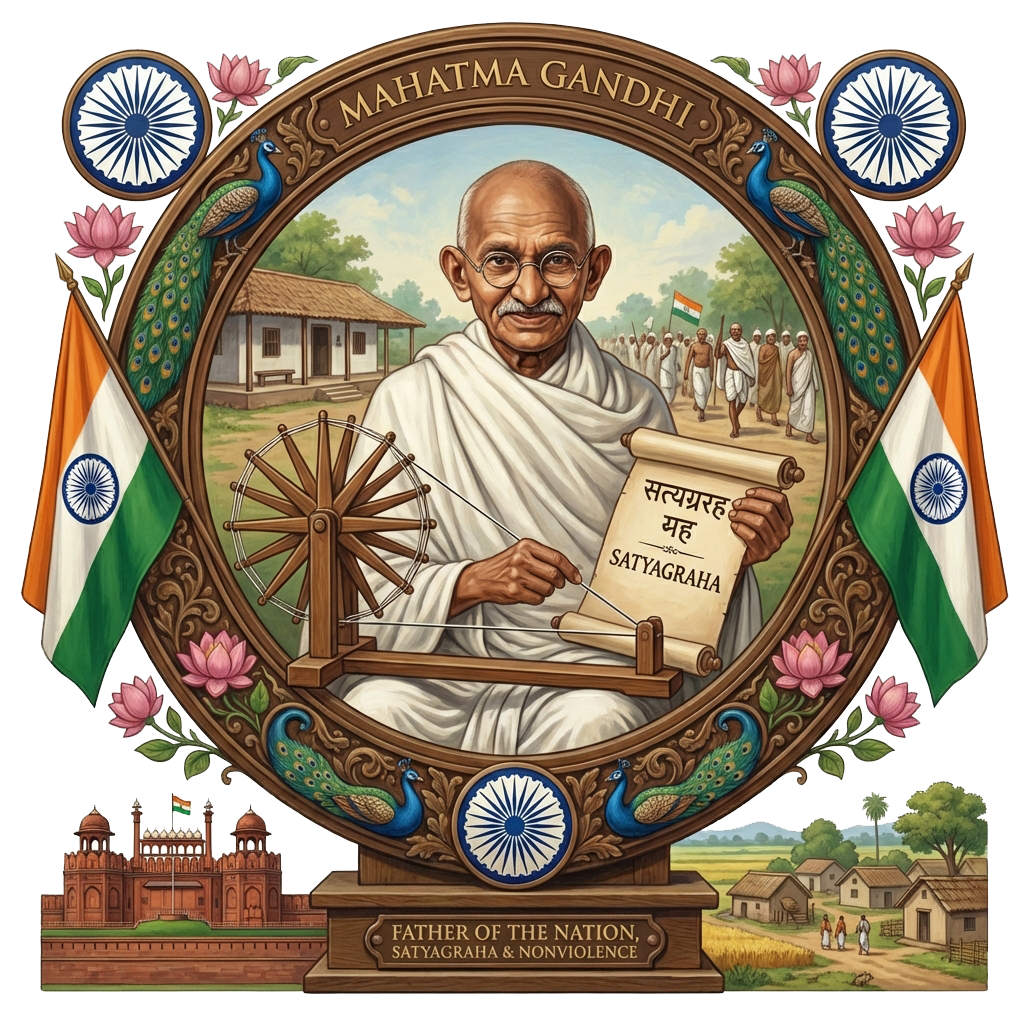
Upon returning to India in 1915, Gandhi brought his philosophy of Satyagraha—truth and firmness—to the forefront of the Indian political landscape. He assumed leadership of the Indian National Congress in 1921, leading nationwide campaigns to ease poverty, expand women's rights, build religious and ethnic amity, end untouchability, and, above all, achieve Swaraj or self-rule. His ascetic lifestyle, characterized by wearing a traditional Indian dhoti woven with yarn he hand-spun on a charkha, resonated deeply with the rural masses.
Gandhi's most famous acts of defiance included the 1930 Dandi Salt March, a 240-mile trek to protest the British salt monopoly, and the launch of the Quit India Movement in 1942, demanding an end to British rule. Though his efforts culminated in India's independence in 1947, the subsequent partition of the subcontinent into India and Pakistan brought him immense sorrow. He spent his final months undertaking fasts to stop the religious violence, until his assassination in 1948 by a Hindu nationalist.
Portrayal characteristics
Saved editorial descriptions used for the reconstruction; these are not authenticated statements by the depicted person.
- Nonviolent
- Ascetic
- Resilient
- Principled
- Compassionate
- Charismatic
Images & artwork 4
Connections
Ashoka the Great
Ideological Inspiration
Ashoka's commitment to non-violence (Ahimsa) served as a historical blueprint for Gandhi's political philosophy.
Mahatma Gandhi deeply admired Ashoka's transition from a conqueror to a peaceful ruler who governed by moral law (Dharma). The modern Indian state, led by figures like Gandhi, adopted Ashoka's Lion Capital and the Dharma Chakra (Wheel of Law) as national symbols to represent non-violence and truth.
Eleanor Roosevelt
Mutual Admirers
Eleanor Roosevelt deeply admired Gandhi's philosophy of non-violence and corresponded with him.
Though they never met in person, Eleanor was a student of Gandhi's methods. After his assassination, she visited India in 1952 to pay her respects and meet with his successors, continuing to champion his ideals of peace and human rights at the United Nations.
Leo Tolstoy
Philosophical Mentor
Gandhi was deeply influenced by Tolstoy's writings on non-violence and Christian anarchism.
The two exchanged letters during the final year of Tolstoy's life while Gandhi was in South Africa. Gandhi credited Tolstoy's book 'The Kingdom of God Is Within You' with curing his skepticism and providing a foundation for his philosophy of Satyagraha.
Rabindranath Tagore
Contemporary Peers
Tagore and Gandhi were the two most prominent figures of the Indian independence era, sharing a complex friendship.
Tagore is famously credited with conferring the title 'Mahatma' (Great Soul) upon Gandhi, while Gandhi referred to Tagore as 'The Great Sentinel.' Despite their mutual respect, they often publicly debated issues such as the role of nationalism and the effectiveness of the spinning wheel (Charkha).
Albert Einstein
Mutual Admirers
Einstein and Gandhi maintained a correspondence and held each other in the highest regard.
Einstein famously said of Gandhi that 'generations to come will scarce believe that such a one as this ever in flesh and blood walked upon this earth.' They shared a commitment to pacifism and the belief that moral force was superior to physical violence.
Martin Luther King Jr.
Ideological Inspiration
King adopted Gandhi's philosophy of non-violent resistance as the core strategy for the American Civil Rights Movement.
King first learned of Gandhi's teachings in seminary and later visited India in 1959 to deepen his understanding of Satyagraha. He famously stated, 'Christ gave us the goals and Mahatma Gandhi the tactics,' applying Gandhian principles to dismantle Jim Crow laws.
Nelson Mandela
Ideological Inspiration
Mandela viewed Gandhi as a primary influence in the struggle against apartheid in South Africa.
Mandela often cited Gandhi's early activism in South Africa as a blueprint for mass mobilization. While Mandela eventually accepted the necessity of armed struggle, he continued to honor Gandhi's legacy as a 'sacred warrior' for justice and human rights.
Winston Churchill
Political Opponents
Churchill was a staunch opponent of Gandhi and the Indian independence movement.
Churchill famously expressed contempt for Gandhi, once referring to him as a 'half-naked fakir.' Their relationship represented the fundamental clash between British imperial interests and the rising tide of Indian nationalism during the mid-20th century.
Leo Tolstoy
Philosophical Mentors
Tolstoy and Gandhi engaged in a significant correspondence regarding non-violent resistance and spiritual ethics.
Tolstoy's book 'The Kingdom of God Is Within You' profoundly influenced Gandhi's development of Satyagraha. Their letters exchanged in the final years of Tolstoy's life highlight a shared commitment to pacifism and the rejection of state-sanctioned violence.
Martin Luther King Jr.
Philosophical Influence
King adopted Gandhi's principle of non-violent resistance (Satyagraha) as the core strategy for the American Civil Rights Movement.
King first learned of Gandhi's teachings while in seminary and later traveled to India in 1959. He described Gandhi as the 'guiding light' of his technique of non-violent social change.
Mother Teresa
Ethical Influence
Mother Teresa was deeply inspired by Gandhi's principles of non-violence and his dedication to the poor in India.
Although they did not work together, Teresa adopted Gandhi's simple lifestyle and his focus on the 'untouchables' as a core part of her mission in Calcutta. She frequently cited his spirit of service as a bridge between her Catholic faith and the Indian context.
Nelson Mandela
Philosophical Influence
Mandela was deeply influenced by Gandhi's philosophy of non-violent resistance (Satyagraha).
Mandela often cited Gandhi as a primary inspiration for the anti-apartheid movement in South Africa, where Gandhi himself had first developed his political tactics. While Mandela eventually accepted the need for armed struggle, he maintained a lifelong reverence for Gandhi's moral leadership.
Rabindranath Tagore
Spiritual & Political Peers
Tagore and Gandhi were the two most influential figures of the Indian independence movement, sharing a complex and respectful friendship.
Tagore famously bestowed the title 'Mahatma' (Great Soul) upon Gandhi, while Gandhi referred to Tagore as 'The Great Sentinel' of India, despite their differing views on nationalism and modernization.
Rani Lakshmibai
Inspirational Figure
Mahatma Gandhi frequently cited Rani Lakshmibai as a symbol of Indian resistance and female bravery.
During the Indian independence movement, Gandhi and other leaders invoked the memory of the Rani of Jhansi to inspire nationalist sentiment against British colonial rule. Her 1857 rebellion served as a foundational narrative for the later non-violent and revolutionary movements led by Gandhi.
Charles de Gaulle
Parallel Figures in Decolonization
While Gandhi led the nonviolent dismantling of the British Empire, de Gaulle was forced to navigate the violent dismantling of the French Empire, representing contrasting approaches to 20th-century decolonization.
Mahatma Gandhi and Charles de Gaulle represent two monumental, yet fundamentally opposing, forces in the 20th-century process of decolonization. Gandhi's philosophy of Satyagraha successfully challenged British imperial rule, setting a moral and political precedent for anti-colonial movements worldwide. De Gaulle, conversely, initially sought to preserve the French Empire after WWII to maintain France's status as a global power. However, the relentless pressure of anti-colonial nationalism—inspired in part by the success of movements like Gandhi's—eventually forced de Gaulle's hand. When de Gaulle returned to power in 1958 amidst the brutal Algerian War, he realized that the era of traditional colonialism was over. In a pragmatic, albeit painful, pivot, de Gaulle orchestrated the independence of Algeria and sub-Saharan African colonies. While Gandhi was the architect of decolonization from below, de Gaulle became the reluctant but decisive facilitator of decolonization from above.
Known for
- Satyagraha (nonviolent resistance)
- Leading the Indian independence movement
- The 1930 Salt March
- Quit India Movement
- Advocating for religious harmony
Episodes featuring or mentioning this figure
No eligible published episode featuring this figure is currently in the library.