



Rabindranath Tagore
A Bengali polymath, poet, and philosopher who became the first non-European to win the Nobel Prize in Literature.
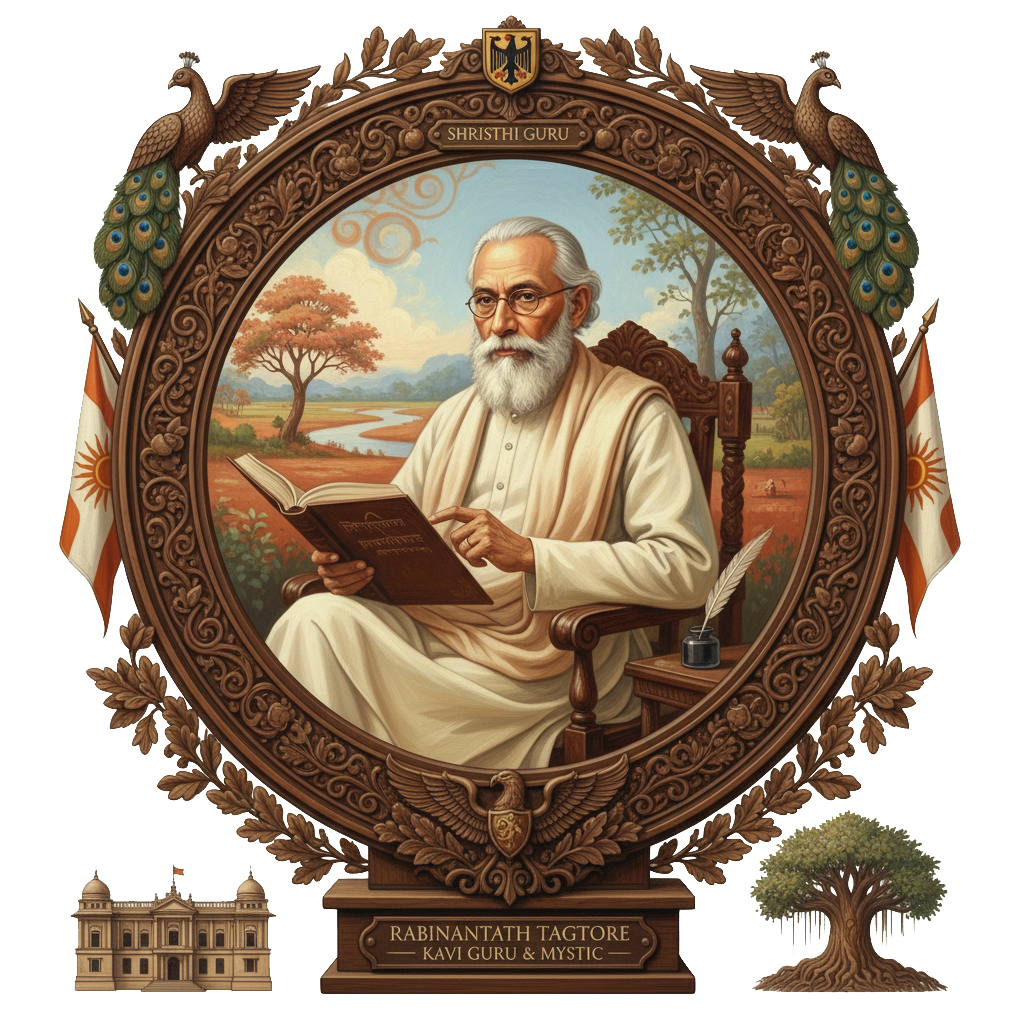
At a glance
- Born
- 1861 CE
- Died
- 1941 CE
- Era classification
- Modern
- Homeland
- India
- Period
- 19th-20th Century CE
- Field
- Poetry & Mysticism
- Language
- Bengali
- Religion
- Brahmoism
- Gender
- male
Biography
Rabindranath Tagore was a towering figure of the Bengali Renaissance, reshaping Bengali literature and music, as well as Indian art with Contextual Modernism in the late 19th and early 20th centuries. Born into a prominent Calcutta family, he began writing poetry at a young age and eventually produced a vast body of work that included novels, essays, short stories, travelogues, and thousands of songs.
In 1913, Tagore achieved global recognition when he was awarded the Nobel Prize in Literature for his collection 'Gitanjali' (Song Offerings). The Nobel committee praised his profoundly sensitive, fresh, and beautiful verse. His writings explored themes of spiritualism, nature, humanism, and nationalism, often challenging conventional boundaries and advocating for universal brotherhood and cultural exchange between the East and the West.
Beyond literature, Tagore was a dedicated educator and social reformer. He founded the Visva-Bharati University in Santiniketan, an institution designed to blend Indian traditions with Western education. His profound influence extends to the national identities of two nations, having composed the national anthems of both India ('Jana Gana Mana') and Bangladesh ('Amar Shonar Bangla').
Portrayal characteristics
Saved editorial descriptions used for the reconstruction; these are not authenticated statements by the depicted person.
- Creative
- Philosophical
- Humanistic
- Expressive
- Visionary
Images & artwork 3


Connections
Mahatma Gandhi
Contemporary Peers
Tagore and Gandhi were the two most prominent figures of the Indian independence era, sharing a complex friendship.
Tagore is famously credited with conferring the title 'Mahatma' (Great Soul) upon Gandhi, while Gandhi referred to Tagore as 'The Great Sentinel.' Despite their mutual respect, they often publicly debated issues such as the role of nationalism and the effectiveness of the spinning wheel (Charkha).
Mahatma Gandhi
Spiritual & Political Peers
Tagore and Gandhi were the two most influential figures of the Indian independence movement, sharing a complex and respectful friendship.
Tagore famously bestowed the title 'Mahatma' (Great Soul) upon Gandhi, while Gandhi referred to Tagore as 'The Great Sentinel' of India, despite their differing views on nationalism and modernization.
Albert Einstein
Intellectual Dialogue
Tagore and Einstein met in 1930 to discuss the intersections of science, philosophy, and religion.
Their recorded conversations explored whether truth exists independently of humanity, representing a historic meeting of Eastern mysticism and Western scientific rationalism.
Rani Lakshmibai
Cultural Legacy
Tagore celebrated the heroism of Rani Lakshmibai in his literary works and historical reflections.
As a key figure of the Bengal Renaissance, Tagore viewed Lakshmibai as a tragic and heroic figure of Indian history. Her defiance against the British East India Company was a recurring theme in the cultural revivalism that Tagore helped lead in the late 19th and early 20th centuries.
Known for
- Nobel Prize in Literature
- Gitanjali
- Composing Indian National Anthem
- Founding Visva-Bharati University
Episodes featuring or mentioning this figure
No eligible published episode featuring this figure is currently in the library.