



Molana Rumi
A 13th-century Persian poet, Islamic scholar, and Sufi mystic whose profound verses on divine love transcend borders.
At a glance
- Born
- 1207 CE
- Died
- 1273 CE
- Era classification
- 66
- Homeland
- Greater Khorasan / Anatolia
- Period
- 13th Century
- Field
- Poetry & Mysticism
- Language
- Persian
- Religion
- Islam (Sufism)
- Gender
- male
Biography
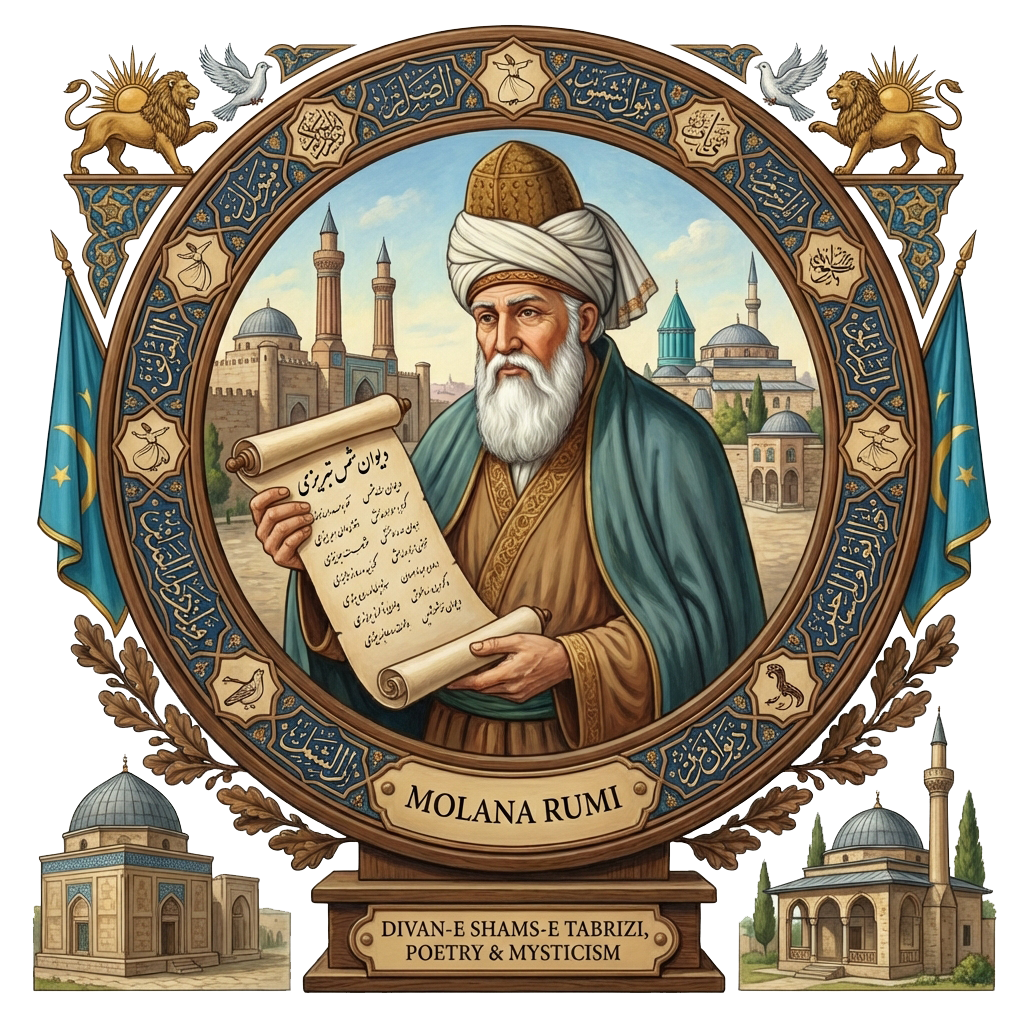
Jalal al-Din Muhammad Rumi was born in 1207 in Balkh, located in the historical region of Greater Khorasan (present-day Afghanistan), into a family of learned theologians. Fleeing the devastating Mongol invasions, his family traveled extensively through Muslim lands, performing pilgrimages and seeking refuge. They eventually settled in Konya, Anatolia (in modern-day Turkey), where Rumi inherited his father's position as a prominent religious teacher and orthodox Islamic scholar.
Rumi's life was forever altered in 1244 when he met the wandering mystic Shams al-Din of Tabriz. This intense spiritual friendship transformed Rumi from a traditional cleric into an impassioned ascetic and mystic. Shams introduced Rumi to the depths of Sufi mysticism, but their companionship was cut short when Shams mysteriously disappeared, likely murdered by jealous disciples. Plunged into deep grief, Rumi channeled his sorrow and overwhelming divine love into an outpouring of ecstatic lyric poetry.
His magnum opus, the 'Masnavi', is a monumental six-volume poem widely considered one of the greatest works of mystical poetry ever written, often referred to as the 'Quran in Persian.' He also composed the 'Divan-e Shams-e Tabrizi', a vast collection of lyric poems dedicated to his spiritual mentor. Rumi's teachings emphasized universal love, tolerance, and the soul's eternal yearning to reunite with the divine source.
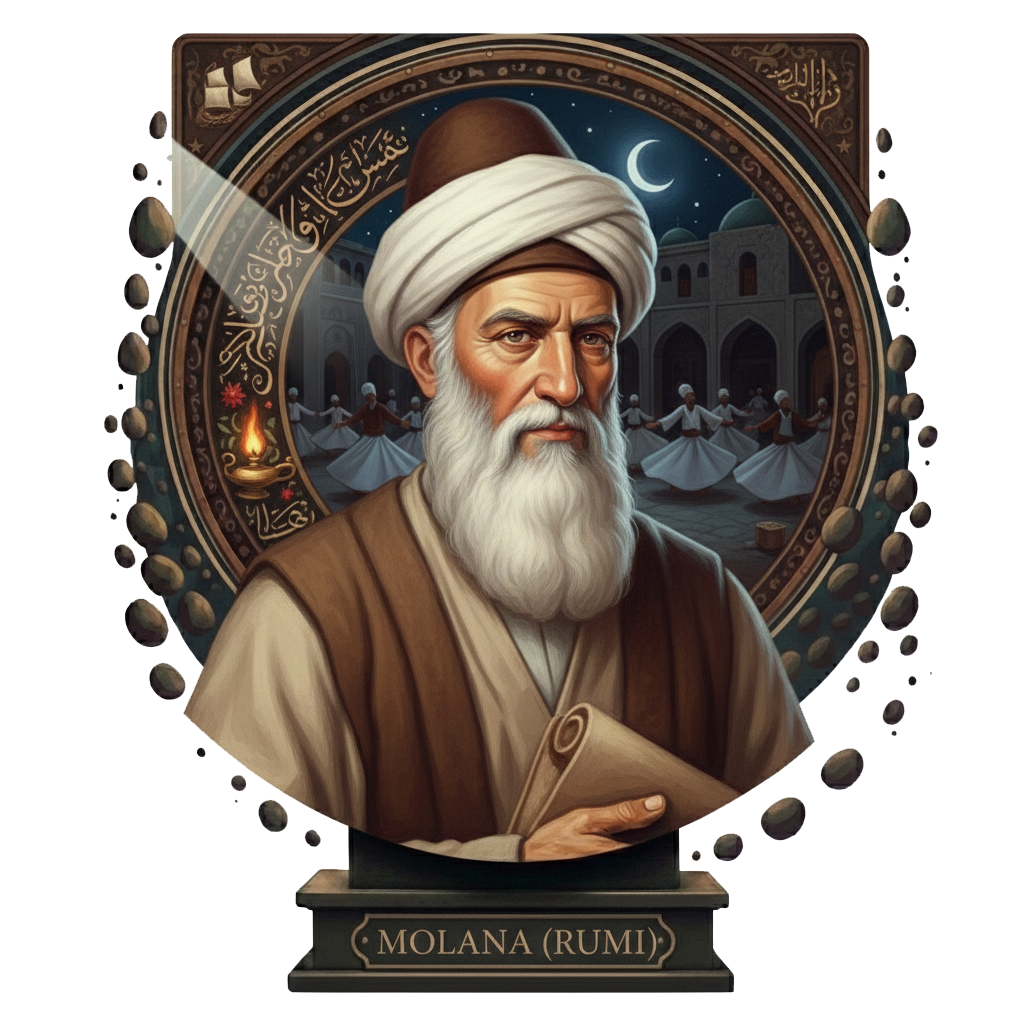
Rumi passed away in 1273 in Konya, where his followers subsequently founded the Mevlevi Order, famously known in the West as the 'Whirling Dervishes.' Today, his poetry is celebrated globally, transcending national, religious, and linguistic boundaries. His enduring legacy has made him one of the most widely read and beloved poets in the world, resonating deeply with seekers of spiritual truth across all cultures.
Portrayal characteristics
Saved editorial descriptions used for the reconstruction; these are not authenticated statements by the depicted person.
- Mystical
- Passionate
- Philosophical
- Tolerant
- Ecstatic
- Devoted
Images & artwork 4
Connections
Abu Ali Sina (Avicenna)
Philosophical Opponent
Rumi, a prominent Sufi mystic, critiqued the strict rationalism and philosophical approach championed by Avicenna.
While Avicenna sought to understand God and the universe through logic and Aristotelian philosophy, Rumi believed that divine truth could only be reached through love and spiritual experience. In his 'Masnavi', Rumi famously dismissed the "wooden legs" of the rationalists, a direct critique of the intellectual tradition that Avicenna represented.
Farid ud-Din Attar
Spiritual Mentor
Attar was a major influence on Rumi and is said to have met him when Rumi was a child.
According to tradition, Attar recognized Rumi's spiritual potential in Nishapur and gave him a copy of his book, the Asrar-nama. Rumi later famously remarked that while he had only reached the first street of love, Attar had traversed all seven cities of love.
Hafez
Spiritual Influence
Hafez's work reflects the mystical and Sufi traditions that were heavily shaped by Rumi's earlier contributions to Persian poetry.
While they lived in different centuries, Hafez's use of wine and love as metaphors for divine intoxication draws directly from the spiritual framework established by Rumi. Hafez integrated Rumi's ecstatic mysticism into the more structured ghazal format.
Shams Tabrizi
Spiritual Mentor
Shams Tabrizi was the wandering mystic who transformed Rumi from a traditional scholar into an ecstatic poet.
Their meeting in Konya in 1244 CE is one of the most famous encounters in mystical history. After Shams disappeared, Rumi's grief found expression in the 'Divan-e Shams-e Tabrizi,' marking the birth of his greatest poetic works.
Farid ud-Din Attar
Major Influence
Attar was a predecessor whose mystical poetry deeply shaped Rumi's spiritual worldview.
According to tradition, a young Rumi met the elderly Attar in Nishapur, where Attar gifted him his 'Book of Secrets' and predicted Rumi's future spiritual eminence. Rumi famously remarked that while Attar roamed the seven cities of love, he was still at the first turn of one street.
Saadi Shirazi
Contemporary Poets
Rumi and Saadi were the two most influential Persian poets of the 13th century, representing different facets of Sufism.
While Rumi focused on ecstatic divine love in Anatolia, Saadi focused on moral wisdom and practical ethics in Shiraz. Historical accounts suggest they were aware of each other's work, and Saadi is said to have sent a poem to Rumi as a gesture of respect.
Yunus Emre
Contemporary Influence
Yunus Emre was a Turkish Sufi poet who lived in Anatolia during Rumi's later years and was influenced by his teachings.
Though Yunus wrote in Turkish and Rumi primarily in Persian, they shared the same cultural and spiritual landscape of the Seljuk Sultanate of Rum. Yunus Emre is often said to have attended Rumi's spiritual circles, and his poetry reflects the same universal humanism found in Rumi's Masnavi.
Nizami Ganjavi
Literary Influence
Nizami's exploration of mystical and romantic themes provided a template for Rumi's spiritual allegories.
Rumi's 'Masnavi' draws upon the symbolic language and storytelling techniques perfected by Nizami. The transition from human romance to divine love, a central theme in Nizami's 'Layla and Majnun', became a cornerstone of Rumi's mystical philosophy.
Saadi Shirazi
Contemporary Peers
Saadi and Rumi were the two most influential Persian poets of the 13th century, representing different facets of Sufi thought.
Historical accounts suggest Saadi traveled to Konya to meet Rumi, and he reportedly sent some of his poems to Rumi for review. While Saadi focused on practical ethics and social wisdom in the 'Gulistan,' Rumi focused on the ecstatic union with the divine.
Shams Tabrizi
Teacher & Student
Shams was the spiritual mentor whose arrival in Konya fundamentally transformed Rumi from a traditional jurist into a mystical poet.
Their intense relationship is one of the most famous in history, leading Rumi to compose the 'Divan-e Shams-e Tabrizi' in honor of his friend. Shams's sudden disappearance or death prompted Rumi's most profound spiritual realizations and poetic output.
Yunus Emre
Contemporary Mystics
Yunus Emre and Rumi were the two most significant figures of the Sufi tradition in 13th-century Anatolia.
Legend suggests the two poets met; while Rumi wrote primarily in Persian for an urban elite, Yunus Emre wrote in simple Turkish, bringing the same mystical concepts of divine love to the common people.
Known for
- The Masnavi
- Divan-e Shams-e Tabrizi
- Inspiration for the Mevlevi Order (Whirling Dervishes)
- Sufi mysticism and philosophy
- Universal themes of divine love
Episodes featuring or mentioning this figure
No eligible published episode featuring this figure is currently in the library.