



Yunus Emre
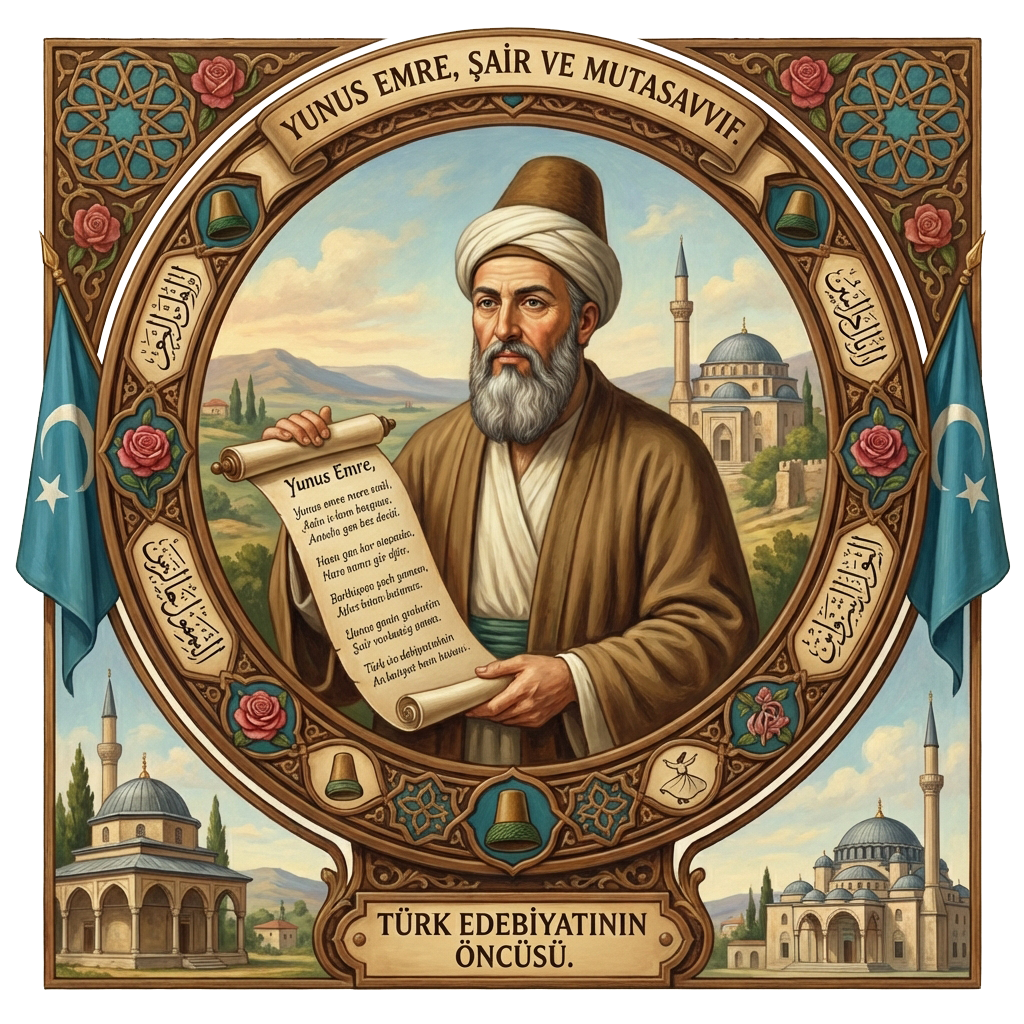
A highly influential Turkish folk poet and Sufi mystic who profoundly shaped Turkish culture and literature.
At a glance
- Born
- 1238 CE
- Died
- 1320 CE
- Era classification
- Medieval
- Homeland
- Anatolia
- Period
- 13th-14th Century
- Field
- Poetry & Mysticism
- Language
- Old Anatolian Turkish
- Religion
- Islam
- Gender
- male
Biography
Yunus Emre was a Turkish folk poet and Sufi mystic who lived during the late 13th and early 14th centuries. He is considered one of the most important figures in Turkish literature, as he was among the first to write his poetry in early Anatolian Turkish rather than Persian or Arabic, which were the dominant literary languages of the time. His choice of language made his spiritual teachings accessible to the common people.
His poetry revolves around the themes of divine love, human destiny, and the mystical journey toward union with God. Yunus Emre emphasized the importance of a pure heart, humility, and love for all of creation, rejecting religious formalism in favor of a deeply personal and experiential spirituality. His verses often reflect the turbulent times of the Mongol invasions, offering a message of peace and spiritual resilience.
Yunus Emre's influence has endured for centuries, and his hymns and poems are still widely read, memorized, and sung in Turkey today. He remains a symbol of humanism and tolerance, and his legacy is celebrated not only in the Turkic world but also recognized globally by institutions like UNESCO for his contributions to world peace and culture.
Portrayal characteristics
Saved editorial descriptions used for the reconstruction; these are not authenticated statements by the depicted person.
- Mystical
- Humble
- Compassionate
- Articulate
- Humanistic
Images & artwork 3
Connections
Molana Rumi
Contemporary Influence
Yunus Emre was a Turkish Sufi poet who lived in Anatolia during Rumi's later years and was influenced by his teachings.
Though Yunus wrote in Turkish and Rumi primarily in Persian, they shared the same cultural and spiritual landscape of the Seljuk Sultanate of Rum. Yunus Emre is often said to have attended Rumi's spiritual circles, and his poetry reflects the same universal humanism found in Rumi's Masnavi.
Osman I
Contemporary
Yunus Emre was a contemporary mystic whose poetry shaped the spiritual landscape of Osman's early Anatolian state.
While Osman provided the political and military leadership for the nascent Ottoman state, Yunus Emre's Sufi humanism provided the cultural and religious identity for the Turkish population in the region.
Molana Rumi
Contemporary Mystics
Yunus Emre and Rumi were the two most significant figures of the Sufi tradition in 13th-century Anatolia.
Legend suggests the two poets met; while Rumi wrote primarily in Persian for an urban elite, Yunus Emre wrote in simple Turkish, bringing the same mystical concepts of divine love to the common people.
Shams Tabrizi
Spiritual Influence
The spiritual revolution sparked by Shams Tabrizi and Rumi created the cultural environment in which Yunus Emre’s poetry flourished.
Though there is no direct record of a meeting, the 'School of Love' established by Shams and Rumi in Konya deeply influenced the wandering dervish tradition that Yunus Emre epitomized.
Osman I
Contemporary Figures
Yunus Emre lived during the rise of Osman I, the founder of the Ottoman Empire.
Yunus Emre's use of the Turkish language and his focus on humanistic values provided a spiritual and cultural backbone for the emerging Turkish identity during the formative years of Osman's principality.
Known for
- Pioneering Turkish literature
- Sufi poetry and hymns
- Promoting divine love and tolerance
- Influencing Anatolian culture
Episodes featuring or mentioning this figure
No eligible published episode featuring this figure is currently in the library.