



Farid ud-Din Attar
A celebrated Persian poet, theoretician of Sufism, and hagiographer who profoundly influenced Islamic mysticism.
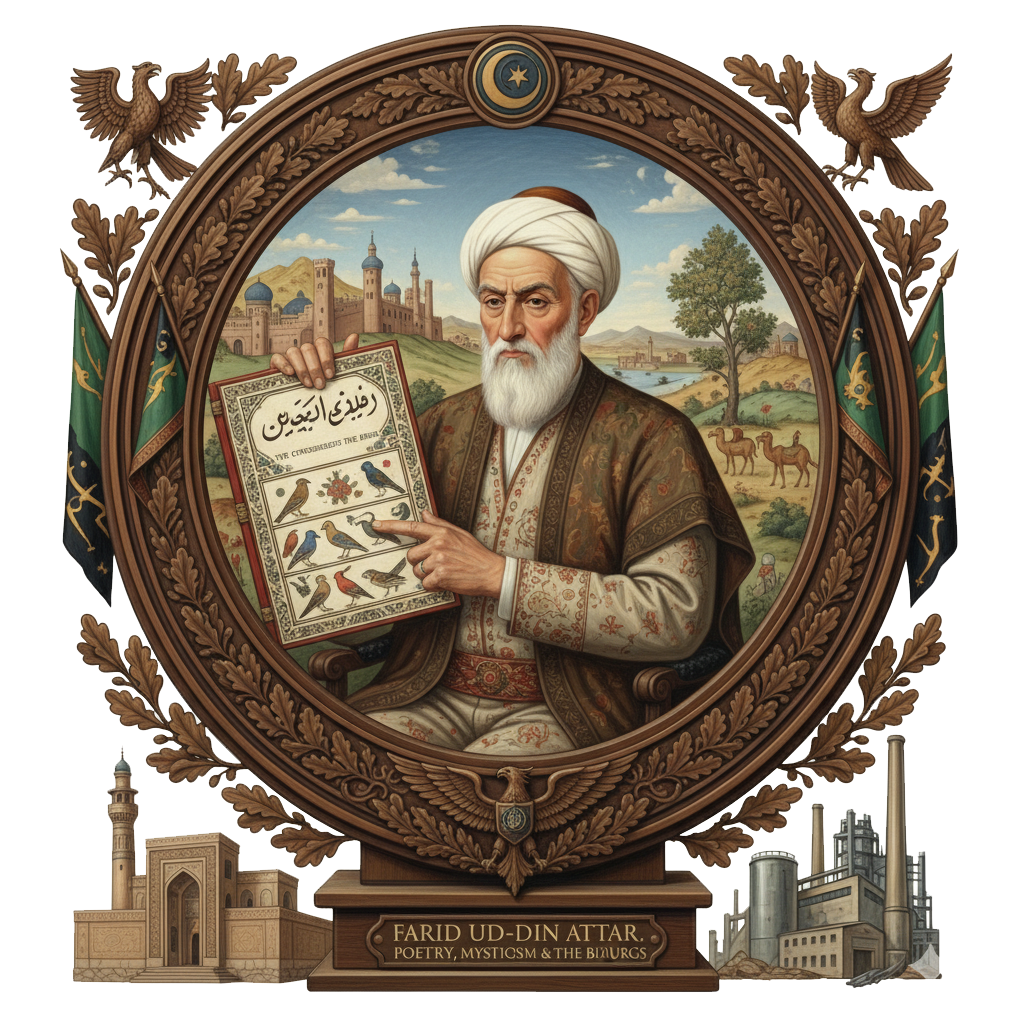
At a glance
- Born
- 1145 CE
- Died
- 1221 CE
- Era classification
- Medieval
- Homeland
- Khwarezmian Empire
- Period
- Khwarezmian Era
- Field
- Poetry & Mysticism
- Language
- Farsi
- Religion
- Islam (Sufism)
- Gender
- male
Biography
Farid ud-Din Attar, commonly known as Attar of Nishapur, was a towering figure in Persian literature and Islamic mysticism. Born in Nishapur, a major cultural center in northeastern Iran, he worked as a pharmacist and physician (the name 'Attar' means perfumer or apothecary). According to legend, his spiritual awakening occurred when a dervish visited his shop, prompting Attar to abandon his worldly profession and embark on a lifelong journey of Sufi asceticism and writing.
Attar's literary output was immense, but he is best known for 'Mantiq al-Tayr' (The Conference of the Birds). This allegorical epic poem describes the journey of the birds of the world, led by the hoopoe, as they seek their legendary king, the Simurgh. Through trials representing the stages of the Sufi path, only thirty birds survive, ultimately realizing that the divine king they sought is a reflection of themselves. This work remains a cornerstone of mystical literature.
In addition to his poetry, Attar compiled the 'Tazkirat al-Awliya' (Memorial of the Saints), a prose collection of biographies of early Sufi masters. His profound spiritual insights and innovative use of allegory deeply influenced later poets, most notably Rumi, who famously declared that Attar had traversed the seven cities of love while he was still at the turn of a single street. Attar reportedly died during the Mongol sack of Nishapur.
Portrayal characteristics
Saved editorial descriptions used for the reconstruction; these are not authenticated statements by the depicted person.
- Mystical
- Devout
- Allegorical
- Insightful
- Ascetic
Images & artwork 3


Connections
Molana Rumi
Spiritual Mentor
Attar was a major influence on Rumi and is said to have met him when Rumi was a child.
According to tradition, Attar recognized Rumi's spiritual potential in Nishapur and gave him a copy of his book, the Asrar-nama. Rumi later famously remarked that while he had only reached the first street of love, Attar had traversed all seven cities of love.
Saadi Shirazi
Literary Influence
Attar's mystical poetry deeply influenced the later works of Saadi Shirazi.
Attar's use of anecdotes to illustrate spiritual truths in 'The Conference of the Birds' served as a model for Saadi's 'Bustan' and 'Gulistan.' Both poets are considered pillars of the Persian literary tradition, bridging the gap between mysticism and ethics.
Molana Rumi
Major Influence
Attar was a predecessor whose mystical poetry deeply shaped Rumi's spiritual worldview.
According to tradition, a young Rumi met the elderly Attar in Nishapur, where Attar gifted him his 'Book of Secrets' and predicted Rumi's future spiritual eminence. Rumi famously remarked that while Attar roamed the seven cities of love, he was still at the first turn of one street.
Shams Tabrizi
Mystical Predecessor
Attar's allegorical Sufi poetry provided the spiritual framework that Shams utilized in his teachings to Rumi.
Shams was deeply familiar with Attar's 'Conference of the Birds,' which describes the soul's journey toward the divine. This tradition of the 'wandering dervish' and the search for the 'Beloved' was the cultural air Shams breathed and passed on to his disciples.
Known for
- The Conference of the Birds
- Memorial of the Saints
- Profoundly influencing Rumi
- Sufi philosophy
Episodes featuring or mentioning this figure
No eligible published episode featuring this figure is currently in the library.