



Nizami Ganjavi
A master of romantic epic poetry in Persian literature, best known for his monumental work, the Khamsa.
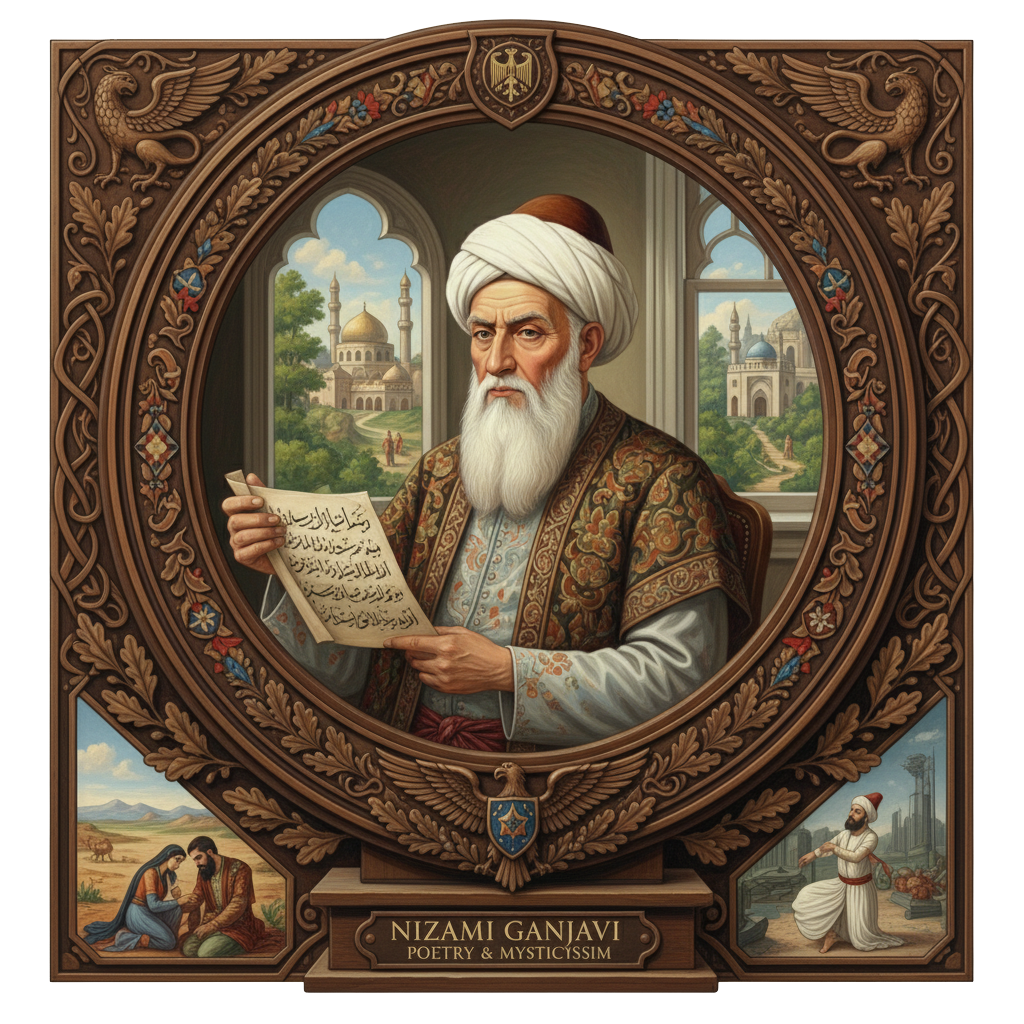
At a glance
- Born
- 1141 CE
- Died
- 1209 CE
- Era classification
- Medieval
- Homeland
- Seljuk Empire
- Period
- Seljuk Era
- Field
- Poetry & Mysticism
- Language
- Farsi
- Religion
- Islam
- Gender
- male
Biography
Nizami Ganjavi is widely considered the greatest romantic epic poet in Persian literature. Born in the city of Ganja (in modern-day Azerbaijan), he spent his entire life in the region, dedicating himself to study and writing. Unlike many poets of his era, Nizami avoided the life of a court poet, preferring a quiet, ascetic existence that allowed him to maintain his intellectual independence and focus entirely on his monumental literary works.
His masterpiece is the 'Khamsa' (The Quintet), a collection of five long narrative poems that blend history, myth, philosophy, and romance. The most famous of these include 'Layla and Majnun', a tragic love story that became the definitive version of the tale in the Islamic world, and 'Khosrow and Shirin', an elaborate romance detailing the love between a Sassanian king and an Armenian princess. His poetry is celebrated for its psychological depth, rich imagery, and complex narrative structures.
Nizami's influence on Persian, Kurdish, Ottoman, and broader Islamic literature is immeasurable. His works established the standard for romantic epics, inspiring countless imitations and adaptations over the centuries. He elevated the Persian language with his erudite vocabulary and philosophical insights, cementing his legacy as a pillar of classical Persian literature.
Portrayal characteristics
Saved editorial descriptions used for the reconstruction; these are not authenticated statements by the depicted person.
- Romantic
- Philosophical
- Imaginative
- Erudite
- Lyrical
Images & artwork 3
Connections
Ferdowsi
Influenced By
Nizami Ganjavi was deeply influenced by the epic tradition established by Ferdowsi's Shahnameh.
Nizami's 'Khamseh' (Quintet) built upon the foundation of Persian narrative poetry laid by Ferdowsi, transitioning from the heroic epic style to more romantic and philosophical narratives. He frequently referenced the legendary history of Iran popularized by Ferdowsi in his own works like 'Eskandar-nameh'.
Saadi Shirazi
Literary Influence
Nizami's narrative style and ethical themes served as a major influence on the later works of Saadi Shirazi.
Saadi's didactic and romantic poetry, particularly in the 'Bustan', reflects the structural and thematic influence of Nizami's 'Khamseh'. Nizami's ability to weave moral lessons into complex romantic epics set a standard that Saadi and subsequent Persian poets followed for centuries.
Molana Rumi
Literary Influence
Nizami's exploration of mystical and romantic themes provided a template for Rumi's spiritual allegories.
Rumi's 'Masnavi' draws upon the symbolic language and storytelling techniques perfected by Nizami. The transition from human romance to divine love, a central theme in Nizami's 'Layla and Majnun', became a cornerstone of Rumi's mystical philosophy.
Known for
- The Khamsa (Quintet)
- Layla and Majnun
- Khosrow and Shirin
- Pioneering the romantic epic
Episodes featuring or mentioning this figure
No eligible published episode featuring this figure is currently in the library.