



Hildegard of Bingen
A German Benedictine abbess, writer, composer, and mystic who was a prominent polymath of the High Middle Ages.
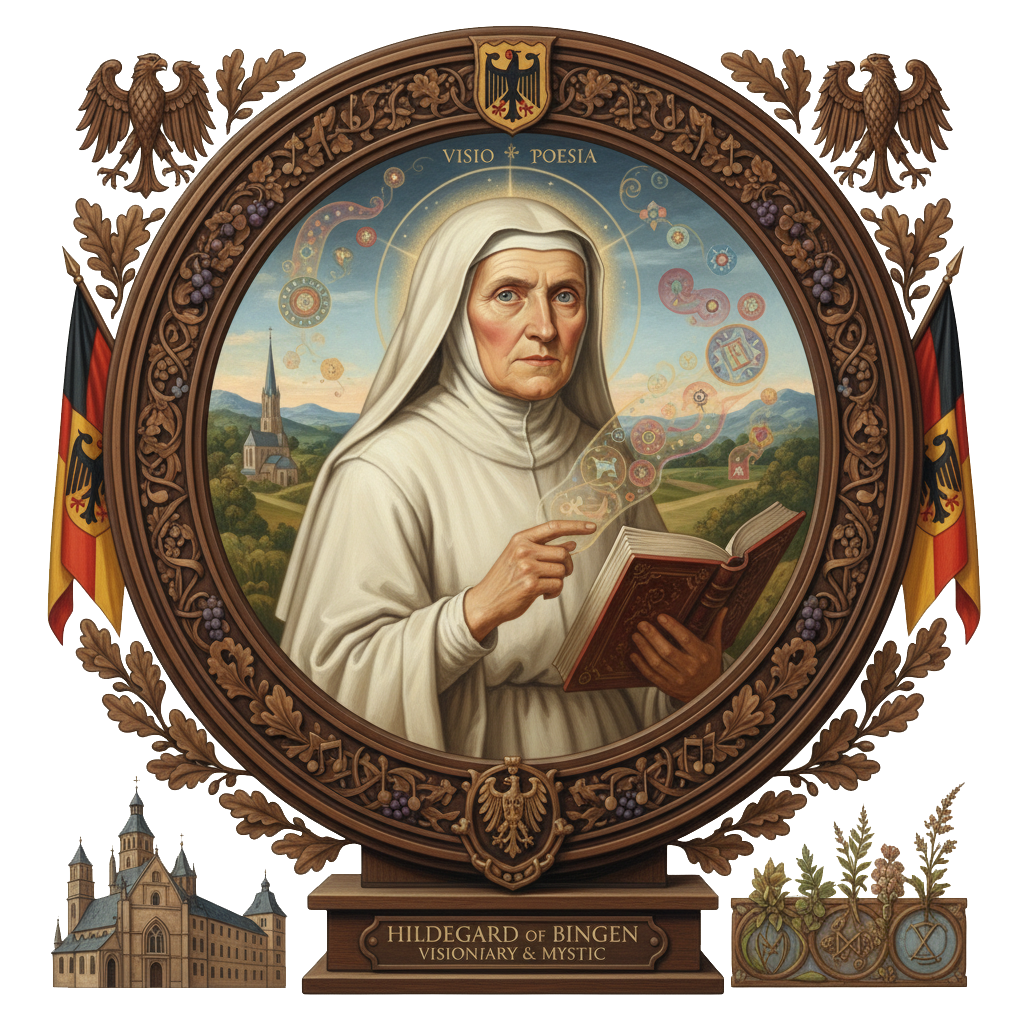
At a glance
- Born
- 1098 CE
- Died
- 1179 CE
- Era classification
- Medieval
- Homeland
- Germany
- Period
- 12th Century
- Field
- Poetry & Mysticism
- Language
- Latin
- Religion
- Catholic
- Gender
- female
Biography
Hildegard of Bingen, also known as Saint Hildegard and the Sibyl of the Rhine, was a German Benedictine abbess, writer, composer, philosopher, Christian mystic, and visionary. Born into a noble family, she was dedicated to the church at a young age and enclosed in a monastery. She experienced religious visions from childhood, which she later recorded in her major theological works, most notably "Scivias."
As a polymath of the High Middle Ages, Hildegard's contributions spanned multiple disciplines. She is one of the best-known composers of sacred monophony, and her musical play "Ordo Virtutum" is considered one of the earliest liturgical dramas. Beyond theology and music, she wrote extensively on natural history and medicine, detailing the medicinal properties of plants, animals, and stones in her works "Physica" and "Causae et Curae."
Hildegard was a powerful figure in a male-dominated church and society. She corresponded with popes, emperors, and kings, offering counsel and sometimes sharp criticism. She founded two new monasteries and went on several preaching tours across Germany. In 2012, she was officially canonized and named a Doctor of the Church by Pope Benedict XVI, recognizing her enduring spiritual and intellectual legacy.
Portrayal characteristics
Saved editorial descriptions used for the reconstruction; these are not authenticated statements by the depicted person.
- Visionary
- Spiritual
- Creative
- Authoritative
- Intellectual
Images & artwork 3


Known for
- Scivias
- Ordo Virtutum
- Medieval medicine
- Christian mysticism
Episodes featuring or mentioning this figure
No eligible published episode featuring this figure is currently in the library.