



Abu Ali Sina (Avicenna)
A Persian polymath and physician whose medical and philosophical texts shaped global thought for centuries.
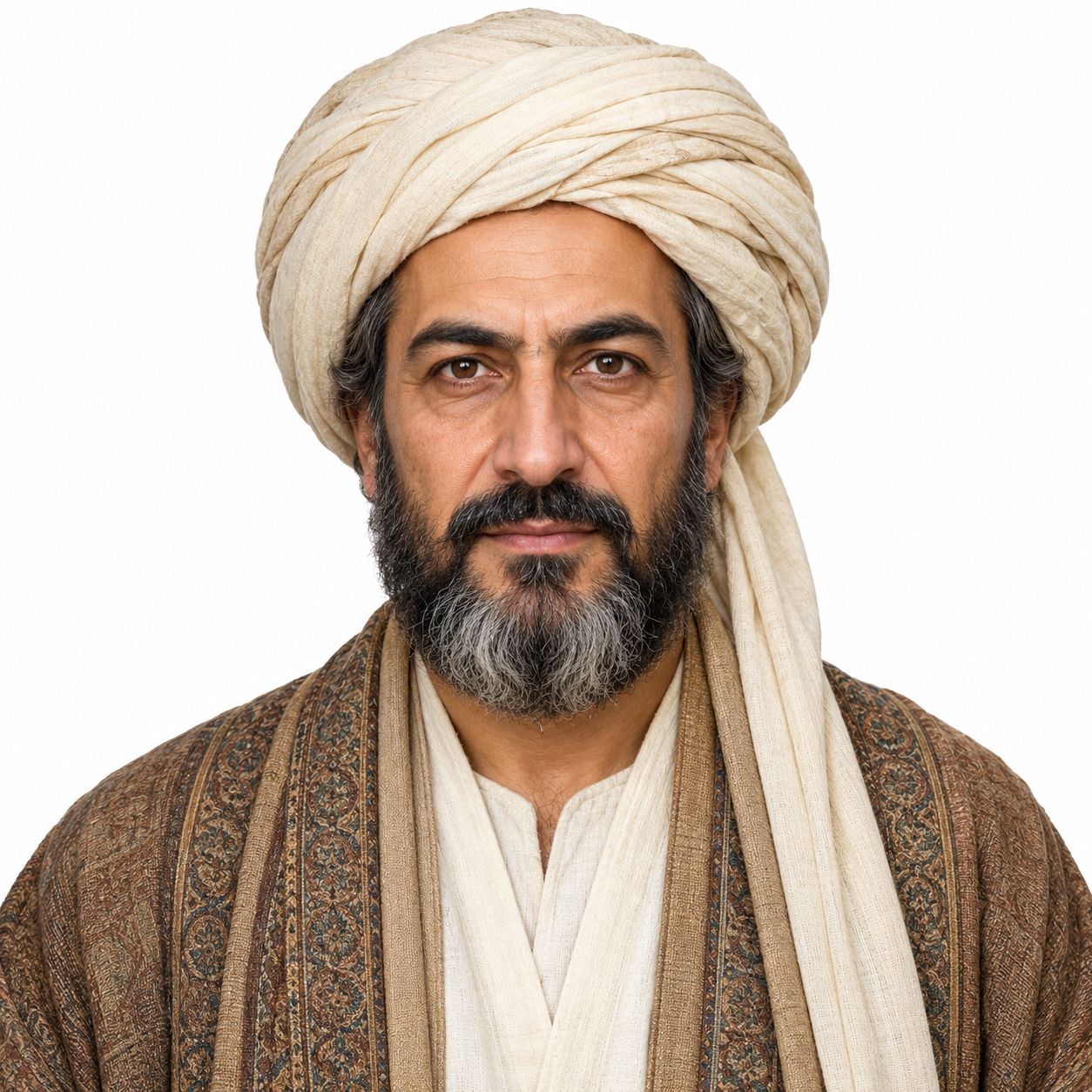
At a glance
- Born
- c. 980 CE
- Died
- 1037 CE
- Era classification
- 57
- Homeland
- Persia (Greater Iran)
- Period
- 980–1037 CE
- Field
- Science, Medicine & Engineering
- Language
- Arabic and Persian
- Religion
- Islam
- Gender
- male
Biography
Abu Ali al-Husayn ibn Abd Allah ibn Sina, known in the West as Avicenna, was a preeminent Persian polymath of the Islamic Golden Age. Born around 980 CE in Afshana, near Bukhara, he displayed an extraordinary intellect from a young age. By the time he was ten, he had memorized the Quran, and by eighteen, he had mastered the medical sciences of his time, earning a reputation that led him to treat the Samanid ruler.
Avicenna's most famous contribution to humanity is 'The Canon of Medicine' (Al-Qanun fi al-Tibb), a monumental five-volume medical encyclopedia. This masterpiece synthesized Greek, Roman, Indian, and Persian medical knowledge, becoming the definitive medical textbook in both the Islamic world and European universities until the 17th century. It introduced advanced concepts such as the contagious nature of infectious diseases, the use of quarantine, and clinical trials.
Beyond medicine, Avicenna was a towering figure in philosophy. His magnum opus in this field, 'The Book of Healing' (Kitab al-Shifa), is a vast philosophical and scientific encyclopedia covering logic, natural sciences, psychology, geometry, astronomy, arithmetic, and music. He successfully reconciled Aristotelian philosophy with Islamic theology, creating a comprehensive system of thought known as Avicennism, which profoundly influenced later Western scholastic philosophers like Thomas Aquinas.
Despite living in a politically turbulent era that required him to frequently relocate and serve various regional rulers as a physician and vizier, Avicenna remained incredibly prolific, writing over 400 works. He died in Hamadan in 1037 CE, leaving behind an unparalleled intellectual legacy that bridged the ancient and modern worlds, cementing his status as one of history's greatest thinkers.
Portrayal characteristics
Saved editorial descriptions used for the reconstruction; these are not authenticated statements by the depicted person.
- Polymathic
- Analytical
- Prolific
- Visionary
- Resilient
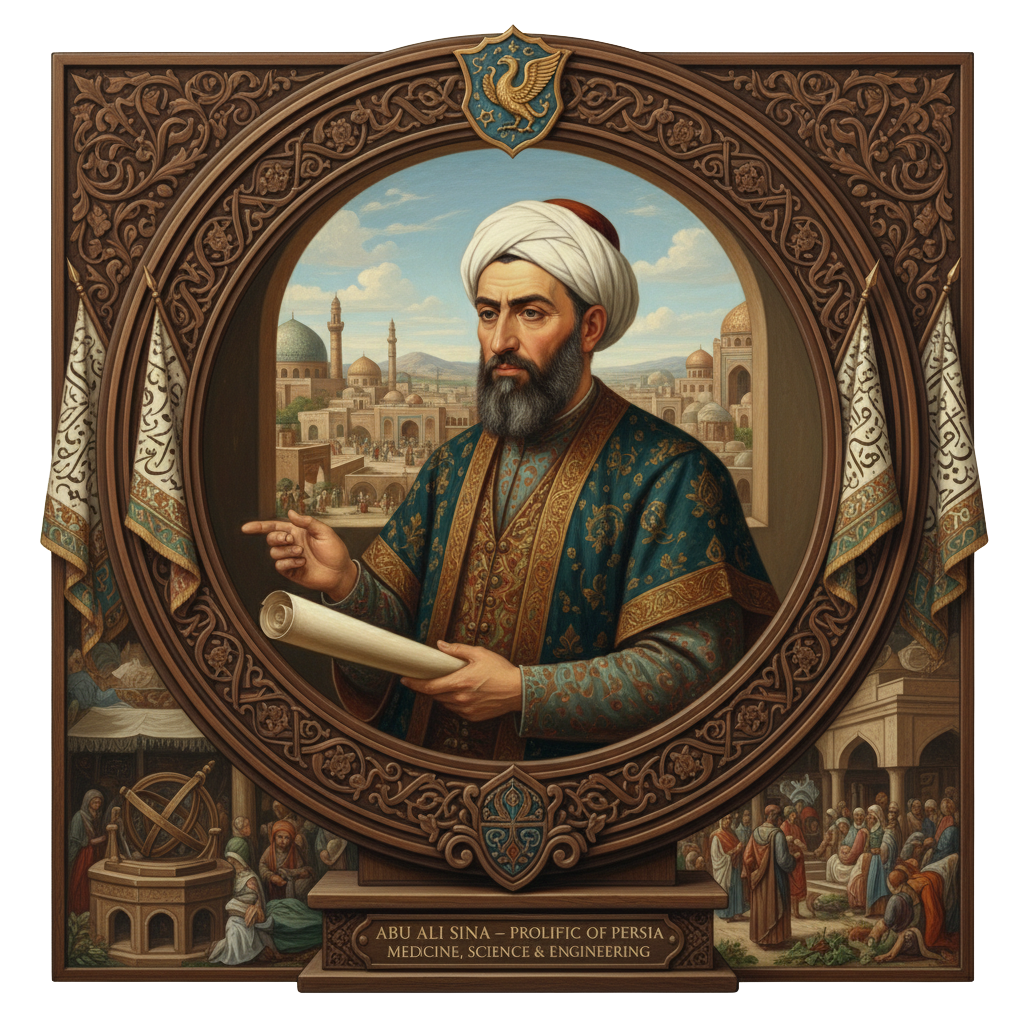
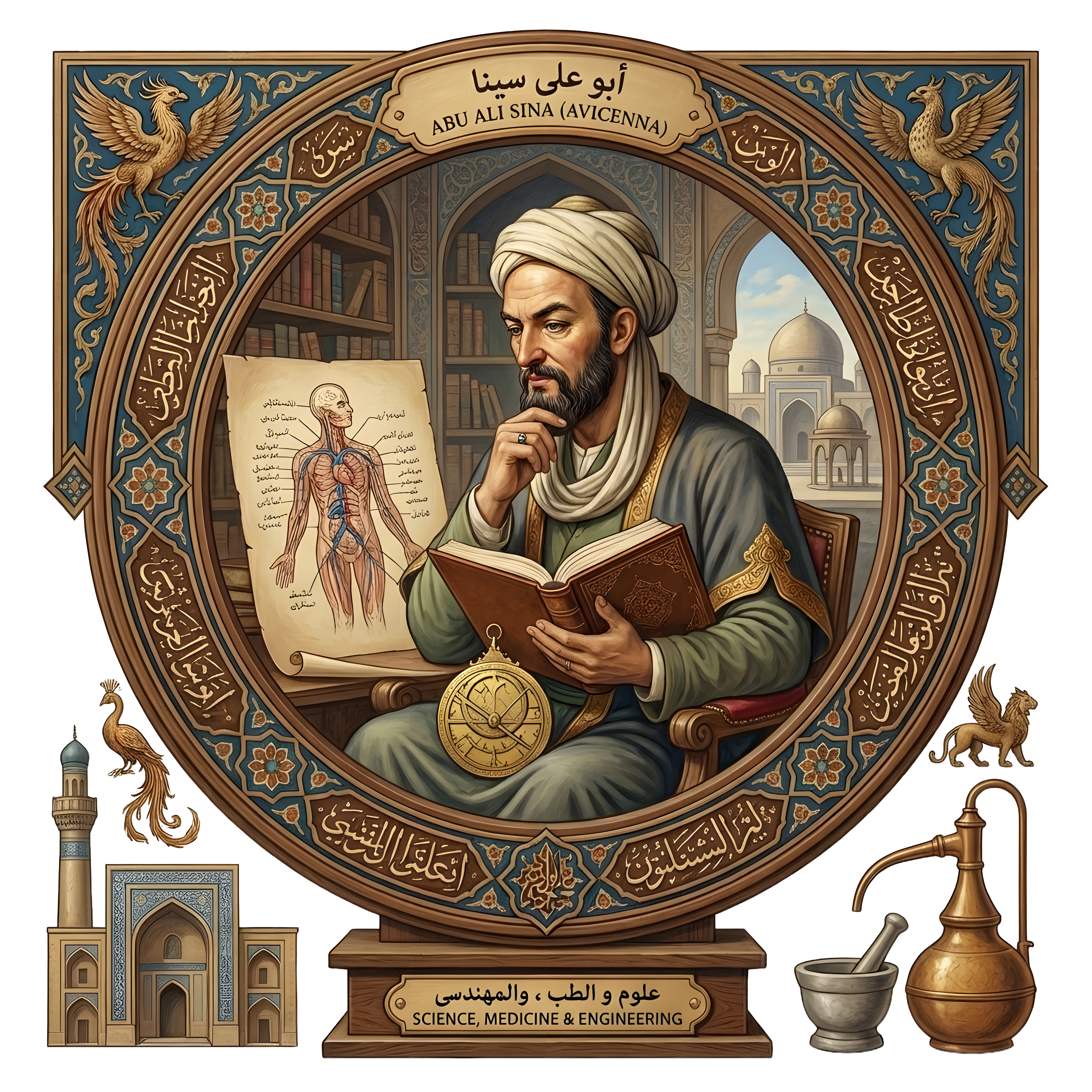
Images & artwork 6
Connections
Aristotle
Influenced By
Avicenna's philosophical system was a profound synthesis and expansion of Aristotelian logic and metaphysics.
Avicenna wrote 'The Book of Healing' (Kitab al-Shifa), which served as a comprehensive commentary on Aristotle's works, attempting to reconcile Peripatetic philosophy with Islamic theology. His interpretation of Aristotle became the standard for both the Islamic world and medieval European scholasticism.
Galen
Influenced By
Avicenna synthesized and codified the medical teachings of Galen into a systematic framework.
In 'The Canon of Medicine', Avicenna organized Galenic anatomy and physiology into a logical structure that remained the primary medical authority in Europe and the Middle East for over six centuries. While he respected Galen, he also corrected several of his observations based on his own clinical practice.
Hippocrates
Influenced By
Avicenna built his medical theories upon the foundational humoral theory established by Hippocrates.
Avicenna's medical corpus adopted the Hippocratic focus on observation and the balance of the four humors. He refined these ancient Greek concepts into a more rigorous scientific methodology that bridged ancient tradition and modern clinical practice.
Omar Khayyam
Philosophical Master
Omar Khayyam deeply revered Avicenna as his philosophical master and intellectual predecessor.
Khayyam studied Avicenna's works extensively and frequently defended his philosophical views against orthodox critics. According to historical accounts, Khayyam was reading Avicenna's 'Book of Healing' on his deathbed. This demonstrates his lifelong devotion to Avicenna's rationalist philosophy and scientific methodology.
Euclid of Alexandria
Studied & Commented On
Avicenna studied Euclid's foundational works in mathematics and geometry, incorporating them into his own scientific treatises.
In his encyclopedic work 'The Book of Healing', Avicenna included a comprehensive summary and commentary on Euclid's 'Elements'. He used Euclidean geometry as a foundational basis for his own explorations into mathematics, astronomy, and logic, helping to transmit and refine Greek mathematical traditions in the Islamic Golden Age.
Andreas Vesalius
Scientific Successor
Vesalius eventually challenged the long-standing medical dominance of Avicenna's 'Canon' during the Renaissance.
For centuries, Avicenna's texts were the absolute authority in European medical schools. Vesalius, through direct human dissection, began to point out errors in the Galenic-Avicennian tradition, marking the transition from medieval scholastic medicine to modern anatomy.
René Descartes
Philosophical Predecessor
Avicenna's "Floating Man" thought experiment is widely recognized as a precursor to Descartes' famous "Cogito, ergo sum."
Centuries before Descartes, Avicenna formulated a thought experiment asking readers to imagine a man suspended in a void with no sensory input, arguing that the man would still be aware of his own existence. This profound argument for the existence of the soul and self-awareness closely parallels Descartes' later epistemological foundation, "I think, therefore I am." Historians frequently note Avicenna's indirect influence on early modern European philosophy.
Leonardo da Vinci
Influenced
Leonardo da Vinci studied Avicenna's medical writings to inform his own pioneering anatomical research.
Avicenna's 'Canon of Medicine' was a standard text in Renaissance Italy. Da Vinci referenced Avicenna's works in his notebooks, particularly regarding the anatomy of the eye, the heart, and the nervous system. He used the Persian polymath's theories as a starting point for his own empirical investigations and highly detailed anatomical drawings.
Molana Rumi
Philosophical Opponent
Rumi, a prominent Sufi mystic, critiqued the strict rationalism and philosophical approach championed by Avicenna.
While Avicenna sought to understand God and the universe through logic and Aristotelian philosophy, Rumi believed that divine truth could only be reached through love and spiritual experience. In his 'Masnavi', Rumi famously dismissed the "wooden legs" of the rationalists, a direct critique of the intellectual tradition that Avicenna represented.
Al-Khwarizmi
Intellectual Successor
Avicenna utilized the mathematical and scientific foundations laid by Al-Khwarizmi during the Islamic Golden Age.
Al-Khwarizmi was a pioneering figure of the early Islamic Golden Age whose works in mathematics and astronomy became standard texts across the Middle East. Avicenna, living roughly a century and a half later, studied these foundational texts during his early education. The mathematical framework and Hindu-Arabic numeral system popularized by Al-Khwarizmi were essential tools for Avicenna's later extensive works in science, philosophy, and medicine.
Nasir al-Din al-Tusi
Intellectual Successor
Al-Tusi was a major commentator and defender of Avicenna's philosophical and scientific works.
Centuries after Avicenna's death, Al-Tusi wrote 'Sharh al-Isharat', a definitive commentary defending Avicenna's 'Remarks and Admonitions' against the criticisms of Fakhr al-Din al-Razi. This work was crucial in preserving and revitalizing Avicennian thought in the later Islamic Golden Age.
Aristotle
Major Influence
Avicenna's philosophical and medical systems were built upon the foundational works of Aristotle.
Avicenna (Abu Ali Sina) was the leading figure in the reconciliation of Aristotelian logic and metaphysics with Islamic theology. His 'The Book of Healing' is an encyclopedic effort to preserve and expand upon the Peripatetic tradition established by Aristotle.
Ferdowsi
Contemporary Intellectuals
Both were towering figures of the Persian Golden Age and lived during the same era under Samanid and Ghaznavid rule.
While they worked in different fields—poetry and medicine—both were products of the same intellectual environment. They represent the peak of Persian contributions to world culture during the 10th and 11th centuries.
Galen
Legacy Influence
Galen's medical theories formed the backbone of Avicenna's 'The Canon of Medicine', which dominated Islamic and European medicine for centuries.
Avicenna synthesized Galen's anatomical and physiological teachings with Aristotelian philosophy. While Avicenna occasionally corrected Galen's observations, the core of his medical framework remained fundamentally Galenic, ensuring Galen's continued authority throughout the Middle Ages.
Omar Khayyam
Philosophical Successor
Khayyam considered himself a spiritual and intellectual student of Avicenna's Peripatetic philosophy.
In his philosophical writings, Khayyam explicitly referred to Avicenna as his 'teacher,' and he spent much of his career defending and refining Avicenna's metaphysical theories against theological critics.
Nasir al-Din al-Tusi
Commentator & Defender
Tusi was a major proponent of Avicenna's philosophy and wrote a definitive defense of his work.
Tusi wrote 'Sharh al-Isharat' (Commentary on the Remarks), a detailed defense of Avicenna's philosophical system against the criticisms of Fakhr al-Din al-Razi. This work was instrumental in preserving and clarifying Avicennian thought for later generations.
Rudaki
Samanid Contemporaries
Both figures were central to the intellectual flourishing of the Samanid Empire, representing the peaks of Persian poetry and science respectively.
While Rudaki was the premier poet of the early Samanid era, Avicenna (Abu Ali Sina) served the later Samanid rulers. Together, they represent the 'Persian Renaissance,' where the court at Bukhara became a global center for both art and logic.
Mohammad Reza Pahlavi
Cultural Heritage & State Patronage
The Shah's regime utilized the legacy of the great Persian polymath Avicenna (Abu Ali Sina) to promote Iranian nationalism, most notably by constructing a grand modern mausoleum for him in Hamadan.
As part of his broader strategy to forge a strong, secular national identity, Mohammad Reza Pahlavi and his government heavily promoted Iran's historical contributions to global science and culture. A prime example of this was the state's treatment of the legendary 11th-century polymath Abu Ali Sina, known in the West as Avicenna. In 1952, under the auspices of the Pahlavi government and the Society for the National Heritage of Iran, a magnificent new mausoleum was constructed over Avicenna's tomb in the city of Hamadan. The architecture of the monument deliberately blended traditional Persian elements with modernist design, perfectly encapsulating the Shah's vision for the country: deeply rooted in a glorious past but rapidly advancing toward a modern, Western-aligned future. By celebrating figures like Avicenna, the Shah sought to instill national pride and project an image of Iran as a historic center of enlightenment, countering the influence of the traditional Islamic clergy by emphasizing secular intellectual achievements.
Known for
- The Canon of Medicine
- The Book of Healing
- Avicennism
- Pioneering quarantine concepts
- Reconciling Aristotelianism with Islam
Episodes featuring or mentioning this figure
No eligible published episode featuring this figure is currently in the library.