



Galen
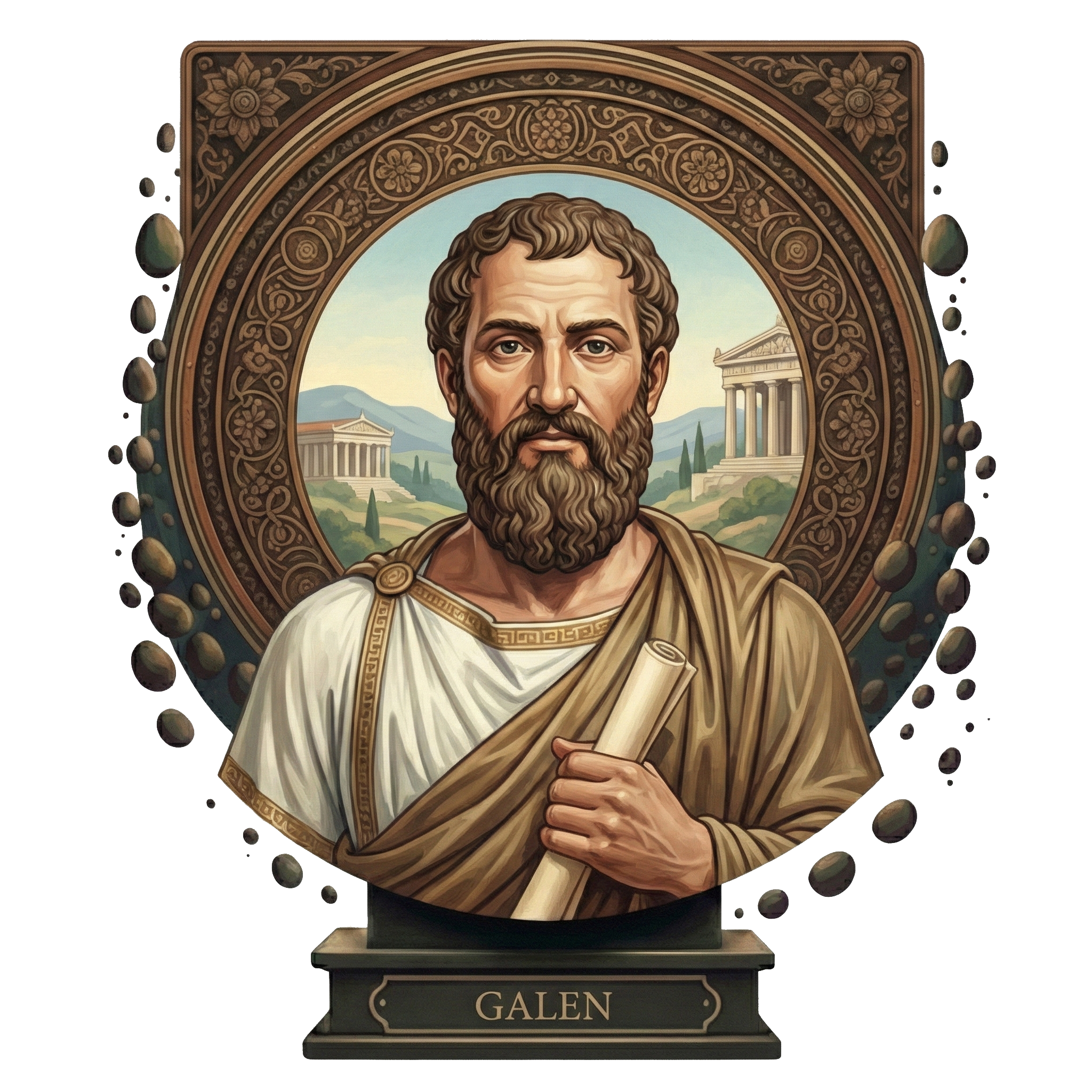
A prominent Greek physician and philosopher whose medical theories dominated Western science for over a millennium.
At a glance
- Born
- 129 CE
- Died
- c. 216 CE
- Era classification
- 87
- Homeland
- Roman Empire (Pergamon)
- Period
- 129–c. 216 CE
- Field
- Medicine & Natural Science
- Language
- Greek
- Religion
- Hellenistic
- Gender
- male
Biography
Galen of Pergamon was born in 129 CE into a wealthy and intellectual family in the ancient city of Pergamon (modern-day Turkey). His father, a successful architect, provided him with an elite education in agriculture, architecture, astronomy, astrology, and philosophy. However, following a dream, his father redirected Galen's studies toward medicine. Galen traveled extensively to study at the most prominent medical centers of the ancient world, including Smyrna, Corinth, and Alexandria, absorbing the vast medical knowledge of his time.
In 157 CE, Galen returned to Pergamon and worked as a physician to gladiators. This role provided him with invaluable practical experience in treating severe trauma and understanding human anatomy, which he famously referred to as 'windows into the body.' He later moved to Rome, where his remarkable surgical skills, public anatomical demonstrations, and intellectual brilliance quickly brought him to the attention of the Roman elite. He eventually became the personal physician to several Roman emperors, including Marcus Aurelius, Commodus, and Septimius Severus.
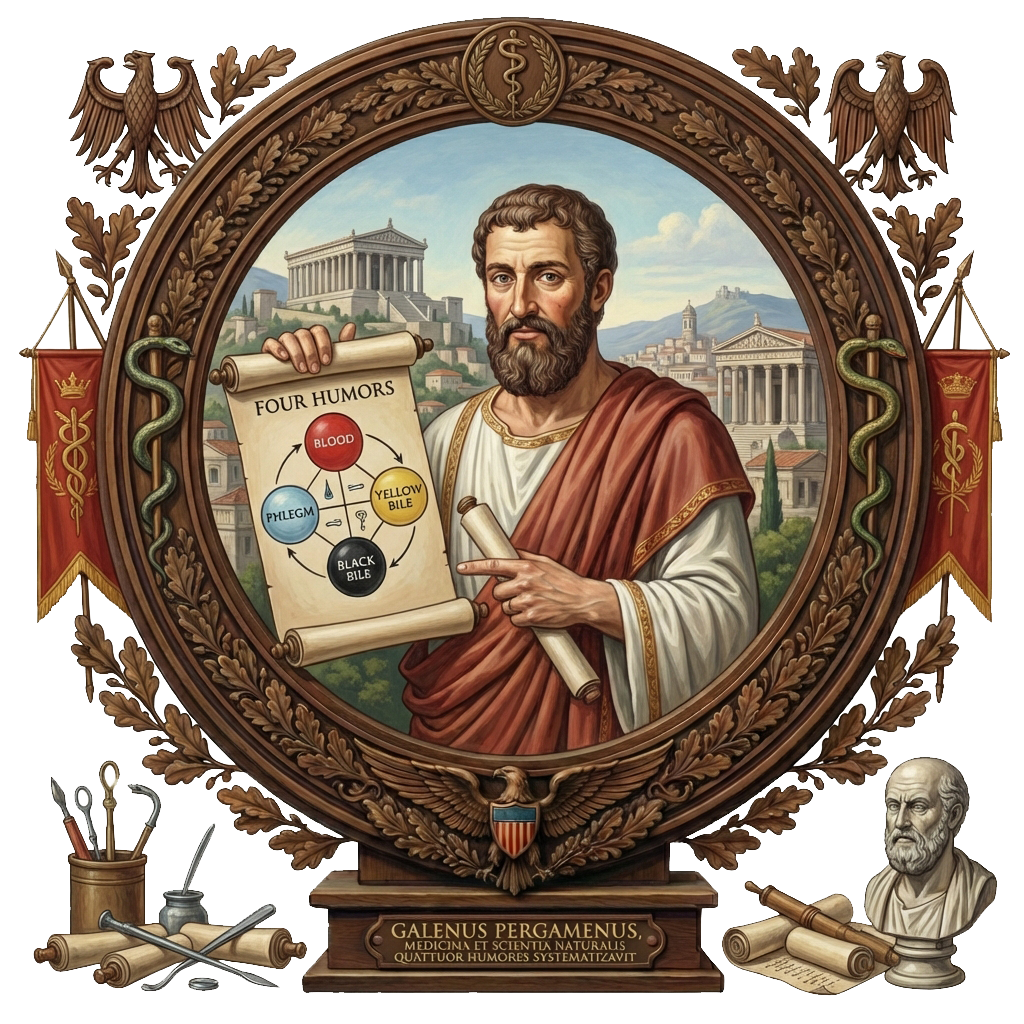
Galen's most enduring legacy is his monumental synthesis of classical medical knowledge, heavily influenced by Hippocrates. Because human dissection was strictly forbidden in ancient Rome, Galen relied on the dissection of animals, such as Barbary macaques and pigs, to understand anatomy. He developed a comprehensive medical system based on the balance of the four humors—blood, yellow bile, black bile, and phlegm. His prolific writings on anatomy, physiology, pathology, and pharmacology became the undisputed medical authority in both the Christian West and the Islamic East for over 1,300 years, only being significantly challenged during the Renaissance by figures like Andreas Vesalius.
Portrayal characteristics
Saved editorial descriptions used for the reconstruction; these are not authenticated statements by the depicted person.
- Empirical
- Prolific
- Philosophical
- Observant
- Dogmatic
- Innovative
Images & artwork 4


Connections
Abu Ali Sina (Avicenna)
Influenced By
Avicenna synthesized and codified the medical teachings of Galen into a systematic framework.
In 'The Canon of Medicine', Avicenna organized Galenic anatomy and physiology into a logical structure that remained the primary medical authority in Europe and the Middle East for over six centuries. While he respected Galen, he also corrected several of his observations based on his own clinical practice.
Andreas Vesalius
Scientific Challenger
Vesalius's work 'De humani corporis fabrica' systematically corrected hundreds of anatomical errors found in the works of Galen.
By performing his own dissections, Vesalius proved that Galen's observations were often based on animal rather than human anatomy, sparking a revolution in medical science.
Hippocrates
Influenced By
Galen was the most significant successor to Hippocrates, systematizing and expanding upon his medical theories.
Living centuries later, Galen viewed Hippocrates as the 'Father of Medicine' and wrote extensive commentaries on the Hippocratic Corpus. Galen's adoption of the four humors theory ensured that Hippocratic ideas dominated Western and Islamic medicine for over 1,500 years.
Hippocrates
Influenced By
Galen viewed himself as the successor to Hippocrates, systematizing and expanding upon the Hippocratic theory of the four humors.
Galen wrote extensive commentaries on the Hippocratic Corpus, aiming to revive what he saw as the true spirit of Hippocratic medicine. He integrated Hippocrates' clinical observations with his own anatomical research to create a medical system that dominated the Western and Islamic worlds for over 1,500 years.
Abu Ali Sina (Avicenna)
Legacy Influence
Galen's medical theories formed the backbone of Avicenna's 'The Canon of Medicine', which dominated Islamic and European medicine for centuries.
Avicenna synthesized Galen's anatomical and physiological teachings with Aristotelian philosophy. While Avicenna occasionally corrected Galen's observations, the core of his medical framework remained fundamentally Galenic, ensuring Galen's continued authority throughout the Middle Ages.
Andreas Vesalius
Scientific Challenger
Vesalius revolutionized anatomy by proving that many of Galen's descriptions, based on animal dissection, were inaccurate for human biology.
In his 1543 work 'De humani corporis fabrica', Vesalius performed direct human dissections to challenge Galen's errors, which had resulted from Galen's reliance on Barbary macaques and pigs. This confrontation marked the beginning of modern observational anatomy and the decline of Galenic authority.
Aristotle
Philosophical Influence
Galen adopted Aristotle's teleological approach, believing that every part of the body was designed by nature for a specific purpose.
Galen heavily utilized Aristotelian logic and biology to explain the functions of organs. He combined Aristotle's concept of 'final causes' with his own medical practice, arguing that the complexity of the human body was proof of a divine or natural design.
Known for
- Systematizing the four humors theory
- Pioneering animal dissections
- Serving as personal physician to Marcus Aurelius
- Discovering that arteries carry blood
- Proving the brain controls muscle movement
Episodes featuring or mentioning this figure
No eligible published episode featuring this figure is currently in the library.