



Gregor Mendel
Austrian friar and scientist whose pea plant breeding experiments established the foundational rules of genetics.
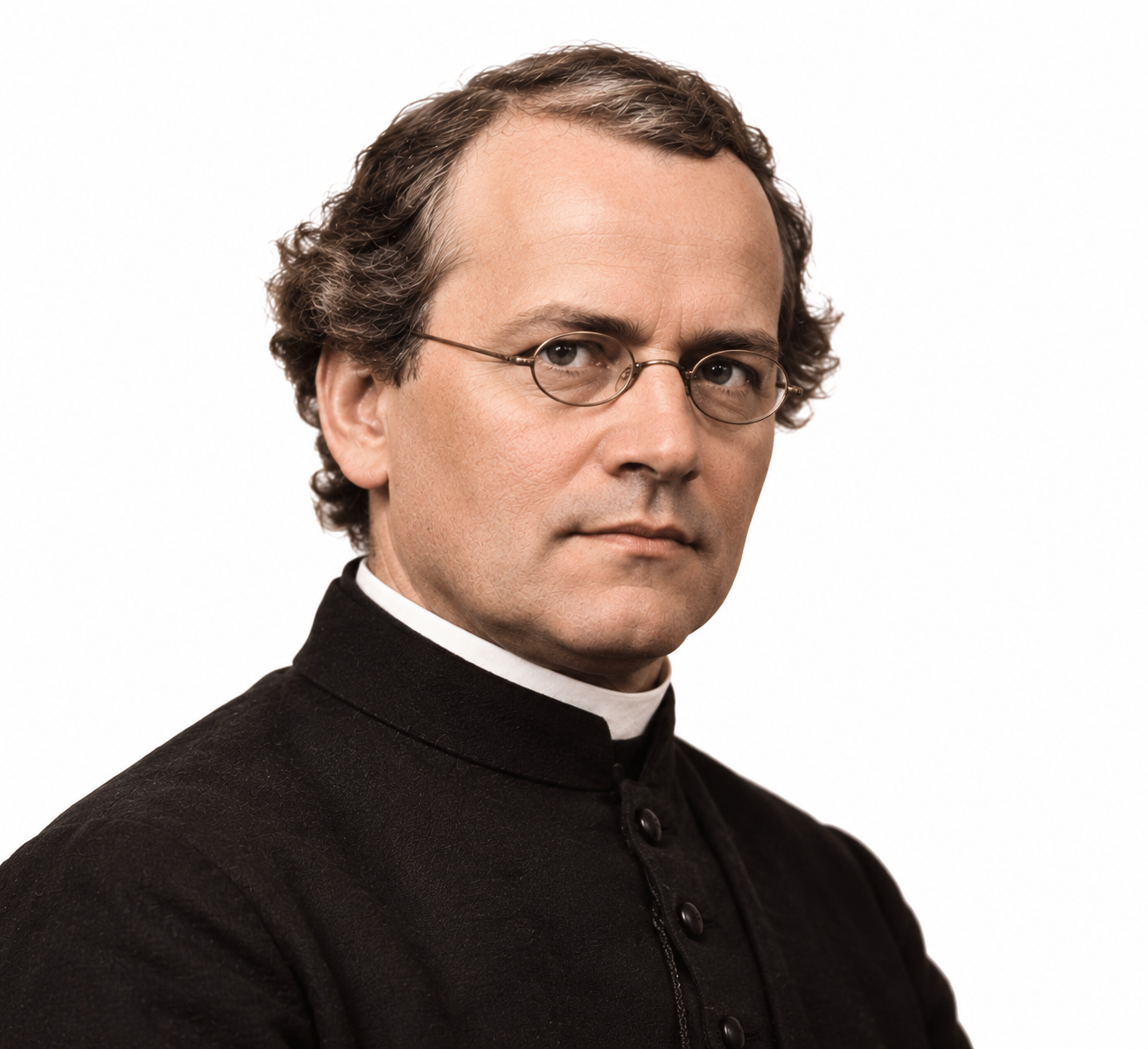
At a glance
- Born
- 1822 CE
- Died
- 1884 CE
- Era classification
- Modern
- Occupation
- Scientist (General)
- Homeland
- Austrian Empire
- Period
- 19th Century
- Field
- Medicine & Natural Science
- Language
- German
- Religion
- Roman Catholicism
- Gender
- male
Biography
Gregor Johann Mendel was born into a German-speaking peasant family in Heinzendorf bei Odrau, in the Austrian Empire (now Hynčice, Czech Republic). Demonstrating strong intellectual aptitude from an early age, he pursued higher studies in philosophy and physics at the University of Olomouc. In 1843, constrained by financial hardship, he joined the Augustinian Abbey of St. Thomas in Brno, taking the monastic name Gregor. The monastery provided him with an intellectually vibrant environment and access to a research garden, while also allowing him to study natural sciences and mathematics at the University of Vienna.
Between 1856 and 1863, Mendel conducted groundbreaking plant hybridization experiments in the abbey's two-hectare monastery garden, primarily using the common edible pea (Pisum sativum). Through meticulous cross-breeding involving roughly 28,000 plants over several generations, he tracked seven distinct physical characteristics such as plant height, flower color, and seed shape. Mendel applied rigorous statistical analysis to his findings, discovering that traits are inherited as discrete, unchanging units—what we now call genes—rather than blending together, and formulated the fundamental principles of dominance, segregation, and independent assortment.
Mendel presented his landmark paper, 'Experiments on Plant Hybridization', to the Natural History Society of Brno in 1865, and it was published the following year. However, his work went largely unappreciated and misunderstood by contemporary scientists during his lifetime, overshadowed in part by Charles Darwin's theories and the era's prevailing belief in blending inheritance. In 1868, Mendel was elected abbot of the monastery, and the administrative burdens, coupled with a bitter tax dispute with the government, largely ended his scientific research.
Following Mendel's death from chronic nephritis in 1884, his scientific contributions remained obscure until 1900, when botanists Hugo de Vries, Carl Correns, and Erich von Tschermak independently rediscovered his work and confirmed his laws of inheritance. Today, Mendel is universally recognized as the 'Father of Modern Genetics', having united mathematics and biology to unlock the fundamental mechanism of biological heredity.
Portrayal characteristics
Saved editorial descriptions used for the reconstruction; these are not authenticated statements by the depicted person.
- Methodical
- Patient
- Observant
- Rigorous
- Analytical
- Humble
Images & artwork 1
Known for
- Formulating the Mendelian laws of inheritance
- Founding the science of modern genetics
- Selective hybridization experiments on pea plants
- Discovering dominant and recessive hereditary traits
- Pioneering the application of statistics to biological heredity
Episodes featuring or mentioning this figure
No eligible published episode featuring this figure is currently in the library.