



Hippocrates
Ancient Greek physician known as the Father of Medicine who established it as a distinct, rational discipline.

At a glance
- Born
- c. 460 BCE
- Died
- c. 370 BCE
- Era classification
- c. 90
- Homeland
- Ancient Greece
- Period
- Classical Antiquity
- Field
- Medicine & Natural Science
- Language
- Ancient Greek
- Religion
- Hellenistic
- Gender
- male
Biography
Hippocrates of Kos, born around 460 BCE on the Greek island of Kos, is universally recognized as the 'Father of Medicine.' Born into a wealthy family of physicians known as the Asclepiads, he received his early medical training from his father and grandfather. He later traveled extensively throughout ancient Greece, studying under other prominent thinkers and treating patients across various city-states, which allowed him to gather a vast amount of clinical experience.
Before Hippocrates, the prevailing belief was that sickness was a punishment inflicted by the gods or the result of supernatural forces. Hippocrates revolutionized the field by introducing a rational approach to healthcare. He posited that diseases were the result of natural causes, such as environmental factors, diet, and living habits. This paradigm shift separated medicine from religion and philosophy, establishing it as a distinct professional discipline based on empirical observation and logical reasoning.
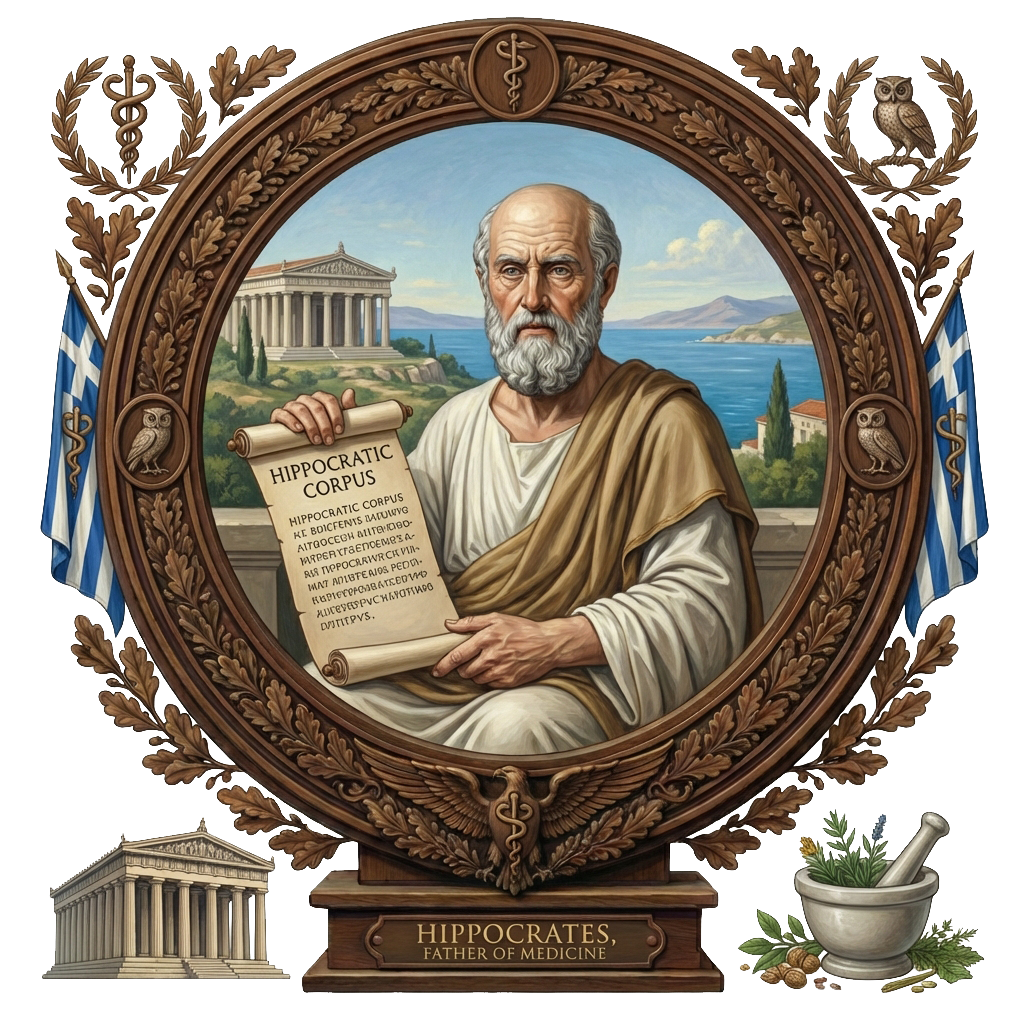
The Hippocratic School of Medicine achieved remarkable advancements under his guidance, most notably documented in the Hippocratic Corpus—a collection of around sixty early ancient Greek medical works. While historians debate how many of these texts were written by Hippocrates himself, they reflect his core philosophies. Among these is the Hippocratic Oath, a seminal document in medical ethics that established enduring principles such as patient confidentiality, professional integrity, and the fundamental tenet to 'do no harm.'
Hippocrates spent his later years in Larissa, Thessaly, where he died around 370 BCE. His legacy is immeasurable; he introduced clinical observation, systematic documentation of symptoms, and the concept of prognosis. By laying the ethical and scientific foundations of medical practice, Hippocrates shaped the trajectory of Western medicine, and his principles continue to guide healthcare professionals to this day.
Portrayal characteristics
Saved editorial descriptions used for the reconstruction; these are not authenticated statements by the depicted person.
- Rational
- Observant
- Ethical
- Methodical
- Empathetic
- Pioneering
Images & artwork 4


Connections
Abu Ali Sina (Avicenna)
Influenced By
Avicenna built his medical theories upon the foundational humoral theory established by Hippocrates.
Avicenna's medical corpus adopted the Hippocratic focus on observation and the balance of the four humors. He refined these ancient Greek concepts into a more rigorous scientific methodology that bridged ancient tradition and modern clinical practice.
Andreas Vesalius
Successor in Medicine
Vesalius operated within the long tradition of Western medicine established by Hippocrates but moved it toward a more physical, observational basis.
Vesalius's insistence on 'autopsia' (seeing for oneself) was an evolution of the Hippocratic focus on clinical observation, moving from the bedside to the dissection table.
Socrates
Contemporary Peers
Socrates and Hippocrates were contemporaries, with Socrates referencing the physician in Plato's dialogues.
In Plato's 'Protagoras' and 'Phaedrus', Socrates discusses Hippocrates of Cos as a famous physician who taught that understanding the nature of the body requires understanding the nature of the whole. This provides historical evidence of Hippocrates' high reputation during the Golden Age of Athens.
Galen
Influenced By
Galen was the most significant successor to Hippocrates, systematizing and expanding upon his medical theories.
Living centuries later, Galen viewed Hippocrates as the 'Father of Medicine' and wrote extensive commentaries on the Hippocratic Corpus. Galen's adoption of the four humors theory ensured that Hippocratic ideas dominated Western and Islamic medicine for over 1,500 years.
Aristotle
Intellectual Successor
Aristotle's biological and empirical methods were deeply influenced by the Hippocratic school.
Aristotle's focus on observation and classification in biology mirrored the Hippocratic emphasis on clinical observation and case histories. Both figures moved Greek thought away from purely supernatural explanations toward naturalistic causes for physical phenomena.
Galen
Influenced By
Galen viewed himself as the successor to Hippocrates, systematizing and expanding upon the Hippocratic theory of the four humors.
Galen wrote extensive commentaries on the Hippocratic Corpus, aiming to revive what he saw as the true spirit of Hippocratic medicine. He integrated Hippocrates' clinical observations with his own anatomical research to create a medical system that dominated the Western and Islamic worlds for over 1,500 years.
Known for
- Father of Medicine
- Hippocratic Oath
- Hippocratic Corpus
- Clinical observation
- Separating medicine from religion
- Theory of the four humors
Episodes featuring or mentioning this figure
No eligible published episode featuring this figure is currently in the library.