



Socrates
A foundational Greek philosopher who pioneered Western epistemology and ethics through his dialectical method.
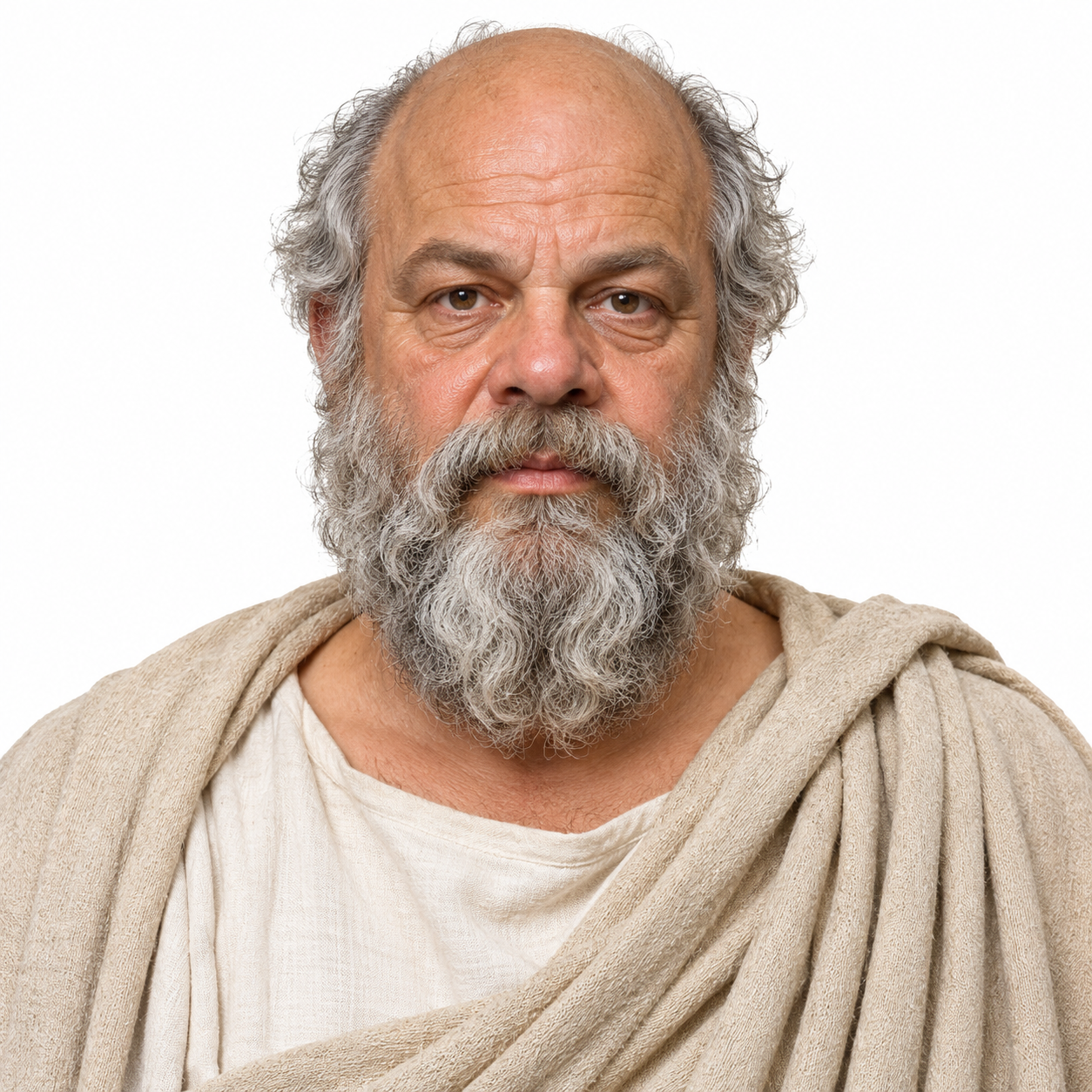
At a glance
- Born
- c. 470 BCE
- Died
- 399 BCE
- Era classification
- 71
- Homeland
- Ancient Greece
- Period
- Classical Antiquity
- Field
- Philosophy & Ideology
- Language
- Ancient Greek
- Religion
- Ancient Greek Religion
- Gender
- male
Biography
Born in Athens around 470 BCE, Socrates became one of the most influential figures in Western philosophy despite never writing a single text. His life and ideas are known primarily through the accounts of his students, most notably Plato and Xenophon, as well as the satirical plays of Aristophanes. He spent much of his life engaging his fellow Athenians in deep philosophical discussions in the city's public spaces, challenging their assumptions about virtue, justice, and truth.
Socrates shifted the focus of Greek philosophy from the natural world to human ethics and morality. He developed the Socratic method (elenchus), a form of cooperative argumentative dialogue based on asking and answering questions to stimulate critical thinking and draw out underlying presumptions. He famously claimed that his only wisdom was knowing that he knew nothing, a stance of epistemological humility that allowed him to expose the ignorance of the self-proclaimed experts of his time.
His relentless questioning of Athenian authority, combined with his association with controversial political figures following the Peloponnesian War, ultimately led to his downfall. In 399 BCE, he was put on trial for corrupting the youth of Athens and impiety against the city's gods. Found guilty, he was sentenced to death by drinking a mixture containing poison hemlock. He accepted his execution with stoic resolve, refusing opportunities to escape, thereby cementing his legacy as a philosophical martyr who chose death over compromising his principles.
Portrayal characteristics
Saved editorial descriptions used for the reconstruction; these are not authenticated statements by the depicted person.
- Inquisitive
- Stoic
- Humble
- Uncompromising
- Intellectually Rigorous
Images & artwork 3


Connections
Aristotle
Philosophical Lineage
Aristotle was the most famous student of Plato, who was himself the student of Socrates.
While Aristotle was born after Socrates' death, he spent twenty years at Plato's Academy. His work often engages with, critiques, and systematizes the dialectical methods and ethical inquiries first introduced by Socrates.
Friedrich Nietzsche
Philosophical Rival
Nietzsche viewed Socrates as the figure responsible for the decline of Greek tragic culture.
In 'The Birth of Tragedy,' Nietzsche argued that Socratic rationalism destroyed the vital Dionysian element of art. He saw Socrates as the 'corrupter' who replaced instinct and myth with a sterile, logic-driven morality.
Hippocrates
Contemporary Peers
Socrates and Hippocrates were contemporaries, with Socrates referencing the physician in Plato's dialogues.
In Plato's 'Protagoras' and 'Phaedrus', Socrates discusses Hippocrates of Cos as a famous physician who taught that understanding the nature of the body requires understanding the nature of the whole. This provides historical evidence of Hippocrates' high reputation during the Golden Age of Athens.
Aristotle
Philosophical Successor
Aristotle was the student of Plato, who was the primary student and biographer of Socrates.
Socrates' dialectic method and focus on ethics provided the foundation for the Platonic school, which in turn educated Aristotle. Together, these three figures established the core tenets of Western philosophy.
Pythagoras
Philosophical Influence
The mathematical and mystical teachings of Pythagoras significantly influenced the Socratic and Platonic schools of thought.
Socrates and his student Plato integrated Pythagorean concepts regarding the immortality of the soul and the mathematical order of the universe into their own philosophical frameworks.
Known for
- The Socratic Method
- Socratic Irony
- Founding Western moral philosophy
- Epistemological humility
- Philosophical martyrdom
Episodes featuring or mentioning this figure
No eligible published episode featuring this figure is currently in the library.