



Thomas Aquinas
Italian Dominican friar and philosopher who synthesized Aristotelian philosophy with Christian theology.
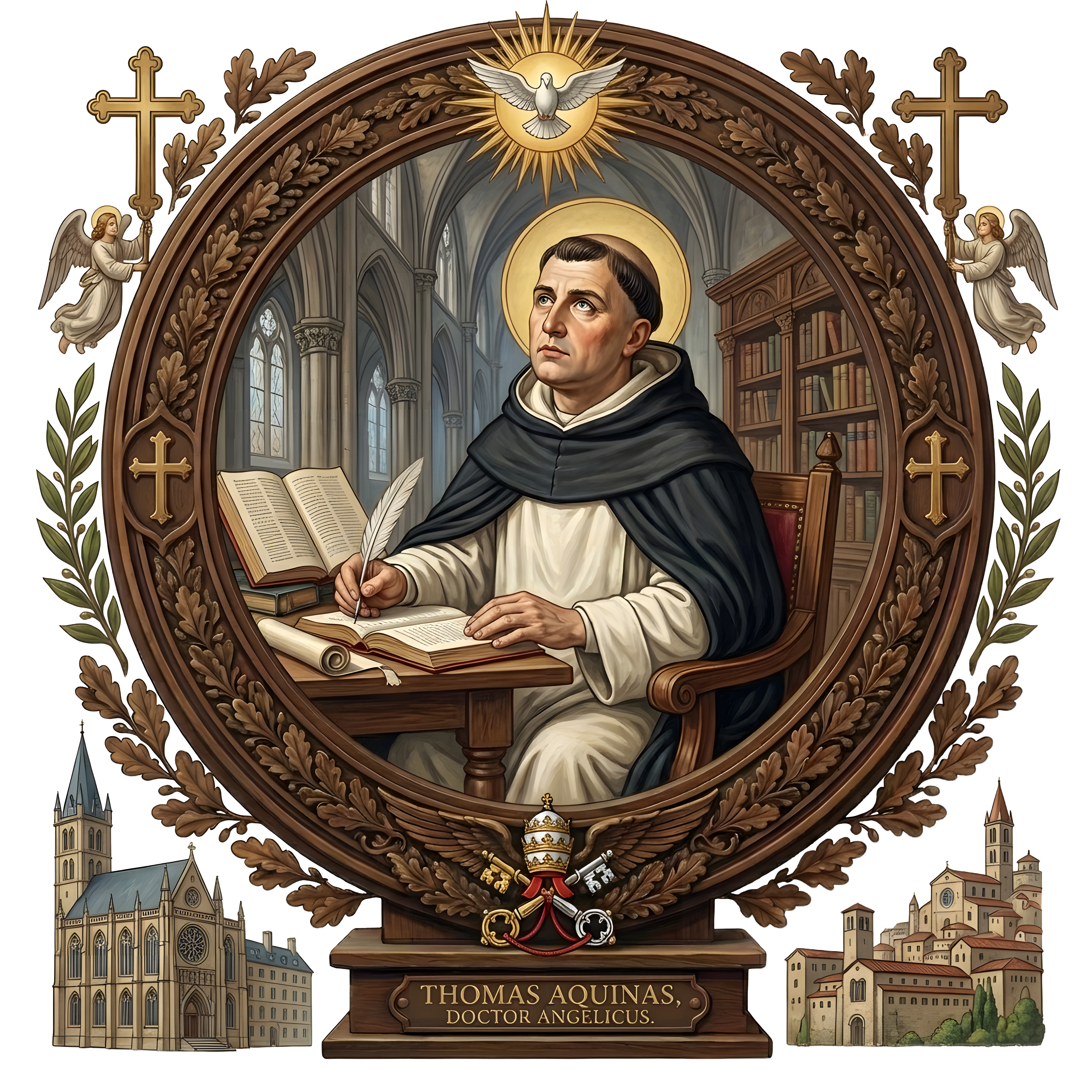
At a glance
- Born
- 1225 CE
- Died
- 1274 CE
- Era classification
- Medieval
- Occupation
- Philosopher
- Homeland
- Italy
- Period
- High Middle Ages
- Field
- Philosophy & Ideology
- Language
- Latin
- Religion
- Roman Catholic
- Gender
- male
Biography
Thomas Aquinas was an Italian Dominican friar and priest who became the preeminent philosopher and theologian of the medieval Scholastic tradition. Born into a noble family, he joined the Dominican Order against his family's wishes and studied under Albert the Great. He spent much of his life teaching at the University of Paris and in Italy, producing a massive body of work.
Aquinas's primary achievement was the synthesis of Aristotelian philosophy with Christian theology. He believed that reason and faith were compatible and that both could lead to the truth. His masterpiece, the "Summa Theologica," is a systematic exploration of Christian doctrine, covering everything from the nature of God to ethics and law. In it, he famously presented the "Five Ways," or logical arguments for the existence of God.
His philosophy, known as Thomism, became the official doctrine of the Catholic Church and has had a lasting impact on Western thought. Aquinas's ideas on natural law, which posits that certain moral principles are inherent in human nature and discoverable through reason, influenced the development of modern legal and political theory. He was canonized as a saint in 1323.
Portrayal characteristics
Saved editorial descriptions used for the reconstruction; these are not authenticated statements by the depicted person.
- Logical
- Systematic
- Devout
- Intellectual
- Prolific
Images & artwork 3


Known for
- Summa Theologica
- Five Ways to prove God's existence
- Thomism
- Natural Law theory
Episodes featuring or mentioning this figure
No eligible published episode featuring this figure is currently in the library.