



Umberto Eco
An Italian polymath and semiotician best known for his influential novels and academic work on signs and meaning.
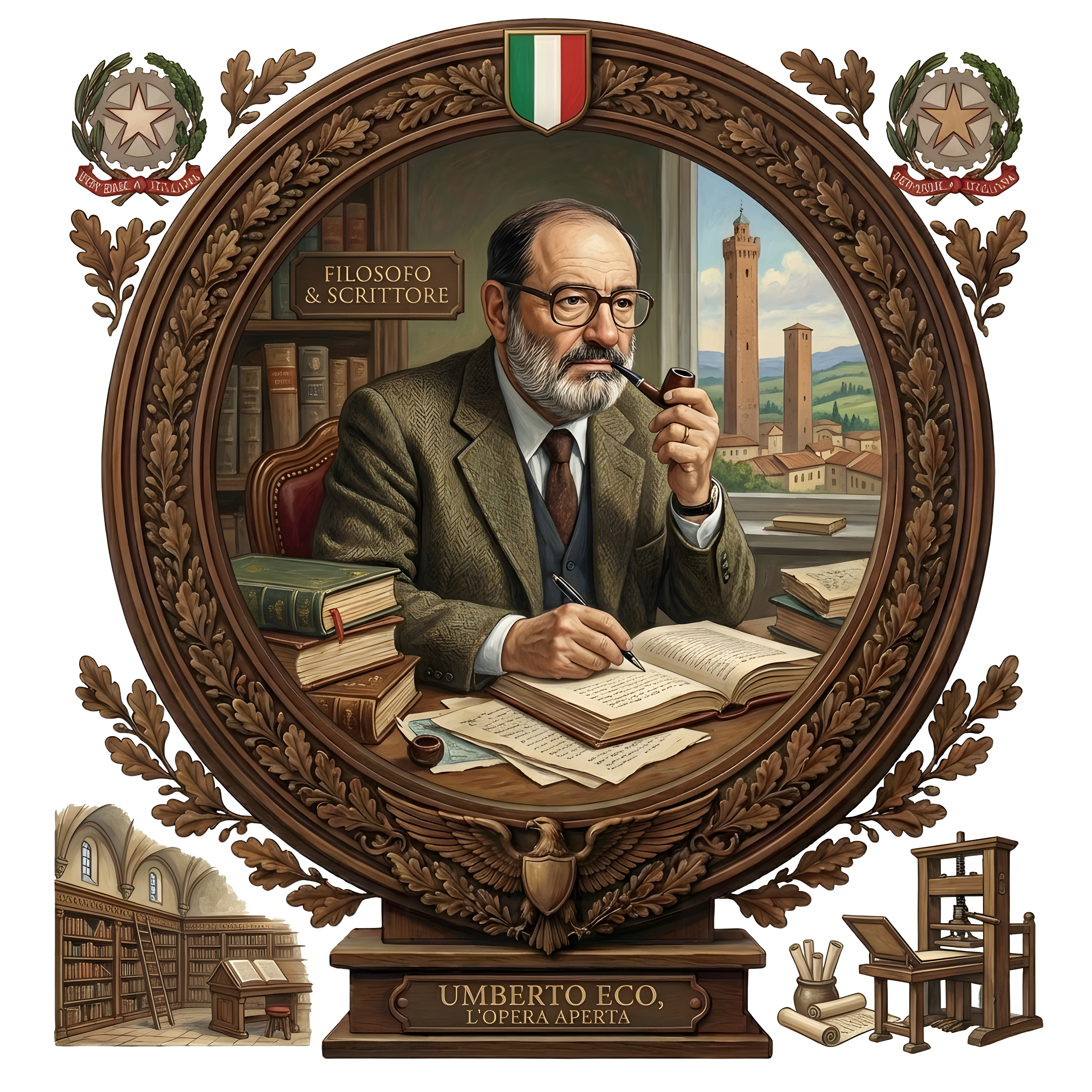
At a glance
- Born
- 1932 CE
- Died
- 2016 CE
- Era classification
- Modern
- Occupation
- Philosopher
- Homeland
- Italy
- Period
- 20th - 21st Century
- Field
- Philosophy & Ideology
- Language
- Italian
- Religion
- Atheist
- Gender
- male
Biography
Umberto Eco was an Italian polymath whose work spanned the fields of semiotics, literary criticism, and philosophy. He is perhaps most famous globally as a novelist, particularly for 'The Name of the Rose,' a historical mystery that combined semiotic analysis with medieval history. His academic career was centered at the University of Bologna, where he held the chair of semiotics.
Eco's contributions to semiotics focused on the process of interpretation and the way signs create meaning within cultural contexts. He argued that texts are 'lazy machines' that require the active participation of the reader to generate meaning. His theoretical works, such as 'A Theory of Semiotics' and 'The Role of the Reader,' remain foundational texts in the humanities.
Beyond academia, Eco was a sharp cultural critic and essayist. He wrote extensively on mass media, aesthetics, and the dangers of 'Ur-Fascism.' His ability to bridge the gap between high intellectual theory and popular culture made him one of the most respected public intellectuals of the late 20th and early 21st centuries.
Portrayal characteristics
Saved editorial descriptions used for the reconstruction; these are not authenticated statements by the depicted person.
- Polymathic
- Analytical
- Witty
- Scholarly
- Creative
Images & artwork 3


Known for
- The Name of the Rose
- Semiotics
- Foucault's Pendulum
- A Theory of Semiotics
Episodes featuring or mentioning this figure
No eligible published episode featuring this figure is currently in the library.