



Thomas Hobbes
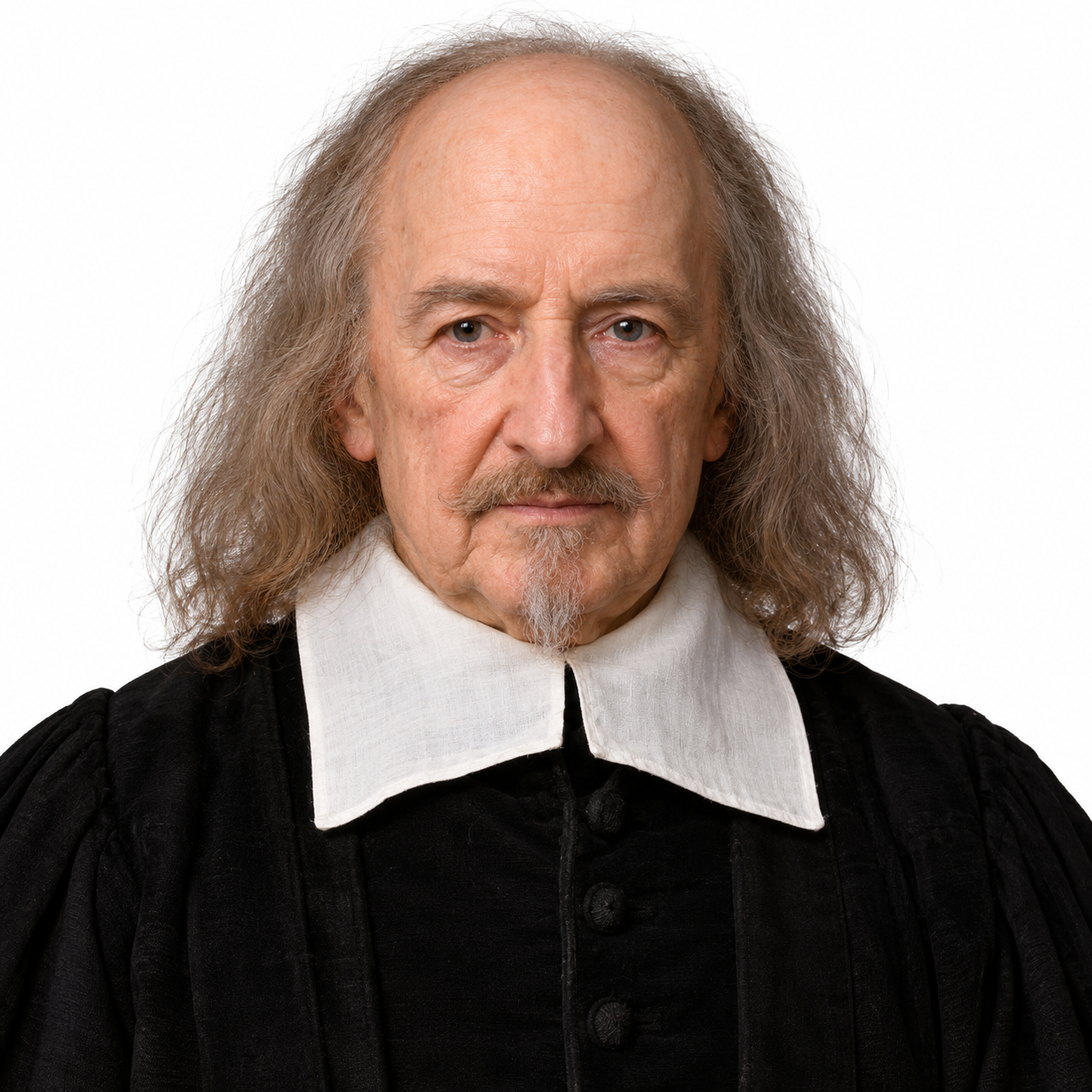
English philosopher best known for his masterpiece Leviathan and foundational contributions to social contract theory.
At a glance
- Born
- 1588 CE
- Died
- 1679 CE
- Era classification
- 91
- Homeland
- England
- Period
- 1588–1679 CE
- Field
- Philosophy & Ideology
- Language
- English
- Religion
- Materialist
- Gender
- male
Biography
Thomas Hobbes was born in 1588 in Malmesbury, England. He famously claimed that his mother gave birth to twins, "myself and fear," as she went into premature labor upon hearing of the approaching Spanish Armada. Educated at Oxford, Hobbes spent much of his life as a tutor to the wealthy Cavendish family. This position afforded him the opportunity to travel extensively across Europe, where he met and exchanged ideas with leading scientific and philosophical figures of his day, including Galileo Galilei and René Descartes.
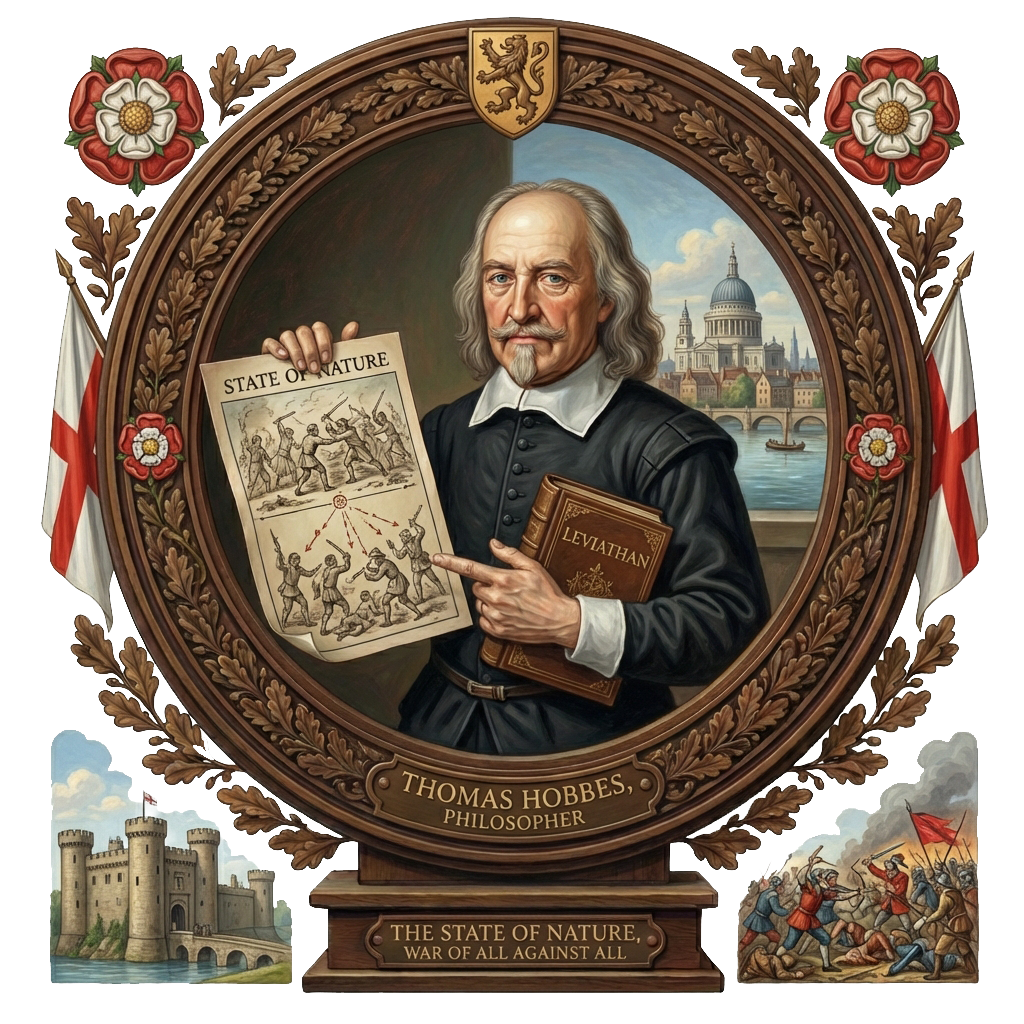
The profound political turmoil of the English Civil War deeply influenced Hobbes's worldview and intellectual trajectory. Fearing for his safety as a known royalist sympathizer, he fled to Paris in 1640 and remained in exile for over a decade. It was during this period of bloody conflict in his homeland that he developed his mature political philosophy, culminating in his 1651 magnum opus, "Leviathan". In it, he famously argued that the natural state of humanity—without a governing authority—is a "war of all against all," rendering human life "solitary, poor, nasty, brutish, and short."
To escape this chaotic state of nature, Hobbes formulated a groundbreaking version of social contract theory. He proposed that individuals must rationally agree to surrender their natural rights and absolute freedoms to a central, absolute sovereign authority. This "Leviathan" would possess undivided power to enforce laws, maintain peace, and protect citizens from one another. By grounding political authority in the rational self-interest of individuals rather than the divine right of kings, Hobbes laid the secular foundations for modern political science.
Despite returning to England and submitting to the new parliamentary regime, Hobbes's later life was marred by controversy. His strict materialist philosophy, which argued that everything in the universe—including the human mind and soul—is composed solely of matter in motion, led to frequent accusations of heresy and atheism. Nevertheless, he survived the political upheavals of the Restoration and lived to the advanced age of 91. Today, Hobbes is universally recognized as one of the most important political philosophers in history, whose stark insights into human nature and state power continue to resonate.
Portrayal characteristics
Saved editorial descriptions used for the reconstruction; these are not authenticated statements by the depicted person.
- Analytical
- Pragmatic
- Rational
- Cynical
- Systematic
- Realist
Images & artwork 5



Connections
Baruch Spinoza
Political Influence
Spinoza was significantly influenced by Hobbes' secular and realistic approach to political power.
In his 'Tractatus Theologico-Politicus', Spinoza built upon Hobbes' social contract theory but moved toward a more democratic conclusion, arguing that the state's ultimate purpose is the preservation of liberty rather than just security.
John Locke
Philosophical Rivals
Locke's political philosophy is often viewed as a direct liberal rebuttal to the absolutism proposed by Thomas Hobbes.
While both used the concept of a 'social contract,' Locke argued for natural rights and the right to revolution in 'Two Treatises of Government,' contrasting sharply with Hobbes's 'Leviathan,' which advocated for an absolute sovereign to prevent social chaos.
René Descartes
Philosophical Rivals
Hobbes and Descartes engaged in a famous intellectual exchange regarding the nature of the mind and matter.
Hobbes provided the 'Third Set of Objections' to Descartes' 'Meditations on First Philosophy'. Their relationship was marked by mutual respect but sharp disagreement, particularly over Descartes' dualism versus Hobbes' materialism.
John Locke
Philosophical Rivals
Hobbes and Locke are the two most influential social contract theorists, offering opposing views on human nature and governance.
While Hobbes argued in 'Leviathan' for absolute sovereignty to prevent a 'war of all against all,' Locke's later work argued for limited government and natural rights, serving as a direct intellectual counterpoint.
René Descartes
Intellectual Correspondents
Hobbes provided a series of formal objections to Descartes' 'Meditations on First Philosophy'.
Their exchange highlighted the fundamental divide between Hobbes' strict materialism and Descartes' mind-body dualism. Their disagreements helped define the boundaries of 17th-century rationalism and empiricism.
Galileo Galilei
Scientific Influence
Hobbes met Galileo in Italy and was deeply influenced by his work on the laws of motion.
Hobbes sought to apply Galileo's principles of physical motion to the study of human behavior and politics. He envisioned a 'science of politics' where the state functioned as a complex mechanical body.
Known for
- Leviathan (1651)
- Social contract theory
- Concept of the state of nature
- Political absolutism
- Materialist philosophy
Episodes featuring or mentioning this figure
No eligible published episode featuring this figure is currently in the library.