



Galileo Galilei
Italian astronomer and physicist who pioneered the scientific method and championed heliocentrism.
At a glance
- Born
- 15 February 1564 CE
- Died
- 8 January 1642 CE
- Era classification
- 77
- Homeland
- Italy
- Period
- 1564–1642
- Field
- Science, Medicine & Engineering
- Language
- Italian
- Religion
- Catholic
- Gender
- male
Biography
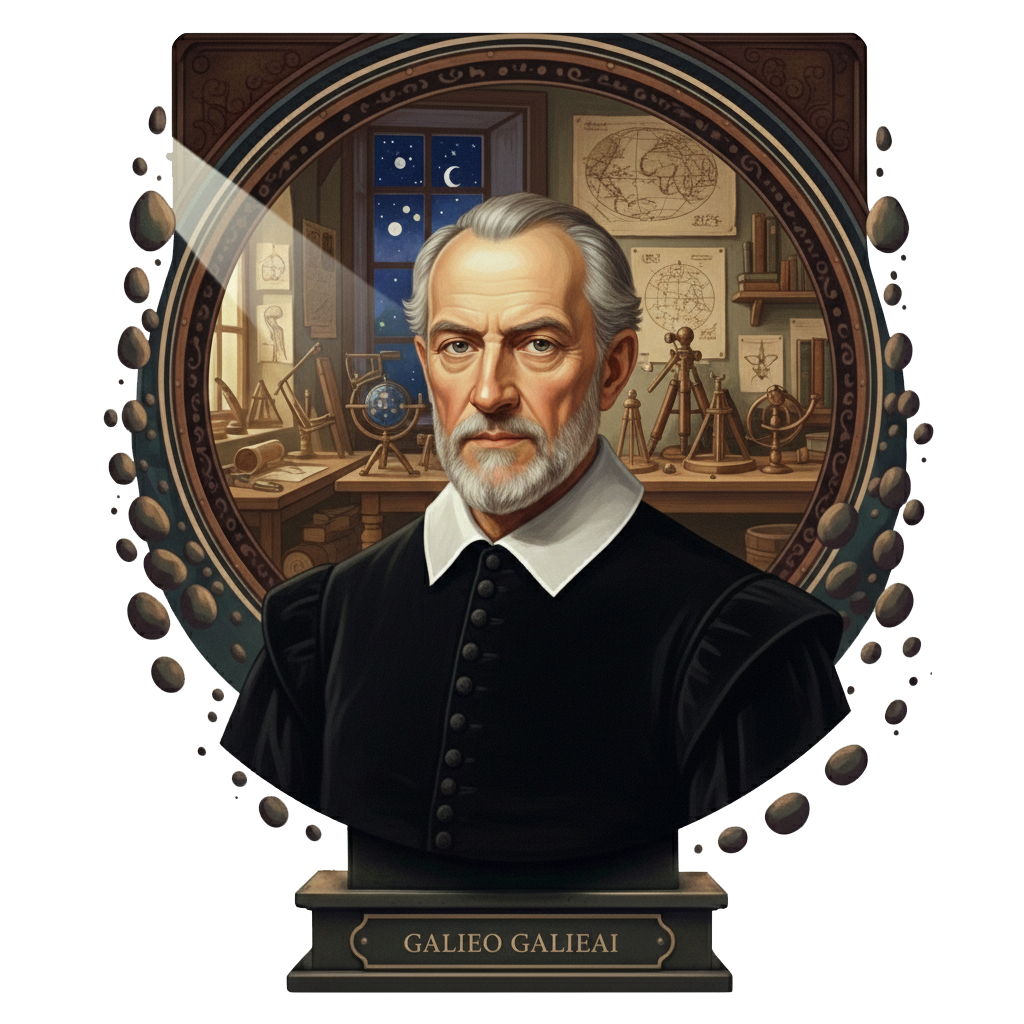
Galileo Galilei was born in Pisa, Italy, in 1564. Though he initially enrolled at the University of Pisa to study medicine at his father's behest, his fascination with geometry and mathematics soon redirected his academic pursuits. He became a professor of mathematics, where he began to question Aristotelian physics, famously demonstrating that objects of different masses fall at the same rate in a vacuum.
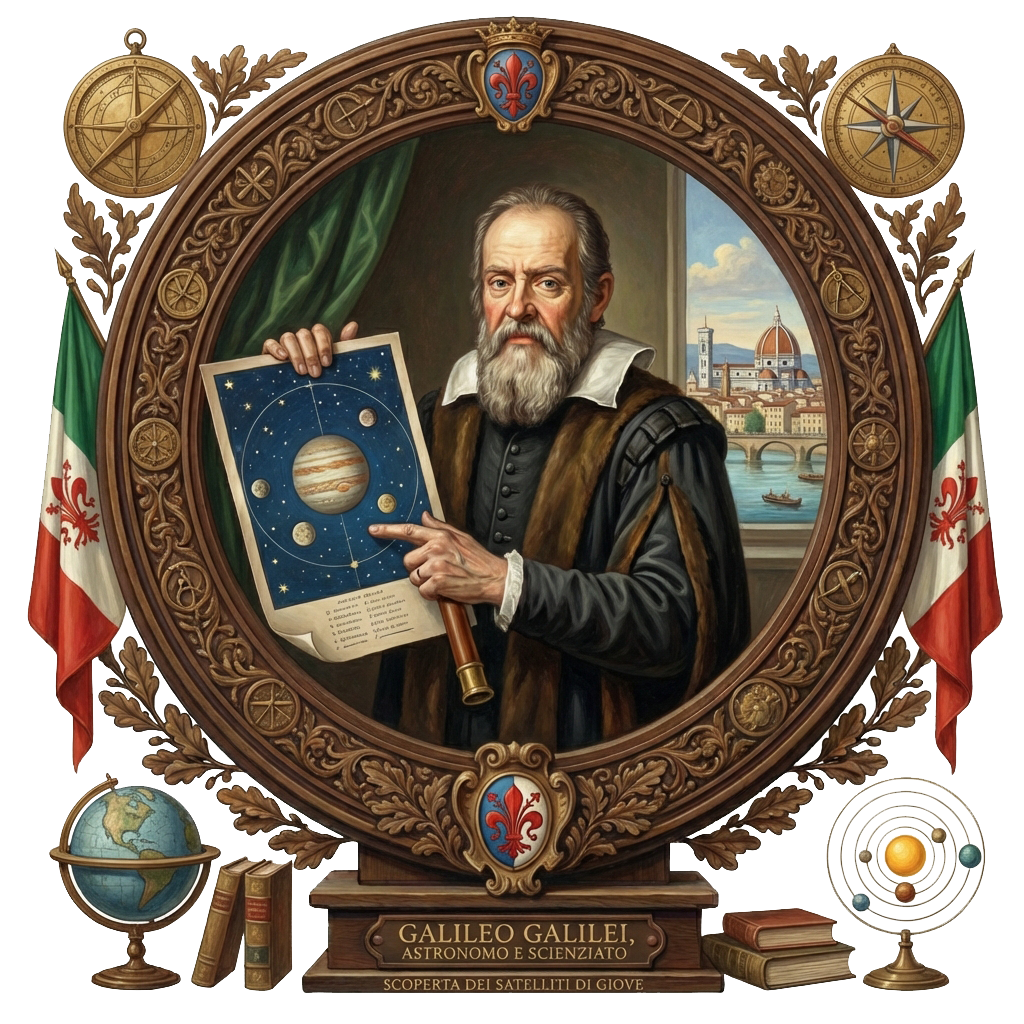
In 1609, Galileo learned of the invention of the telescope and significantly improved its design. Turning his new instrument to the night sky, he made a series of revolutionary discoveries. He observed the craters of the Moon, the phases of Venus, sunspots, and the four largest moons of Jupiter, which are now known as the Galilean moons. These empirical observations provided crucial evidence against the prevailing geocentric model of the universe.
Galileo's vocal support for the Copernican heliocentric system—which posited that the Earth revolves around the Sun—brought him into direct conflict with the Catholic Church. In 1633, he was tried by the Roman Inquisition, found 'vehemently suspect of heresy,' and forced to recant his views. He spent the remainder of his life under house arrest, during which he wrote 'Two New Sciences,' a foundational text summarizing his earlier work on kinematics and the strength of materials.
Today, Galileo is universally celebrated as the 'father of modern science.' His insistence that the laws of nature are written in the language of mathematics, combined with his pioneering use of observation and experimentation, fundamentally transformed humanity's approach to the natural world and paved the way for future scientific giants like Isaac Newton.
Portrayal characteristics
Saved editorial descriptions used for the reconstruction; these are not authenticated statements by the depicted person.
- Analytical
- Inquisitive
- Defiant
- Innovative
- Empirical
Images & artwork 4
Connections
Johannes Kepler
Contemporary Allies
Kepler and Galileo were the two most prominent defenders of the Copernican heliocentric system during the early 17th century.
The two scientists corresponded briefly; Kepler publicly supported Galileo's 'Sidereus Nuncius' and his telescopic discoveries. While Galileo largely ignored Kepler's discovery of elliptical orbits, their combined work provided the empirical and theoretical foundation for the Scientific Revolution.
Isaac Newton
Scientific Successor
Newton's laws of motion and universal gravitation were built directly upon Galileo's work on inertia and falling bodies.
Newton famously stated he 'stood on the shoulders of giants,' referring in part to Galileo. Newton's First Law of Motion is a formalization of Galileo's concept of inertia, and Newton's mathematical treatment of gravity unified Galileo's terrestrial mechanics with Kepler's celestial laws.
Aristotle
Intellectual Opponent
Galileo's scientific career was defined by his systematic rejection of Aristotelian physics and geocentric cosmology.
Galileo used both mathematical proofs and telescopic observations to refute Aristotle's claims that heavier objects fall faster and that the heavens are unchanging. His work 'Dialogue Concerning the Two Chief World Systems' was a direct critique of the Aristotelian-Ptolemaic worldview.
Albert Einstein
Scientific Legacy
Einstein credited Galileo as the father of modern physics and the pioneer of the principle of relativity.
Einstein's Special Theory of Relativity is an extension of 'Galilean Relativity,' the idea that the laws of physics are the same in any inertial frame. Einstein frequently praised Galileo for insisting that the laws of nature must be determined through observation and mathematical description rather than dogma.
Isaac Newton
Scientific Predecessor
Newton's first law of motion was a direct refinement and formalization of Galileo's principle of inertia.
Newton famously stated, 'If I have seen further it is by standing on the shoulders of Giants,' referring to Galileo's foundational work on kinematics and the motion of falling bodies.
Johannes Kepler
Scientific Correspondents
Kepler and Galileo were contemporaries who corresponded regarding their support for the Copernican heliocentric model.
Kepler was one of the few prominent scientists to publicly support Galileo's telescopic discoveries in his work 'Dissertatio cum Nuncio Sidereo,' though Galileo was often slow to reciprocate Kepler's enthusiasm for elliptical orbits.
Stephen Hawking
Symbolic Connection
Hawking was born on the 300th anniversary of Galileo's death, a coincidence he often noted with pride.
Hawking felt a deep connection to Galileo's role as the father of modern science and his willingness to challenge established dogma through observation and mathematics.
Thomas Hobbes
Scientific Influence
Hobbes met Galileo in Italy and was deeply influenced by his work on the laws of motion.
Hobbes sought to apply Galileo's principles of physical motion to the study of human behavior and politics. He envisioned a 'science of politics' where the state functioned as a complex mechanical body.
Known for
- Discovery of the Galilean moons of Jupiter
- Law of falling bodies and kinematics
- Championing Copernican heliocentrism
- Significant improvements to the telescope
- Pioneering the modern scientific method
Episodes featuring or mentioning this figure
No eligible published episode featuring this figure is currently in the library.